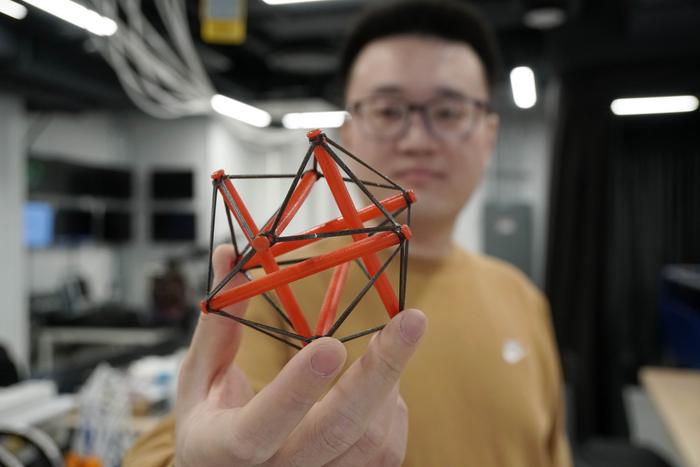
Princeton researchers united two disciplines to help create unique shapes. Credit Aaron Nathans/Princeton University
Designing irregular structures often means wrestling with huge systems of equations. Princeton engineers have found a shortcut, using a mathematical bridge between origami and tensegrity to preserve known mechanical properties as a structure shifts into a more complex shape. Tensegrity is a structural principle where a continuous network of tension (cables or strings) and a discontinuous set of compression members stabilizes a system.
The work, published March 19 in the Proceedings of the National Academy of Sciences, shows that the equations governing how origami surfaces fold along creases can be directly translated into the rules governing how tensegrity structures distribute compressive and tensile forces. Glaucio Paulino, the Margareta Engman Augustine Professor of Engineering, and postdoctoral researcher Xiangxin Dang led the work. The researchers dubbed their theory “invariant dual mechanics of tensegrity and origami.”
The method gives designers a way around one of the most challenging parts of irregular-structure design. Regular shapes such as cubes and spheres can be described with a small set of variables. Irregular forms, including termite-mound ventilation networks or the trabecular lattice inside human bone, require many more. Those variables can balloon into large systems of equations. In turn, that makes computational design slow or impractical.
The Princeton team’s approach starts from a symmetric structure. Because its mechanical behavior is already known, including its stability, flexibility and load distribution, engineers can transform the structure into a more irregular form. And they can accomplish this while preserving its properties. Since the math stays consistent through the transformation, the new shape’s behavior can be predicted without rebuilding the analysis from the ground up.
The insight builds on rigidity theory, a branch of mathematics that couples force and motion analysis. Dang noted that early theoretical work in this area dates back several decades but had not been developed into practical engineering tools. Paulino’s lab, specializing in translating abstract mathematical frameworks into applied structural and materials systems, recognized the opportunity to bridge that gap through origami and tensegrity.
In November 2024, Dang and Paulino published work in PNAS on folding high-genus surfaces (sheets with many holes) into functional metamaterials. In April 2025, the lab published in Science Advances on shape and topology morphing of closed surfaces integrating origami and kirigami. That same month, Paulino’s group made the cover of Nature with their “metabot,” a modular chiral origami metamaterial that can twist, contract, and shrink under a single actuation input, responding to external magnetic fields without any motor or internal gears. Dang contributed simulations and deformation models to that project as well.
Paulino received the ASME Drucker Medal in 2020 and the Society of Engineering Science’s Eringen Medal in 2023, both citing his contributions to geometric mechanics associated with origami and tensegrity engineering.
The Princeton team says designers could start with a regular structure whose stability or flexibility is already understood, then transform it into irregular versions that preserve those properties. The release points to robotics and metamaterials as likely uses. Both rely on complex geometries whose behavior can be expensive to predict. The researchers also frame the method as useful for design optimization. Examples of the latter include tuning an autobody shape or generating three-dimensional architected materials with known mechanical behavior.