Research & Development World

  • R&D World Home
  • Topics
    • Aerospace
    • Automotive
    • Biotech
    • Careers
    • Chemistry
    • Environment
    • Energy
    • Life Science
    • Material Science
    • R&D Management
    • Physics
  • Technology
    • 3D Printing
    • A.I./Robotics
    • Software
    • Battery Technology
    • Controlled Environments
      • Cleanrooms
      • Graphene
      • Lasers
      • Regulations/Standards
      • Sensors
    • Imaging
    • Nanotechnology
    • Scientific Computing
      • Big Data
      • HPC/Supercomputing
      • Informatics
      • Security
    • Semiconductors
  • R&D Market Pulse
  • R&D 100
    • 2025 R&D 100 Award Winners
    • 2025 Professional Award Winners
    • 2025 Special Recognition Winners
    • R&D 100 Awards Event
    • R&D 100 Submissions
    • Winner Archive
  • Resources
    • Research Reports
    • Digital Issues
    • Educational Assets
    • R&D Index
    • Subscribe
    • Video
    • Webinars
    • Content submission guidelines for R&D World
  • Global Funding Forecast
  • Top Labs
  • Advertise
  • SUBSCRIBE

Researchers could be one step closer to understanding the origin of matter thanks to a new study

By Julia Rock-Torcivia | October 24, 2025

Neutrinos, discovered in 1956, are small, fundamental particles that can pass through objects without interacting with matter. The particles interact only through gravity and the weak nuclear force, meaning they can pass through massive objects with an extremely small chance of interacting with any atoms. Neutrinos are little understood, despite being the most abundant particle with mass in the universe. Scientists think understanding neutrinos might help them shed light on bigger mysteries such as the origin of matter, the nature of dark matter and the inner workings of supernovas. 
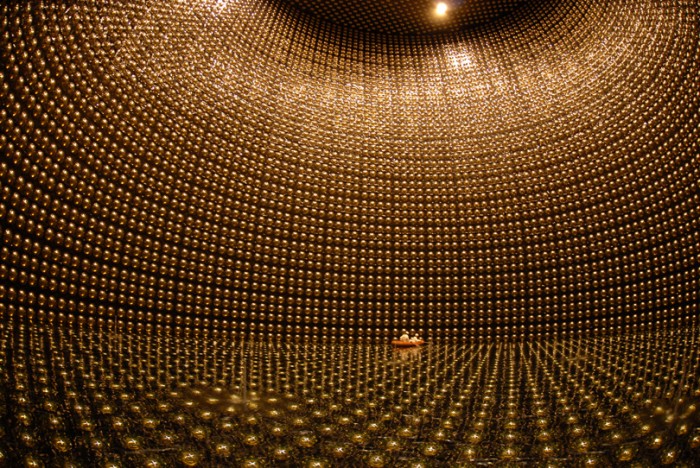
Inside of the Super-Kamiode Detector. Credit: the T2K experiment, http://t2k-experiment.org

Not all neutrinos are created equal. There are three types, called “flavors,” of neutrinos, and the particles can change between them, an action called oscillation. A new study published in Nature offers insight into the mass-squared difference – the difference in the squares of the masses – between neutrino types. 

Insight by international collaboration

The NOvA experiment, conducted at the U.S. Department of Energy’s Fermi National Accelerator Laboratory in Batavia, Illinois, sent an underground beam of neutrinos from the lab to a detector in Ash River, Minnesota, about 500 miles away. 

In Japan, the T2K experiment sent a beam of neutrinos about 185 miles from Tokai to a detector in Kamioka. T2K performed a search for oscillations from muon neutrino to electron neutrino, providing the first experimental evidence of this type of oscillation in 2011. In this experiment, T2K tracks muon neutrino disappearance, which is primarily driven by oscillation into tau neutrinos. 
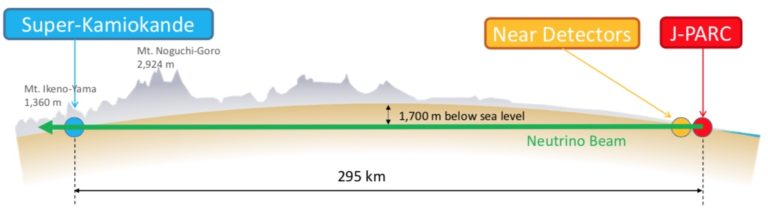
Overview of the T2K experiment: Credit: the T2K experiment, http://t2k-experiment.org

The new study combines data from NOvA and T2K and reveals a high-precision measurement of the neutrino mass-squared differences.

The researchers studied almost a decade’s worth of data from these two experiments. The study was able to determine the mass-squared difference between two types of neutrinos with less than 2% uncertainty, NOvA scientist Zoya Vallari said. 

The experiments continue to investigate whether neutrinos and antineutrinos oscillate differently by comparing neutrino oscillations to antineutrino oscillations. 

“That question is especially important because it may help explain one of the biggest mysteries in physics: why the universe is made mostly of matter instead of antimatter. At the Big Bang, matter and antimatter should have existed in equal amounts and destroyed each other. But somehow, matter won, and we’re here because of it,” Vallari told Reuters.

Related Articles Read More >

The Milky Way is glowing: these scientists think dark matter may be the cause
Three scientists awarded Nobel Prize in physics for showing quantum properties could exist in large-scale systems
ORNL named on 20 R&D 100 Awards, including carbon-capture and AM tools
Revealing the 2025 R&D 100 Awards Winners
rd newsletter
EXPAND YOUR KNOWLEDGE AND STAY CONNECTED
Get the latest info on technologies, trends, and strategies in Research & Development.
RD 25 Power Index

R&D World Digital Issues

Fall 2024 issue

Browse the most current issue of R&D World and back issues in an easy to use high quality format. Clip, share and download with the leading R&D magazine today.

Research & Development World
  • Subscribe to R&D World Magazine
  • Sign up for R&D World’s newsletter
  • Contact Us
  • About Us
  • Drug Discovery & Development
  • Pharmaceutical Processing
  • Global Funding Forecast

Copyright © 2025 WTWH Media LLC. All Rights Reserved. The material on this site may not be reproduced, distributed, transmitted, cached or otherwise used, except with the prior written permission of WTWH Media
Privacy Policy | Advertising | About Us

Search R&D World

  • R&D World Home
  • Topics
    • Aerospace
    • Automotive
    • Biotech
    • Careers
    • Chemistry
    • Environment
    • Energy
    • Life Science
    • Material Science
    • R&D Management
    • Physics
  • Technology
    • 3D Printing
    • A.I./Robotics
    • Software
    • Battery Technology
    • Controlled Environments
      • Cleanrooms
      • Graphene
      • Lasers
      • Regulations/Standards
      • Sensors
    • Imaging
    • Nanotechnology
    • Scientific Computing
      • Big Data
      • HPC/Supercomputing
      • Informatics
      • Security
    • Semiconductors
  • R&D Market Pulse
  • R&D 100
    • 2025 R&D 100 Award Winners
    • 2025 Professional Award Winners
    • 2025 Special Recognition Winners
    • R&D 100 Awards Event
    • R&D 100 Submissions
    • Winner Archive
  • Resources
    • Research Reports
    • Digital Issues
    • Educational Assets
    • R&D Index
    • Subscribe
    • Video
    • Webinars
    • Content submission guidelines for R&D World
  • Global Funding Forecast
  • Top Labs
  • Advertise
  • SUBSCRIBE