Research & Development World

  • R&D World Home
  • Topics
    • Aerospace
    • Automotive
    • Biotech
    • Careers
    • Chemistry
    • Environment
    • Energy
    • Life Science
    • Material Science
    • R&D Management
    • Physics
  • Technology
    • 3D Printing
    • A.I./Robotics
    • Software
    • Battery Technology
    • Controlled Environments
      • Cleanrooms
      • Graphene
      • Lasers
      • Regulations/Standards
      • Sensors
    • Imaging
    • Nanotechnology
    • Scientific Computing
      • Big Data
      • HPC/Supercomputing
      • Informatics
      • Security
    • Semiconductors
  • R&D Market Pulse
  • R&D 100
    • 2026 R&D 100 Award Winners
    • 2026 Professional Award Winners
    • 2026 Special Recognition Winners
    • R&D 100 Awards Event
    • R&D 100 Submissions
    • Winner Archive
  • Resources
    • Research Reports
    • Digital Issues
    • Educational Assets
    • Subscribe
    • Video
    • Webinars
    • PharmSci360
    • Content submission guidelines for R&D World
  • Global Funding Forecast
  • Top Labs
  • Advertise
  • SUBSCRIBE

Scientists to Track the Reaction of Crystals to the Electric Field

By Peter the Great St. Petersburg Polytechnic University | November 6, 2018

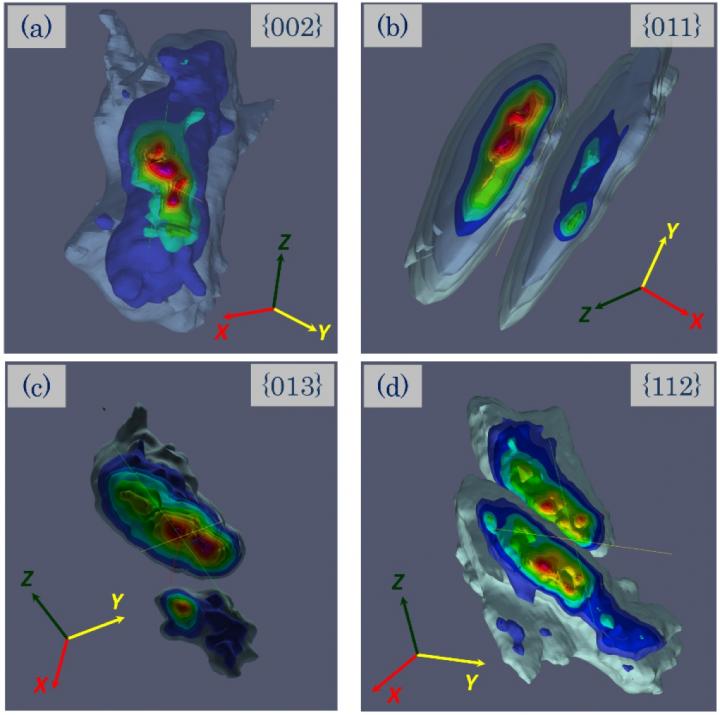
The international scientific team developed a new method for measuring the response of crystals on the electric field. Credit: Peter the Great St. Petersburg Polytechnic University

The international scientific team, which included the researchers and alumni of Peter the Great St. Petersburg Polytechnic University (SPbPU) developed a new method for measuring the response of crystals on the electric field.

The results a collaborative research done at the European Synchrotron Radiation Facility (ESRF) were published in the Journal of Applied Crystallography and appeared on the cover of the October issue.

According to the international scientific group (the team that unites scientists from China, Israel, England, and Russia), this method will help to implement new and improve existing functional materials.

“The study is dedicated to crystalline materials (ferroelectric), which are used in a variety of devices from sonars for submarines to elements of ultrasonic diagnostic devices”, said researcher of the Swiss-Norwegian Beam Lines at ESRF and the “Physical electronics” department of SPbPU Dmitry Chernyshov. He stressed that improving the properties of such materials is an extremely important scientific task.

The scientist said that detailed three-dimensional scattering maps were collected during the synchrotron experiments at the ESRF. These maps carry detailed information about the structure of the crystal and its response to the electric field. Next, a mathematical method was invented for extracting the relevant information from such maps. The crystals under study were placed in a special cell for the application of electric field, the cell was developed by the alumni of St. Petersburg Polytechnic University Tikhon Vergentiev as part of his PhD project during his internship at the ESRF.

As Dmitry Chernyshov explained that the structure of crystals can be described in different spatial scales. It is possible to describe the structure at the atomic level or at the level of large blocks of the atomic structure (domains, boundaries between domains, structural defects). When the external conditions change (temperature, pressure, etc.), all components of the structure react differently. The research team studied the response of the material to the electric field, which appears in its atomic and domain structures.

“In the framework of one experiment we were able to see how the different levels of the structural hierarchy react to external influences: if we measure and describe the response of individual components of a complex system, as well as their interaction, it is going to be possible to rationally control the structure and properties of such materials”, mentioned Dmitry Chernyshov.

The authors of the study expect that the obtained results will be required by a wide range of specialists: it will help chemists to tune the chemical composition and crystal structure, and materials scientists will use new tools for manipulating the large blocks of structure, domains (domain engineering). According to scientists, this will lead to the improvement of the properties of materials used in ultrasonic diagnostic devices.

Related Articles Read More >

How a Duke-led HPC method brought cell-scale cancer simulation to a single cloud node 
Princeton researchers uncover hidden mathematical link between origami and structural design
NTT Research taps Tetsuomi Sogawa to lead PHI Lab as optical-computing work advances
IBM physicist and Montreal computer scientist share Turing Award for quantum information breakthroughs
rd newsletter
EXPAND YOUR KNOWLEDGE AND STAY CONNECTED
Get the latest info on technologies, trends, and strategies in Research & Development.

R&D World Digital Issues

Fall 2025 issue

Browse the most current issue of R&D World and back issues in an easy to use high quality format. Clip, share and download with the leading R&D magazine today.

R&D 100 Awards
Research & Development World
  • Subscribe to R&D World Magazine
  • Sign up for R&D World’s newsletter
  • Contact Us
  • About Us
  • Drug Discovery & Development
  • Pharmaceutical Processing
  • Global Funding Forecast

Copyright © 2026 Arrowfly LLC. All Rights Reserved. The material on this site may not be reproduced, distributed, transmitted, cached or otherwise used, except with the prior written permission of Arrowfly
Privacy Policy | Advertising | About Us

Search R&D World

  • R&D World Home
  • Topics
    • Aerospace
    • Automotive
    • Biotech
    • Careers
    • Chemistry
    • Environment
    • Energy
    • Life Science
    • Material Science
    • R&D Management
    • Physics
  • Technology
    • 3D Printing
    • A.I./Robotics
    • Software
    • Battery Technology
    • Controlled Environments
      • Cleanrooms
      • Graphene
      • Lasers
      • Regulations/Standards
      • Sensors
    • Imaging
    • Nanotechnology
    • Scientific Computing
      • Big Data
      • HPC/Supercomputing
      • Informatics
      • Security
    • Semiconductors
  • R&D Market Pulse
  • R&D 100
    • 2026 R&D 100 Award Winners
    • 2026 Professional Award Winners
    • 2026 Special Recognition Winners
    • R&D 100 Awards Event
    • R&D 100 Submissions
    • Winner Archive
  • Resources
    • Research Reports
    • Digital Issues
    • Educational Assets
    • Subscribe
    • Video
    • Webinars
    • PharmSci360
    • Content submission guidelines for R&D World
  • Global Funding Forecast
  • Top Labs
  • Advertise
  • SUBSCRIBE