Research & Development World

  • R&D World Home
  • Topics
    • Aerospace
    • Automotive
    • Biotech
    • Careers
    • Chemistry
    • Environment
    • Energy
    • Life Science
    • Material Science
    • R&D Management
    • Physics
  • Technology
    • 3D Printing
    • A.I./Robotics
    • Software
    • Battery Technology
    • Controlled Environments
      • Cleanrooms
      • Graphene
      • Lasers
      • Regulations/Standards
      • Sensors
    • Imaging
    • Nanotechnology
    • Scientific Computing
      • Big Data
      • HPC/Supercomputing
      • Informatics
      • Security
    • Semiconductors
  • R&D Market Pulse
  • R&D 100
    • 2026 R&D 100 Award Winners
    • 2026 Professional Award Winners
    • 2026 Special Recognition Winners
    • R&D 100 Awards Event
    • R&D 100 Submissions
    • Winner Archive
  • Resources
    • Research Reports
    • Digital Issues
    • Educational Assets
    • Subscribe
    • Video
    • Webinars
    • PharmSci360
    • Content submission guidelines for R&D World
  • Global Funding Forecast
  • Top Labs
  • Advertise
  • SUBSCRIBE

Scientists Use Hydrophone to Listen in on Methane Seeps in Ocean

By Oregon State University | June 27, 2018

A research team has successfully recorded the sound of methane bubbles from the seafloor off the Oregon coast using a hydrophone, opening the door to using acoustics to identify – and perhaps quantify – this important greenhouse gas in the ocean.

The next step, researchers say, is to fine-tune their ability to detect the acoustic signature of the bubbles so they can use the sounds to estimate the volume of methane in the offshore reservoirs.

Results of the study have just been published in the journal Deep-Sea Research II.

“The bubbles in the streams make sound, and the frequency of the sound is related to the size of the bubble,” said Robert Dziak, an acoustics scientist with the National Oceanic and Atmospheric Administration and lead author on the study. “The smaller the bubble, the higher the pitch. And the larger the bubble, the lower the sound pitch, but the more methane it contains.

“Our ultimate goal is to use sound to estimate the volume and rate of methane gas exiting these seafloor fields,” added Dziak, who has a courtesy appointment in OSU’s College of Earth, Ocean, and Atmospheric Sciences.

In recent years, scientists have found hundreds of bubble streams emanating from methane deposits off the Pacific Northwest coast, but they have no way to determine how much methane is stored there. Methane is found both as an icy hydrate deposit and in a gas phase within the sediments of the continental margins.

It potentially could be a new energy source, or it could pose a serious environmental threat as a greenhouse gas.

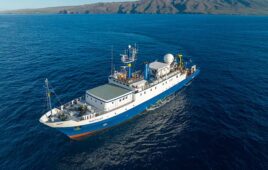
The research team used the remotely operated vehicle (ROV) Hercules from the Exploration Vessel (E/V) Nautilus, owned and operated by the Ocean Exploration Trust, to deploy a hydrophone about 10 kilometers off Heceta Bank on the Oregon continental margin in 1,228 meters of water (about three-fourths of a mile deep). The acoustic signatures of the bubbles from the seep site are depicted in the hydrophone record as a series of short, high-frequency bursts, lasting 2-3 seconds.

The researchers then compared the sound record with still images from the ROV and found their estimates of bubble size from the hydrophone record matched the visual evidence.

This June, a project led by OSU researchers Tamara Baumberger and Susan Merle and utilizing the E/V Nautilus will map additional methane seep sites off the Pacific Northwest coast. Dziak and OSU researcher Haru Matsumoto will work with the team to deploy a hydrophone into the depths of Astoria Canyon at the site of a high-rate methane seep and leave it there for 2-3 days.

The expedition will feature a live, 24/7 broadcast on http://www.nautiluslive.org.

“The frequencies are so high on some of these recordings that the data drive fills up quickly on battery-operated hydrophones,” Dziak said. “However, this new experiment will record for a longer time period, allowing us to see how seafloor methane emissions vary over time, and how they may be influenced by the ocean tides.”
Related Articles Read More >

Research vessel Nautilus is mapping the bottom of the Mariana Trench with new multibeam sonar 
Inside the Lab: NETL’s Oil and Gas Center of Excellence focuses on technologies to enhance production   
How LLNL won a $2M grant and found a commercialization partner for its methanol reactor design 
New process could reduce energy needed for crude-oil distillation by 31%
rd newsletter
EXPAND YOUR KNOWLEDGE AND STAY CONNECTED
Get the latest info on technologies, trends, and strategies in Research & Development.

R&D World Digital Issues

Fall 2025 issue

Browse the most current issue of R&D World and back issues in an easy to use high quality format. Clip, share and download with the leading R&D magazine today.

R&D 100 Awards
Research & Development World
  • Subscribe to R&D World Magazine
  • Sign up for R&D World’s newsletter
  • Contact Us
  • About Us
  • Drug Discovery & Development
  • Pharmaceutical Processing
  • Global Funding Forecast

Copyright © 2026 Arrowfly LLC. All Rights Reserved. The material on this site may not be reproduced, distributed, transmitted, cached or otherwise used, except with the prior written permission of Arrowfly
Privacy Policy | Advertising | About Us

Search R&D World

  • R&D World Home
  • Topics
    • Aerospace
    • Automotive
    • Biotech
    • Careers
    • Chemistry
    • Environment
    • Energy
    • Life Science
    • Material Science
    • R&D Management
    • Physics
  • Technology
    • 3D Printing
    • A.I./Robotics
    • Software
    • Battery Technology
    • Controlled Environments
      • Cleanrooms
      • Graphene
      • Lasers
      • Regulations/Standards
      • Sensors
    • Imaging
    • Nanotechnology
    • Scientific Computing
      • Big Data
      • HPC/Supercomputing
      • Informatics
      • Security
    • Semiconductors
  • R&D Market Pulse
  • R&D 100
    • 2026 R&D 100 Award Winners
    • 2026 Professional Award Winners
    • 2026 Special Recognition Winners
    • R&D 100 Awards Event
    • R&D 100 Submissions
    • Winner Archive
  • Resources
    • Research Reports
    • Digital Issues
    • Educational Assets
    • Subscribe
    • Video
    • Webinars
    • PharmSci360
    • Content submission guidelines for R&D World
  • Global Funding Forecast
  • Top Labs
  • Advertise
  • SUBSCRIBE