Research & Development World

  • R&D World Home
  • Topics
    • Aerospace
    • Automotive
    • Biotech
    • Careers
    • Chemistry
    • Environment
    • Energy
    • Life Science
    • Material Science
    • R&D Management
    • Physics
  • Technology
    • 3D Printing
    • A.I./Robotics
    • Software
    • Battery Technology
    • Controlled Environments
      • Cleanrooms
      • Graphene
      • Lasers
      • Regulations/Standards
      • Sensors
    • Imaging
    • Nanotechnology
    • Scientific Computing
      • Big Data
      • HPC/Supercomputing
      • Informatics
      • Security
    • Semiconductors
  • R&D Market Pulse
  • R&D 100
    • 2025 R&D 100 Award Winners
    • 2025 Professional Award Winners
    • 2025 Special Recognition Winners
    • R&D 100 Awards Event
    • R&D 100 Submissions
    • Winner Archive
  • Resources
    • Research Reports
    • Digital Issues
    • Educational Assets
    • R&D Index
    • Subscribe
    • Video
    • Webinars
    • Content submission guidelines for R&D World
  • Global Funding Forecast
  • Top Labs
  • Advertise
  • SUBSCRIBE

Separating DNA Now Takes Minutes, Not Hours

By Wiebe Van Der Veen, University of Twente | May 30, 2017

Researchers at the University of Twente have developed a glass microchip for ultrafast separation and purification of DNA fragments. The chip is easy and cheap to produce.

The UT scientists published their results in Microsystems and Nano Engineering, a Nature publication.

The new chip is capable of fractionating DNA fragments within just a few minutes, while conventional approaches take hours. The chip does this in high resolution and also purifies the fragments; it removes the other salts in the DNA sample. Tiny amounts of DNA, like in medical diagnostics or in forensics, will be sufficient. The fragments are typically in the size range of second generation DNA sequencing, the next step after the well-known Human Genome Project.

UT scientist Burcu Gumuscu and her colleagues achieved this high speed and resolution by inventing a new approach to the common technique of gel electrophoresis. In the conventional approach, the DNA moves in a gel by an applied electric field. Larger fragments will move slower than small ones, and in this way size separation is possible. But the electric field has one direction and the molecules move in a straight line. What about varying the field, the UT scientists thought. If you periodically apply an electric field of different magnitude in the perpendicular direction, the fragments will also respond to this. They don’t just move in a straight line now, but somewhere in between the two field directions. As large fragments respond differently — like a snake moves — to the fields than small ones, fragments can be separated.
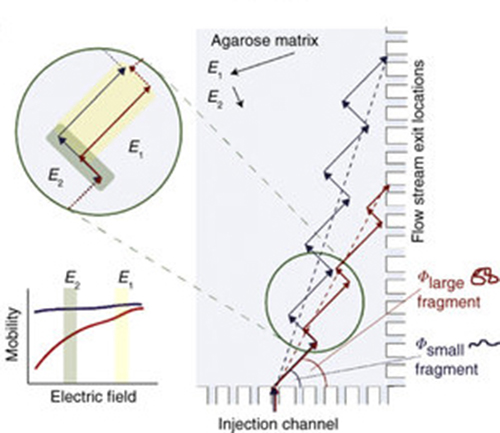
By applying electric fields in two directions, larger and smaller fragments move in a different way and exit at different micro channels.

For collecting the fragments, the chip has arrays of micro channels on the sides of a square separation chamber of about 1 square centimeter. Next to that, it has a DNA reservoir and electrodes for applying the electric fields. The chip is relatively easy to produce using fundamental cleanroom techniques of the MESA+ NanoLab, and cheap. It is versatile as well, as the type and concentration of gel and the electric fields can be adjusted to the application. Protein separation is one of the other possible application areas.

The research shows that DNA fragments between 0,5 kbp and 10 kpb (1 kbp= 1000 base pairs) can be fractionated within two minutes, at high resolution. These are typically the smaller fragments, essential for the second generation DNA sequencing. Speeding up the separation is also a major step forward in medical applications.

The research has been done in the BIOS Lab-on-a-chip group, part of the MESA+ and MIRA research institutes of the University of Twente.

The paper, titled “Exploiting biased reptation for continuous flow preparative DNA fractionation in a versatile microfluidic platform,” by Burcu Gümüşcü, Johan Bomer, Hans de Boer, Albert van den Berg, and Jan Eijkel, is published by Nature Microsystems and Nano-Engineering.

Source: University of Twente

Related Articles Read More >

Interactive Data Analysis and Forecasting. Business and finance concept.
The future of science: 15 big predictions for 2026 in tech, AI and biopharma
RED-CRISPR doubles knock-in efficiency
Thermo Fisher adds chemically defined E. coli fermentation medium and feed to Gibco Bacto line
JLL: 2026 could be a realignment year for life science labs
rd newsletter
EXPAND YOUR KNOWLEDGE AND STAY CONNECTED
Get the latest info on technologies, trends, and strategies in Research & Development.
RD 25 Power Index

R&D World Digital Issues

Fall 2025 issue

Browse the most current issue of R&D World and back issues in an easy to use high quality format. Clip, share and download with the leading R&D magazine today.

R&D 100 Awards
Research & Development World
  • Subscribe to R&D World Magazine
  • Sign up for R&D World’s newsletter
  • Contact Us
  • About Us
  • Drug Discovery & Development
  • Pharmaceutical Processing
  • Global Funding Forecast

Copyright © 2025 WTWH Media LLC. All Rights Reserved. The material on this site may not be reproduced, distributed, transmitted, cached or otherwise used, except with the prior written permission of WTWH Media
Privacy Policy | Advertising | About Us

Search R&D World

  • R&D World Home
  • Topics
    • Aerospace
    • Automotive
    • Biotech
    • Careers
    • Chemistry
    • Environment
    • Energy
    • Life Science
    • Material Science
    • R&D Management
    • Physics
  • Technology
    • 3D Printing
    • A.I./Robotics
    • Software
    • Battery Technology
    • Controlled Environments
      • Cleanrooms
      • Graphene
      • Lasers
      • Regulations/Standards
      • Sensors
    • Imaging
    • Nanotechnology
    • Scientific Computing
      • Big Data
      • HPC/Supercomputing
      • Informatics
      • Security
    • Semiconductors
  • R&D Market Pulse
  • R&D 100
    • 2025 R&D 100 Award Winners
    • 2025 Professional Award Winners
    • 2025 Special Recognition Winners
    • R&D 100 Awards Event
    • R&D 100 Submissions
    • Winner Archive
  • Resources
    • Research Reports
    • Digital Issues
    • Educational Assets
    • R&D Index
    • Subscribe
    • Video
    • Webinars
    • Content submission guidelines for R&D World
  • Global Funding Forecast
  • Top Labs
  • Advertise
  • SUBSCRIBE