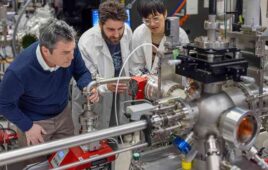
Scientists have built a single-atom magnet that is the most stable to-date. The breakthrough paves the way for the scalable production of miniature magnetic storage devices.
Magnetic storage devices, such as computer hard drives or memory cards, are widespread today. But as computer technology grows smaller, there is a need to also miniaturize data storage. This is epitomized by an effort to build magnets the size of a single atom. However, a magnet that small is very hard to keep “magnetized,” which means that it would be unable to retain information for a meaningful amount time. In a breakthrough study published in Science, researchers led by EPFL and ETH Zurich have now built a single-atom magnet that, although working at around 40 Kelvin (-233.15 oC), is the smallest and most stable to date.
Magnets work because of electron spin, which is a complicated motion best imagined as a spinning top. Electrons can spin up or down (something like clockwise or anti-clockwise), which creates a tiny magnetic field. In an atom, electrons usually come in pairs with opposite spins, thus cancelling out each other’s magnetic field. But in a magnet, atoms have unpaired electrons, and their spins create an overall magnetic field.
A challenge today is to build smaller and smaller magnets that can be implemented in data storage devices. The problem is something called “magnetic remanence,” which describes the ability of a magnet to remain magnetized. Remanence is very difficult to observe from a single atom, because environmental fluctuations can flip its magnetic fields. In terms of technology, a limited remanence would mean limited information storage for atom-sized magnets.
A team of scientists led by Harald Brune at EPFL and Pietro Gambardella at ETH Zurich, have built a prototypical single-atom magnet based on atoms of the rare-earth element holmium. The researchers placed single holmium atoms on ultrathin films of magnesium oxide, which were previously grown on a surface of silver. This method allows the formation of single-atom magnets with robust remanence. The reason is that the electron structure of holmium atoms protects the magnetic field from being flipped.
The magnetic remanence of the holmium atoms is stable at temperatures around 40 Kelvin (-233.15 oC) which, though far from room temperature, are the highest achieved ever. The scientists’ calculations demonstrate that the remanence of single holmium atoms at these temperatures is much higher than the remanence seen in previous magnets, which were also made up of three to 12 atoms. This makes the new single-atom magnet a worldwide record in terms of both size and stability.
This project involved a collaboration of EPFL’s Institute of Condensed Matter Physics with ETH Zurich, Swiss Light Source (PSI), Vinča Institute of Nuclear Sciences (Belgrade), the Texas A&M University at Qatar and the European Synchrotron Radiation Facility (Grenoble). It was funded by the Swiss National Science Foundation, the Swiss Competence Centre for Materials Science and Technology (CCMX), the ETH Zurich, EPFL and the Marie Curie Institute, and the Serbian Ministry of Education and Science.
Citation: Donati F, Rusponi S, Stepanow S, Wäckerlin C, Singha A, Persichetti L, Baltic R, Diller K, Patthey F, Fernandes E, Dreiser J, Šljivančanin Ž, Kummer K, Nistor C, Gambardella P, Brune H. Magnetic remanence in single atoms. Science 14 April 2016. DOI: 10.1126/science.aad9898