Research & Development World

  • R&D World Home
  • Topics
    • Aerospace
    • Automotive
    • Biotech
    • Careers
    • Chemistry
    • Environment
    • Energy
    • Life Science
    • Material Science
    • R&D Management
    • Physics
  • Technology
    • 3D Printing
    • A.I./Robotics
    • Software
    • Battery Technology
    • Controlled Environments
      • Cleanrooms
      • Graphene
      • Lasers
      • Regulations/Standards
      • Sensors
    • Imaging
    • Nanotechnology
    • Scientific Computing
      • Big Data
      • HPC/Supercomputing
      • Informatics
      • Security
    • Semiconductors
  • R&D Market Pulse
  • R&D 100
    • 2025 R&D 100 Award Winners
    • 2025 Professional Award Winners
    • 2025 Special Recognition Winners
    • R&D 100 Awards Event
    • R&D 100 Submissions
    • Winner Archive
  • Resources
    • Research Reports
    • Digital Issues
    • Educational Assets
    • Subscribe
    • Video
    • Webinars
    • Content submission guidelines for R&D World
  • Global Funding Forecast
  • Top Labs
  • Advertise
  • SUBSCRIBE

Stanford bioengineers compress protein engineering cycle to 24 hours

By Brian Buntz | May 18, 2026

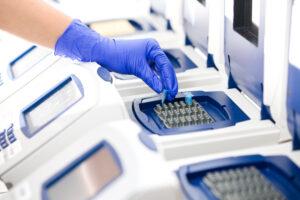
Scientist with DNA copying, Real-time PCR cycler, wide

[Adobe Stock]

Stanford researchers have announced that they have compressed a time-intensive protein building and testing process to 24 hours. Published in Molecular Systems Biology, the paper describes a method known as MIDAS (Microbe-Independent Deep Assembly and Screening) that differs from traditional protein engineering, which requires cloning genes into circular plasmids, growing them in bacteria or yeast, then transferring the DNA into mammalian cells for testing. MIDAS bypasses the microbial step and treats DNA as linear information amplified via polymerase chain reaction (PCR).. “With MIDAS, we can receive PCR primers in the morning, assemble the necessary genes by mid-day, and by late afternoon transfer the genes into cells to observe how the proteins function,” says co-first author Yan Wu in a press release. “And we can do this all for hundreds or thousands of protein variants in parallel at a time.”

In a practical test, MIDAS allowed researchers to evaluate 384 protein variants with roughly four hours of hands-on lab work and about $2,000 in reagents. By comparison, traditional cloning-based approaches would require an experienced researcher to spend approximately 192 hours and $20,000 in reagents to evaluate just 24 variants. The researchers calculate that MIDAS is nearly 50 times faster and a tenth the cost of conventional methods.

Circular structure of plasmids, while standard, is incompatible with PCR and not necessary for gene expression in mammalian cells. Dropping it unlocks parallelization where hundreds to thousands of protein variants can be assembled and screened simultaneously.

MIDAS could accelerate enzyme and biosensor studies across oncology, environmental science and other fields, according to the Stanford Report summary. The linear PCR-based workflow is also well suited to integration with liquid-handling robots. Most relevant for the AI-bio intersection, the method can generate large sequence-fitness datasets quickly, feeding machine-learning models for computational protein design.

Related Articles Read More >

Beyond the sequence: how Ötzi the Iceman exposed the blind spots of pure metagenomics
Flatworms sacrifice healthy cells to destroy the root cause of mutations in explosive immune response
OpenAI research and product leads detail GPT-Rosalind capabilities and benchmarks
Sanofi deepens its Owkin bet with a five-year deal to build bespoke drug-development agents
rd newsletter
EXPAND YOUR KNOWLEDGE AND STAY CONNECTED
Get the latest info on technologies, trends, and strategies in Research & Development.

R&D World Digital Issues

Fall 2025 issue

Browse the most current issue of R&D World and back issues in an easy to use high quality format. Clip, share and download with the leading R&D magazine today.

R&D 100 Awards
Research & Development World
  • Subscribe to R&D World Magazine
  • Sign up for R&D World’s newsletter
  • Contact Us
  • About Us
  • Drug Discovery & Development
  • Pharmaceutical Processing
  • Global Funding Forecast

Copyright © 2026 WTWH Media LLC. All Rights Reserved. The material on this site may not be reproduced, distributed, transmitted, cached or otherwise used, except with the prior written permission of WTWH Media
Privacy Policy | Advertising | About Us

Search R&D World

  • R&D World Home
  • Topics
    • Aerospace
    • Automotive
    • Biotech
    • Careers
    • Chemistry
    • Environment
    • Energy
    • Life Science
    • Material Science
    • R&D Management
    • Physics
  • Technology
    • 3D Printing
    • A.I./Robotics
    • Software
    • Battery Technology
    • Controlled Environments
      • Cleanrooms
      • Graphene
      • Lasers
      • Regulations/Standards
      • Sensors
    • Imaging
    • Nanotechnology
    • Scientific Computing
      • Big Data
      • HPC/Supercomputing
      • Informatics
      • Security
    • Semiconductors
  • R&D Market Pulse
  • R&D 100
    • 2025 R&D 100 Award Winners
    • 2025 Professional Award Winners
    • 2025 Special Recognition Winners
    • R&D 100 Awards Event
    • R&D 100 Submissions
    • Winner Archive
  • Resources
    • Research Reports
    • Digital Issues
    • Educational Assets
    • Subscribe
    • Video
    • Webinars
    • Content submission guidelines for R&D World
  • Global Funding Forecast
  • Top Labs
  • Advertise
  • SUBSCRIBE