Research & Development World

  • R&D World Home
  • Topics
    • Aerospace
    • Automotive
    • Biotech
    • Careers
    • Chemistry
    • Environment
    • Energy
    • Life Science
    • Material Science
    • R&D Management
    • Physics
  • Technology
    • 3D Printing
    • A.I./Robotics
    • Software
    • Battery Technology
    • Controlled Environments
      • Cleanrooms
      • Graphene
      • Lasers
      • Regulations/Standards
      • Sensors
    • Imaging
    • Nanotechnology
    • Scientific Computing
      • Big Data
      • HPC/Supercomputing
      • Informatics
      • Security
    • Semiconductors
  • R&D Market Pulse
  • R&D 100
    • 2026 R&D 100 Award Winners
    • 2026 Professional Award Winners
    • 2026 Special Recognition Winners
    • R&D 100 Awards Event
    • R&D 100 Submissions
    • Winner Archive
  • Resources
    • Research Reports
    • Digital Issues
    • Educational Assets
    • Subscribe
    • Video
    • Webinars
    • PharmSci360
    • Content submission guidelines for R&D World
  • Global Funding Forecast
  • Top Labs
  • Advertise
  • SUBSCRIBE

Super-Sensitive IR Instruments Prepped for NASA Telescope

By R&D Editors | April 11, 2016

NIRCam (left) beat requirements during final cryogenic testing with the Integrated Science Instrument Module for the James Webb Space Telescope. The module recently completed testing at NASA’s Goddard Space Flight Center.The ultra-sensitive, highly precise Near Infrared Camera (NIRCam) instrument for the James Webb Space Telescope beat its most stringent requirements during Integrated Science Instrument Module (ISIM) testing, which is now complete. Lockheed Martin built the instrument for the University of Arizona and NASA to serve as both the primary science instrument and the primary mirror-alignment sensor aboard the telescope.

Unlike other space observatories like the Hubble Space Telescope, the Webb telescope does not use a single monolithic primary mirror. Instead its primary mirror is made up of 18 individual, adjustable segments that will be aligned in space using NIRCam.

Read more in this CE exclusive article: Large Scale Satellite Production: Every Particle Counts 

“NIRCam has to work in order for the James Webb Space Telescope to work,” says Alison Nordt, NIRCam program manager at Lockheed Martin. “That’s because the alignment of the primary mirror segments depends on NIRCam to determine how to adjust the segments correctly. During instrument testing at Lockheed Martin, we tested the camera in two parts, and the optical performance was excellent. Now it has been tested at a higher level of assembly — both before and after flight-like vibration—and the optical performance is extremely stable.”

NIRCam performed better than requirements in the recent tests at ultra-cold cryogenic temperatures. When performance is measured in nanometers, precision takes on new meaning. For example, the recent test results show the NIRCam absolute wavefront performance — or its measure of accuracy — to be between 32 and 52 nm (much better than the requirement of less than 93 nm). To get an idea of how precise that is, a human cell is several thousand nm across, and 52 nm is roughly 1/40th of the wavelength of the light being measured. Moreover, not only is optical performance better than required, it is rock-steady having shown no measurable change between tests.

Lockheed Martin delivered NIRCam to NASA in March 2014 to be installed into the ISIM. Now that NASA completed ISIM trials, technicians will integrate the instrument cluster with the optical telescope element for combined testing. Performing better than expected, NIRCam is helping the Webb telescope stay on its path to launch, which is scheduled for October 2018.

NIRCam is one of many precision optical payloads Lockheed Martin designs, develops, and produces. Through the Optical Payload Center of Excellence and the Advanced Technology Center, Lockheed Martin has a deep understanding of optical and infrared missions and their technologies, building on decades of experience to deliver high-performing and reliable optical systems.

The James Webb Space Telescope is the scientific successor to NASA’s Hubble Space Telescope, and it will be the most powerful space telescope ever built. It is being assembled in a Class 10,000 cleanroom at NASA’s Goddard Space Flight Center in Maryland. Webb is an international project led by NASA with its partners, the European Space Agency, and the Canadian Space Agency.

Source: Lockheed Martin 

Related Articles Read More >

The UAE’s new space probe will crash into the asteroid it’s designed to study
Semiconductors, biomanufacturing and dual-use tech fill ISS National Lab’s startup cohort 
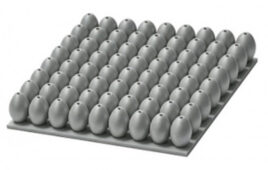
Eggshell-inspired shield cut projectile speed by 65% in simulation, but light-gas gun testing has not confirmed it 
The 100 most innovative companies of 2026: from NVIDIA and OpenAI to Eli Lilly and SpaceX
rd newsletter
EXPAND YOUR KNOWLEDGE AND STAY CONNECTED
Get the latest info on technologies, trends, and strategies in Research & Development.

R&D World Digital Issues

Fall 2025 issue

Browse the most current issue of R&D World and back issues in an easy to use high quality format. Clip, share and download with the leading R&D magazine today.

R&D 100 Awards
Research & Development World
  • Subscribe to R&D World Magazine
  • Sign up for R&D World’s newsletter
  • Contact Us
  • About Us
  • Drug Discovery & Development
  • Pharmaceutical Processing
  • Global Funding Forecast

Copyright © 2026 Arrowfly LLC. All Rights Reserved. The material on this site may not be reproduced, distributed, transmitted, cached or otherwise used, except with the prior written permission of Arrowfly
Privacy Policy | Advertising | About Us

Search R&D World

  • R&D World Home
  • Topics
    • Aerospace
    • Automotive
    • Biotech
    • Careers
    • Chemistry
    • Environment
    • Energy
    • Life Science
    • Material Science
    • R&D Management
    • Physics
  • Technology
    • 3D Printing
    • A.I./Robotics
    • Software
    • Battery Technology
    • Controlled Environments
      • Cleanrooms
      • Graphene
      • Lasers
      • Regulations/Standards
      • Sensors
    • Imaging
    • Nanotechnology
    • Scientific Computing
      • Big Data
      • HPC/Supercomputing
      • Informatics
      • Security
    • Semiconductors
  • R&D Market Pulse
  • R&D 100
    • 2026 R&D 100 Award Winners
    • 2026 Professional Award Winners
    • 2026 Special Recognition Winners
    • R&D 100 Awards Event
    • R&D 100 Submissions
    • Winner Archive
  • Resources
    • Research Reports
    • Digital Issues
    • Educational Assets
    • Subscribe
    • Video
    • Webinars
    • PharmSci360
    • Content submission guidelines for R&D World
  • Global Funding Forecast
  • Top Labs
  • Advertise
  • SUBSCRIBE