Research & Development World

  • R&D World Home
  • Topics
    • Aerospace
    • Automotive
    • Biotech
    • Careers
    • Chemistry
    • Environment
    • Energy
    • Life Science
    • Material Science
    • R&D Management
    • Physics
  • Technology
    • 3D Printing
    • A.I./Robotics
    • Software
    • Battery Technology
    • Controlled Environments
      • Cleanrooms
      • Graphene
      • Lasers
      • Regulations/Standards
      • Sensors
    • Imaging
    • Nanotechnology
    • Scientific Computing
      • Big Data
      • HPC/Supercomputing
      • Informatics
      • Security
    • Semiconductors
  • R&D Market Pulse
  • R&D 100
    • 2025 R&D 100 Award Winners
    • 2025 Professional Award Winners
    • 2025 Special Recognition Winners
    • R&D 100 Awards Event
    • R&D 100 Submissions
    • Winner Archive
  • Resources
    • Research Reports
    • Digital Issues
    • Educational Assets
    • R&D Index
    • Subscribe
    • Video
    • Webinars
    • Content submission guidelines for R&D World
  • Global Funding Forecast
  • Top Labs
  • Advertise
  • SUBSCRIBE

SwRI’s motion prediction algorithms enhance safety features for automated vehicles

By Heather Hall | February 24, 2020

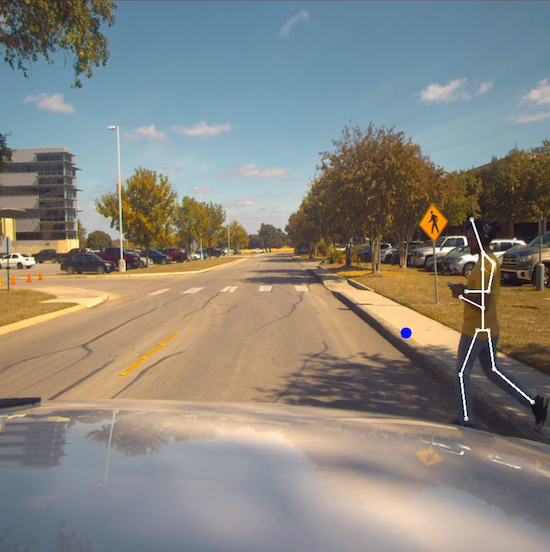
SwRI’s human motion prediction system overlays sparse skeletal features on pedestrians to predict movement. The blue dot in this image predicts the future direction of pedestrian on right. Deep learning algorithms predict motion based on pelvic biomechanical movement.

Southwest Research Institute, a leading innovator of machine learning technologies, has developed a motion prediction system that enhances pedestrian detection for automated vehicles. The computer vision tool uses a novel deep-learning algorithm to predict motion by observing real-time biomechanical movements with the pelvic area being a key indicator for changes.

“For instance, if a pedestrian is walking west, the system can predict if that person will suddenly turn south,” said SwRI’s Samuel E. Slocum, a senior research analyst who led the internally funded project. “As the push for automated vehicles accelerates, this research offers several important safety features to help protect pedestrians.”

Recent accidents involving automated vehicles have heightened the call for improved detection of pedestrians and other moving obstacles. Although previous technologies could track and predict movements in a straight line, they were unable to anticipate sudden changes.

Motion prediction often uses “optical flow” algorithms to predict direction and speed based on lateral motion. Optical flow, a type of computer vision, pairs algorithms with cameras to track dynamic objects. The accuracy of optical flow diminishes, however, when people move in unexpected directions.

To improve accuracy, SwRI compared optical flow to other deep learning methods, including temporal convolutional networks (TCNs) and long short-term memory (LSTM). After testing several configurations, researchers optimized a novel TCN that outperformed competing algorithms, predicting sudden changes in motion within milliseconds with a high level of accuracy.

The temporal design uses a convolutional neural network to process video data. SwRI’s novel approach optimizes dilation in network layers to learn and predict trends at a higher level. Dilated convolutions are structures that store and access video data for spatial observations.

People draw on experience and inference when driving near pedestrians and cyclists. SwRI’s research is a small step for autonomous systems to react more like human drivers.

“If we see a pedestrian, we might prepare to slow down or change lanes in anticipation of someone crossing the street,” said Dr. Douglas Brooks, a manager in SwRI’s Applied Sensing Department. “We take it for granted, but it’s incredibly complex for a computer to process this scene and predict scenarios.”

The research team leveraged SwRI’s markerless motion capture system, which automates biomechanical analysis in sports science. Using camera vision and perception algorithms, the system provides deep insights into kinematics and joint movement.

Applications for the project, titled “Motion Prediction from Sparse Skeletal Features,” include human performance, automated vehicles and manufacturing robotics. The algorithms can work with a variety of camera-based systems, and datasets are also available to SwRI clients.

SwRI’s data scientists work in collaborative teams to solve problems for several industries. Their rigorous approach to machine learning system design has led to innovations in automated detection of methane, cancer tumor cells, chemical analysis, traffic hazards and even distant exoplanets.

View a video of the technology here.

Related Articles Read More >

R&D 100 Winner Spotlight: GM’s next-gen medium-duty truck engine
DARPA Grand Challenge at 21: Two decades Ago, driverless vehicles made history in the Mojave Desert
2025 R&D layoffs tracker: hardware and chips lead the year’s biggest cuts while biopharma pares pipelines
Post-DOGE drama, Tesla pivots to AI abundance with trillion-dollar Musk incentive
rd newsletter
EXPAND YOUR KNOWLEDGE AND STAY CONNECTED
Get the latest info on technologies, trends, and strategies in Research & Development.
RD 25 Power Index

R&D World Digital Issues

Fall 2025 issue

Browse the most current issue of R&D World and back issues in an easy to use high quality format. Clip, share and download with the leading R&D magazine today.

R&D 100 Awards
Research & Development World
  • Subscribe to R&D World Magazine
  • Sign up for R&D World’s newsletter
  • Contact Us
  • About Us
  • Drug Discovery & Development
  • Pharmaceutical Processing
  • Global Funding Forecast

Copyright © 2026 WTWH Media LLC. All Rights Reserved. The material on this site may not be reproduced, distributed, transmitted, cached or otherwise used, except with the prior written permission of WTWH Media
Privacy Policy | Advertising | About Us

Search R&D World

  • R&D World Home
  • Topics
    • Aerospace
    • Automotive
    • Biotech
    • Careers
    • Chemistry
    • Environment
    • Energy
    • Life Science
    • Material Science
    • R&D Management
    • Physics
  • Technology
    • 3D Printing
    • A.I./Robotics
    • Software
    • Battery Technology
    • Controlled Environments
      • Cleanrooms
      • Graphene
      • Lasers
      • Regulations/Standards
      • Sensors
    • Imaging
    • Nanotechnology
    • Scientific Computing
      • Big Data
      • HPC/Supercomputing
      • Informatics
      • Security
    • Semiconductors
  • R&D Market Pulse
  • R&D 100
    • 2025 R&D 100 Award Winners
    • 2025 Professional Award Winners
    • 2025 Special Recognition Winners
    • R&D 100 Awards Event
    • R&D 100 Submissions
    • Winner Archive
  • Resources
    • Research Reports
    • Digital Issues
    • Educational Assets
    • R&D Index
    • Subscribe
    • Video
    • Webinars
    • Content submission guidelines for R&D World
  • Global Funding Forecast
  • Top Labs
  • Advertise
  • SUBSCRIBE