Foodborne illnesses kill roughly 3,000 Americans each year and about one in six are sickened, according to the Centers for Disease Control and Prevention.
Yet most contaminated foods are never traced back to their source. That’s because existing methods to track tainted food following its supply chain from table to farm are highly inefficient, jeopardizing the health of millions and costing the food industry billions. A typical process to trace food includes interviewing consumers and suppliers and examining every detail of the supply chain, a tedious method that takes weeks at best to complete.
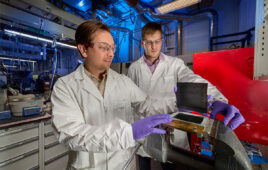
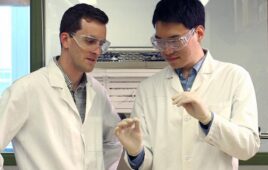
Lawrence Livermore National Laboratory (LLNL) researchers, in collaboration with the startup DNATrek, have developed a cost-effective and highly efficient method to accurately trace contaminated food back to its source. Lawrence Livermore originally designed the technology, known as DNATrax, to safely track indoor and outdoor airflow patterns.
“One of the unexpected capabilities from DNATrax was being able to apply it to food products,” said George Farquar, an LLNL physical chemist who led a team of researchers that developed the technology for biosecurity applications. “You can spray it on food products in the field to identify and track the source of the food.”
DNATrax are particles comprised of sugar and non-living and non-viable DNA that can serve as an invisible barcode. It’s an odorless and tasteless substance that’s been approved by the Food and Drug Administration as a food additive, safe for consumption. Think of it as a microscopic barcode that’s sprayed on food at the farm or processing plant.
If the food turns out to be contaminated when it reaches the store or dinner table, DNATrax can be lifted off the food and analyzed in the laboratory using polymerase chain reaction (PCR) to identify the source in an hour. A tainted apple, for example, can be traced back to the orchards by DNATrax to determine when it was picked, who picked it and potentially which tree it came from.
“We all hear horror stories about contaminated foods,” said DNATrek CEO Anthony Zografos, who recently licensed the technology from Lawrence Livermore. “We are not prepared to deal with an outbreak of pathogens such as E. coli and salmonella in tainted foods. However, DNATrax is a quick and efficient way to stop these foods from sickening more people and costing producers more money due to massive recalls triggered by poor traceability.”
About 128,000 Americans are hospitalized each year from contaminated foods, according to CDC statistics. Beyond health concerns, foodborne illnesses cost the food industry nearly $70 billion annually in the form of recalls and other related costs, according to the FDA.
DNATrax also can be used to trace fraudulent food back to producers using similar methods. Mislabeled foods are becoming a serious problem that are costing the food industry billions of dollars, Zografos said. It’s particularly problematic with premium goods such as olive oil and wine.
“Usually, the producers themselves are not the ones who commit the fraud,” Zografos said. “It’s committed down the supply chain.”
In the case of olive oil, DNATrax can be added to the olives as they are pressed into oil. If the fraudulent bottle is pulled off a store’s shelf, a quantitative analysis can be done on the DNATrax to determine how much of the oil has been diluted.
DNATrax’s original application was to monitor airflow patterns inside buildings and other facilities to plan safe evacuation routes and outside to determine routes that biological agents travel. The technology does not detect for biological agents, but is used in advance to ensure detection systems work properly.
To do this, tiny DNATrax particles are released as an aerosol and carried by the airflow inside a building. The particles are collected from the interior or exterior by swipes or filters, in a manner similar to forensic investigations. Using a PCR Thermo Cycler, a common instrument that serves as a photocopier for DNA, the data are analyzed to provide valuable information that can be used to improve the ability to protect lives if a harmful biological agent is released intentionally or accidentally.
“This technology provides a safe and cost-effective way to ensure biodetection systems are working as designed,” Farquar said. “So far, we’ve successfully conducted three tests at the Pentagon. Each test provided valuable information on how to enhance the Pentagon’s biodetection systems.”
In the future, Farquar hopes DNATrax can be used to assist in training to determine if personal protective equipment (PPE)—such as hazmat suits used by emergency responders and health care workers to treat Ebola patients—have been breached. The DNA particles can be applied to the PPE’s exterior, and if contaminants appear on a person’s skin, then a breach has occurred.
“This is important because current detection methods give a false impression of PPEs working properly,” Farquar said.