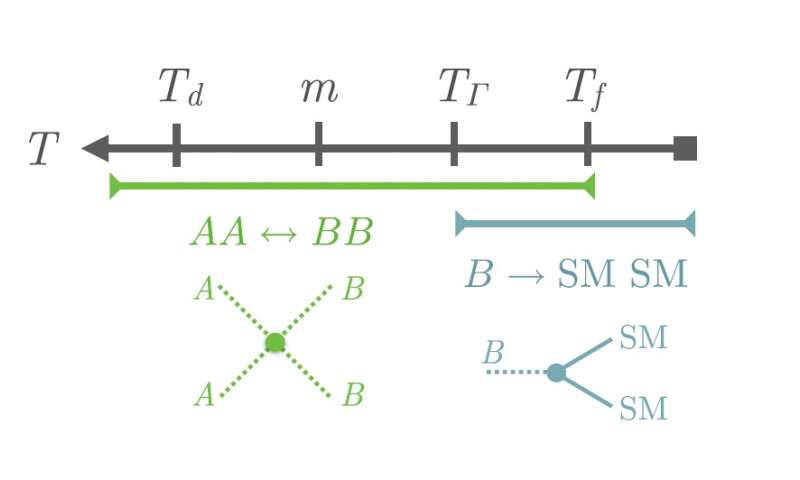
A timeline of co-decaying dark matter: the standard model and dark sector decouple at Td, the dark sector density begins to decrease at TΓ, and dark matter “freezes out” at Tf, resulting in a relic abundance. (Credit: Dror et al. 2016 American Physical Society)
There isn’t as much dark matter around today as there used to be. According to one of the most popular models of dark matter, the universe contained much more dark matter early on when the temperature was hotter. As the universe cooled, the dark matter annihilated away, at least up until a point when thermal equilibrium was reached and the annihilations ceased, resulting in the number of dark matter particles in the universe “freezing out” and remaining roughly constant.
Although this scenario, called “the weakly-interacting-massive-particle” (WIMP) scenario, has been researched extensively, it’s still unclear if the dark matter is indeed a WIMP.
In a new study published in Physical Review Letters, Cornell physicists Jeff Asaf Dror, Eric Kuflik, and Wee Hao Ng have proposed a new mechanism for dark matter freeze-out in which there is not one but many dark sector particles that all co-decay to produce the observed dark matter density. One or more of these particles are potential candidates for dark matter.
“For a long time, the Weakly Interacting Massive Particle (WIMP) has been the paradigm for explaining the particle nature of dark matter,” Kuflik told Phys.org. “Most experiments to discover dark matter were designed to find something that looks like a WIMP. The motivation for our work was to try to find other explanations for the nature of dark matter that would be experimentally searched for in a qualitatively different way than the WIMP.
“Co-decaying dark matter provides a new mechanism for dark matter to freeze out and obtain its observed relic abundance. Here dark matter can freeze out early in the universe and obtain the correct abundance we observe today. Its properties suggest that the current experiments would not be sensitive to this type of dark matter, but it can lead to other, unique experimental signatures. Furthermore, the mechanism is quite general and will be realized in many extensions of the standard model of particle physics.”
As the physicists explain, one of the biggest differences between the new mechanism and previous ones is that, in the new mechanism, the dark sector decouples from the standard model early on, which causes the two sectors to become out of equilibrium. This modification changes the decay rate by delaying the starting point of the decay, which causes the freeze-out to begin at later times. Ultimately this leads to a smaller dark matter density.
If the dark matter density is smaller as predicted here, then in order to match the observed dark matter abundance, the annihilation rate must be larger than in previous mechanisms. The larger annihilation rate might be detected by future indirect-detection experiments, which could distinguish between the two scenarios.
“Indirect-detection experiments for dark matter are experiments looking for the by-products of dark matter annihilating or decaying in space,” Dror explained. “The experiments point telescopes or satellites in regions where a large number of dark matter particles are expected (for example, the center of galaxies). Often, the by-products are photons (the quanta of light) which can be detected near the Earth. In contrast, direct-detection experiments correspond to waiting for dark matter particles themselves to collide with particles in detectors on Earth. The primary advantage of indirect-detection over direct-detection methods is that while the latter assumes that dark matter will collide frequently with lab experiment, the former does not. Indeed, this need not be the case: co-decaying dark matter is a prime example in which direct-detection signals are small, while indirect-detection signals are prominent.”
The researchers plan to explore these possibilities in the future, and also further investigate the properties of dark matter particles and how this type of dark matter might fit into a larger framework.
“We are looking into several novel effects that such dark matter can have,” Ng said. “Some of these are still work-in-progress so we are not yet ready to discuss the results. One example of an effect we are exploring are particles that are produced at the LHC, transverse a large distance in the detector, and then decay into the dark matter.
“We are also studying explicit particle realizations of co-decaying dark matter. Co-decaying dark matter is a framework to produce the correct abundance, and new particle physics models that realize the framework are being explored.”