Research & Development World

  • R&D World Home
  • Topics
    • Aerospace
    • Automotive
    • Biotech
    • Careers
    • Chemistry
    • Environment
    • Energy
    • Life Science
    • Material Science
    • R&D Management
    • Physics
  • Technology
    • 3D Printing
    • A.I./Robotics
    • Software
    • Battery Technology
    • Controlled Environments
      • Cleanrooms
      • Graphene
      • Lasers
      • Regulations/Standards
      • Sensors
    • Imaging
    • Nanotechnology
    • Scientific Computing
      • Big Data
      • HPC/Supercomputing
      • Informatics
      • Security
    • Semiconductors
  • R&D Market Pulse
  • R&D 100
    • 2026 R&D 100 Award Winners
    • 2026 Professional Award Winners
    • 2026 Special Recognition Winners
    • R&D 100 Awards Event
    • R&D 100 Submissions
    • Winner Archive
  • Resources
    • Research Reports
    • Digital Issues
    • Educational Assets
    • Subscribe
    • Video
    • Webinars
    • PharmSci360
    • Content submission guidelines for R&D World
  • Global Funding Forecast
  • Top Labs
  • Advertisers
    • Advertise
    • PR Submissions
    • Eblast Submissions
  • SUBSCRIBE

How Fermilab plans to fill two giant underground tanks with 34,000 tons of liquid argon

By Julia Rock-Torcivia | November 16, 2026

Filling the tanks with 34,000 metric tons of liquid argon means turning it into gas and back again. Fermilab will vaporize each delivery at the surface, pipe the gas nearly a mile down the shaft, then purify it and liquefy it again next to the detectors.
give me the image caption
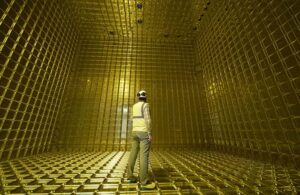
Inside the first ProtoDUNE detector at CERN, a prototype for DUNE’s far detectors, before it was filled with liquid argon. [Image courtesy of CERN]

DUNE is an international physics experiment hosted by Fermilab that will fire a beam of neutrinos 800 miles from Illinois to South Dakota to compare how the particles change type as they travel. In doing so, scientists hope to learn why the universe is made of matter rather than antimatter, and other unknowns about the origins of the universe.

Crews from the Fermi National Accelerator Laboratory, the Sanford Underground Research Facility and CERN, the European Organization for Nuclear Research, began assembling those tanks, called cryostats, in early November, Fermilab said in a Nov. 10 release.

The argon within the tanks is what will allow scientists to analyze the neutrinos after their journey. When a neutrino strikes an argon atom, the collision produces charged particles that knock loose electrons, which an electric field pulls through the liquid to readout planes.

Trucks will bring the argon in, and a surface plant will vaporize it and send it 4,850 ft down as a gas through a 6-inch stainless steel pipe. Underground, the cryogenics system will purify the argon and turn it back into liquid.

The argon order

The cryostats’ outer structures will use more than 6,200 metric tons of steel, all from CERN. Filling the first one will take about 1,000 truckloads over about a year, four 20-ton loads a day, seven days a week.

Each cryostat will hold roughly five Olympic pools’ worth of liquid argon, which is 1.4 times as dense as water. The cryostats will also have to hold up across a swing of about 375° F, from room temperature to the argon’s operating temperature.

When the argon arrives, the receiving facility will test it for purity and vaporize it. Tanks at the site will also be able to pump the argon back into trucks at the end of the experiment.

The RFI plans for 280 metric tons of storage at the surface, enough for 3.5 to 4 days at 70 metric tons a day, and two redundant 500 kW vaporizers.

From the surface to the cavern

Fermilab’s cryogenics team chose to send the argon down as gas rather than liquid. A June solicitation describes an 8-in. stainless steel pipe from the receiving facility to the Ross Shaft, 6-in. pipe down the shaft to the 4850 Level, the depth where DUNE’s caverns sit, and 8-in. pipe again to the Central Utility Cavern, to carry about 40,000 metric tons of argon. That cavern sits between the two detector halls and houses the cryogenics.

Bids for the pipeline contract closed July 27, and Fermilab hasn’t announced a winner. Its February project update scheduled the surface trench and the shaft pipe construction for 2027, and the solicitation’s scope of work puts the start in May 2027.

Once the argon gas is underground, liquid nitrogen will recondense it into a liquid. Air Products, an Allentown, Pennsylvania–based industrial gas company, holds the contract for that nitrogen system, and CERN is procuring the argon condensers.

Under Fermilab’s 2023 design estimates, the liquid argon would fill the cryostats at 0.8 and 0.5 kg/sec, respectively, taking about 257 days for cryostat 1 and 436 days for cryostat 2. Fermilab’s February project update said the first detector will start taking data while crews are still building the second.

 

Tell Us What You Think! Cancel reply

You must be logged in to post a comment.

Related Articles Read More >

Two Science papers catch altermagnets by handedness
An H3 rocket carrying JAXA's MMX spacecraft lifts off at night from Tanegashima Space Center
LLNL’s gamma-ray sensor is bound for a Martian moon
OpenAI logo glowing on a smartphone screen resting on a laptop keyboard
OpenAI says its AI models produced major proofs in mathematics, computer science and physics
Illustration of an antiferromagnetic tunnel junction pillar beside the two spin configurations of platinum-manganese that store a bit.
Northwestern and Western Digital demonstrate a new way to write magnetic memory
rd newsletter
EXPAND YOUR KNOWLEDGE AND STAY CONNECTED
Get the latest info on technologies, trends, and strategies in Research & Development.

R&D World Digital Issues

Fall 2026 issue

Browse the most current issue of R&D World and back issues in an easy to use high quality format. Clip, share and download with the leading R&D magazine today.

R&D 100 Awards
Research & Development World
  • Subscribe to R&D World Magazine
  • Sign up for R&D World’s newsletter
  • Contact Us
  • About Us
  • Drug Discovery & Development
  • Pharmaceutical Processing
  • Global Funding Forecast

Copyright © 2026 Arrowfly LLC. All Rights Reserved. The material on this site may not be reproduced, distributed, transmitted, cached or otherwise used, except with the prior written permission of Arrowfly
Privacy Policy | Advertising | About Us

Search R&D World

  • R&D World Home
  • Topics
    • Aerospace
    • Automotive
    • Biotech
    • Careers
    • Chemistry
    • Environment
    • Energy
    • Life Science
    • Material Science
    • R&D Management
    • Physics
  • Technology
    • 3D Printing
    • A.I./Robotics
    • Software
    • Battery Technology
    • Controlled Environments
      • Cleanrooms
      • Graphene
      • Lasers
      • Regulations/Standards
      • Sensors
    • Imaging
    • Nanotechnology
    • Scientific Computing
      • Big Data
      • HPC/Supercomputing
      • Informatics
      • Security
    • Semiconductors
  • R&D Market Pulse
  • R&D 100
    • 2026 R&D 100 Award Winners
    • 2026 Professional Award Winners
    • 2026 Special Recognition Winners
    • R&D 100 Awards Event
    • R&D 100 Submissions
    • Winner Archive
  • Resources
    • Research Reports
    • Digital Issues
    • Educational Assets
    • Subscribe
    • Video
    • Webinars
    • PharmSci360
    • Content submission guidelines for R&D World
  • Global Funding Forecast
  • Top Labs
  • Advertisers
    • Advertise
    • PR Submissions
    • Eblast Submissions
  • SUBSCRIBE