In a future of personalized medicine, doctors may quickly glean the changes in the DNA sequences of patients that predispose them to specific diseases or determine the most appropriate therapeutic approach simply by analyzing a saliva sample. At present, however, reading DNA sequences from genomes using current next generation sequencing methods is still a costly endeavor restricted to well-equipped laboratories.
Now, George Church’s team at Harvard’s Wyss Institute for Biologically Inspired Engineering and the Harvard Medical School developed a new electronic DNA sequencing platform based on biologically engineered nanopores that could help overcome these limitations. The method is reported in PNAS.
“In this study, we have explored the foundation for a highly scalable, accurate, single-molecule DNA sequencing platform with the potential for extensive sampling of environmental genomes, of pathogens as well as long DNA reads at lower costs, transforming precision medicine,” says Church, Ph.D., who is Core Faculty Member at the Wyss Institute for Biologically Inspired Engineering at Harvard University, leader of its Synthetic Biology Platform, and Professor of Genetics at Harvard Medical School.
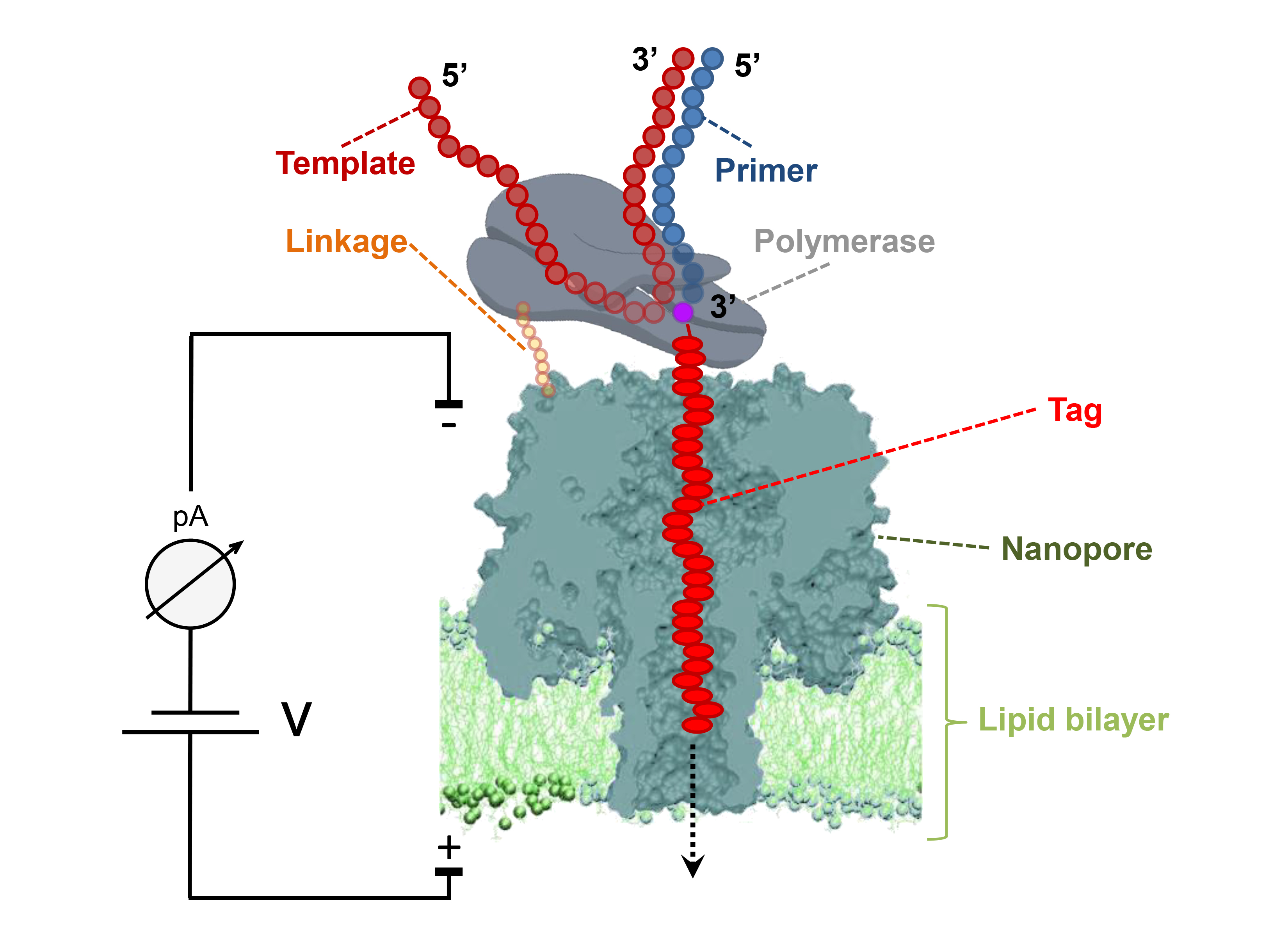
The sequencing engine consists of an open pore build of six subunits embedded in a lipid membrane, with one of them being specifically linked to the DNA polymerase molecule (grey) that synthesizes a string of DNA complementary to the template strand to be sequenced (dark red). By extending a primer (blue) that is pre-bound to the template, the polymerase adds complementary nucleotides (purple), each carrying a tag (red) specifying the type of nucleotide. While the polymerase progresses on the template, the tags are successively released into the nanopore where they cause a characteristic change in current (V). Image: Wyss Institute at Harvard University
Since the 1990s, Church and other researchers have been investigating an alternative method to sequence DNA called nanopore-based sequencing-by-synthesis (Nanopore-SBS). Nanopores are tiny holes within a membrane separating two different electrolyte solutions. By applying a voltage differential, a continuous stream of small charged ion molecules can be made to pass through each pore, from one side of the membrane to the other. The changes in current produced allow researchers to interpret the molecules’ shapes and tell their identities. In his previous Nano-SBS work, Church applied this principle to the electric discrimination of the four DNA nucleotides. With the help of the enzyme DNA polymerase, the DNA template of unknown sequence is copied into the complementary string composed of the four different nucleotides, each of them carrying a nucleotide-specific synthetic tag. The bulky tags are then successively released into the nanopore where they can be identified in real time.
The method is complicated when several DNA polymerase molecules copy their DNA template sequences into complementary nucleotide strings that get mixed up in the nanopore and also trigger a mixed series of changes in the pore’s electric current.
“A key problem of the method at the time is that it lacked accuracy. This is because more than one complementary DNA strand is synthesized close to the nanopore opening, which produces jumbled electrical signals inside the pore that don’t anymore relate to a single original DNA template molecule. But we have now engineered a new sequencing engine that gives robust and reliable sequencing results, can be loaded with different DNA templates, and can be highly multiplexed in a chip composed of hundreds nanopores individually addressable by electrodes,” says P. Benjamin Stranges, Ph.D., a Postdoctoral Fellow working with Church and one of the two first authors of the study.
This new sequencing engine contains seven protein subunits that together build a suitable nanopore complex. Only one of them can be specifically conjugated to a DNA polymerase enzyme that is positioned right at the pore opening.
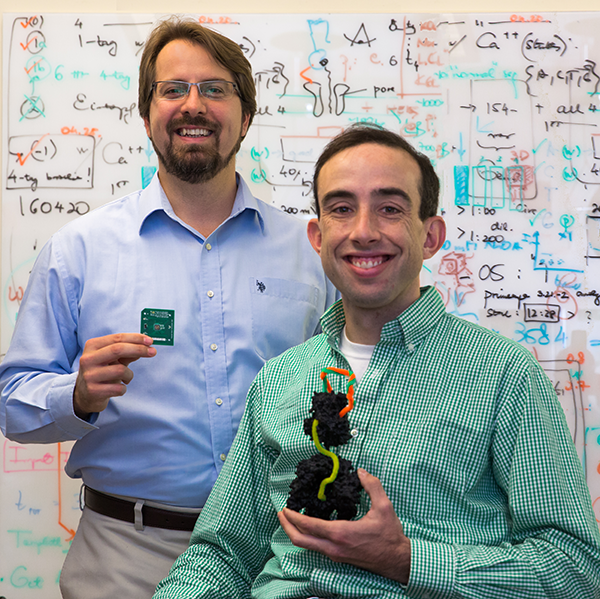
In this picture Mirkó Palla (left) and P. Benjamin Stranges (right) who performed the work at the Wyss Institute as members of George Church’s team present one of the nanopore-containing chips they used to demonstrate the sequencing engine’s functionality and a 3D model of the engineered sequencing engine itself. Image: Wyss Institute at Harvard University
Being able to multiplex and individually analyze many DNA sequences electronically on the same chip at the same time, compared with conventional sequencing procedures performed with much less throughput, as well as expensive reagents and machines, has the potential to dramatically lower the costs of sequencing.
“We are able to identify the correct nucleotide between 79 to 99 percent of the time and only found background events classified as true captures less than 1.2% of the time,” says Mirkó Palla, Ph.D., the second first author of the study and a Research Fellow at the Wyss Institute. “This presents a remarkable advance over previous Nanopore-SBS systems.”
Other authors of the study were from the Center for Genome Technology and Biomolecular Engineering and the College of Physicians and Surgeons at Columbia University, and Genia Technologies, which also provided the semiconductor chips.
“This technology is a great example of how our deep understanding of how living systems function at the molecular scale can be leveraged to develop breakthrough technologies,” says Wyss Institute Founding Director Donald Ingber, M.D., Ph.D., who is the Judah Folkman Professor of Vascular Biology at Harvard Medical School and the Vascular Biology Program at Boston Children’s Hospital, and also Professor of Bioengineering at the Harvard John A. Paulson School of Engineering and Applied Sciences. “By combining engineered macromolecular machines in the form of nanopores with synthetic membranes, and then integrating them with conventional electronics, the Church team has created a capability that could enable development of an entirely new class of low-cost gene diagnostics.”
Source: Harvard’s Wyss Institute for Biologically Inspired Engineering