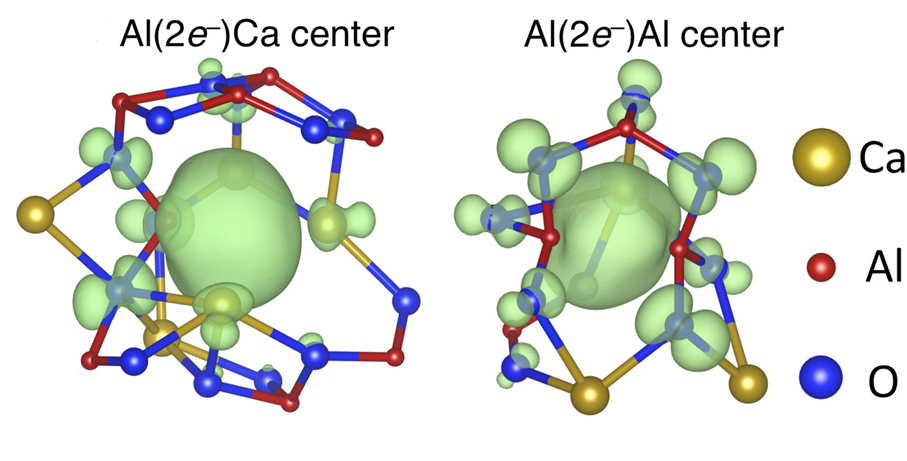
Electron anions (center green blob) pair up in the center of molecular cages and lower the temperature at which glass forms in C12A7 electride.
Simple cements are everywhere in construction, but researchers want to create novel construction materials to build smarter infrastructure. The cement known as mayenite is one smart material — it can be turned from an insulator to a transparent conductor and back. Other unique properties of this material make it suitable for industrial production of chemicals such as ammonia and for use as semiconductors in flat panel displays.
The secret behind mayenite’s magic is a tiny change in its chemical composition, but researchers hadn’t been sure why the change had such a big effect on the material, also known as C12A7. In new work, researchers show how C12A7 components called electron anions help to transform crystalline C12A7 into semiconducting glass.
The study, published recently in Proceedings of the National Academy of Sciences, uses computer modeling that zooms in at the electron level along with lab experiments. They showed how the small change in composition results in dramatic changes of the glass properties and, potentially, allows for greater control of the glass formation process.
“We want to get rid of the indium and gallium currently used in most flat panel displays,” says materials scientist Peter Sushko of the Department of Energy’s Pacific Northwest National Laboratory. “This research is leading us toward replacing them with abundant non-toxic elements such as calcium and aluminum.”
More than a decade ago, materials scientist Hideo Hosono at the Tokyo Institute of Technology and colleagues plucked an oxygen atom from a crystal of C12A7 oxide, which turned the transparent insulating material into a transparent conductor. This switch is rare because the conducting material is transparent: Most conductors are not transparent (think metals) and most transparent materials are not conductive (think window glass).
Back in the crystal, C12A7 oxide’s departing oxygen leaves behind a couple electrons and creates a material known as an electride. This electride is remarkably stable in air, water, and ambient temperatures. Most electrides fall apart in these conditions. Because of this stability, materials scientists want to harness the structure and properties of C12A7 electride. Unfortunately, its crystalline nature is not suitable for large-scale industrial processes, so they needed to make a glass equivalent of C12A7 electride.
And several years ago, they did. Hosono and colleagues converted crystalline C12A7 electride into glass. The glass shares many properties of the crystalline electride, including the remarkable stability.
Crystals are neat and tidy, like apples and oranges arranged orderly in a box, but glasses are unordered and messy, like that same fruit in a plastic grocery bag. Researchers make glass by melting a crystal and cooling the liquid in such a way that the ordered crystal doesn’t reform. With C12A7, the electride forms a glass at a temperature about 200 degrees lower than the oxide does.
This temperature — when the atoms stop flowing as a liquid and freeze in place — is known as the glass transition temperature. Controlling the glass transition temperature allows researchers to control certain properties of the material. For example, how car tires wear down and perform in bad weather depends on the glass transition temperature of the rubber they’re made from.
Sushko, his PNNL colleague Lewis Johnson, Hosono and others at Tokyo Tech wanted to determine why the electride’s glass transition temperature was so much lower than the oxide’s. They suspected components of the electride known as electron anions were responsible. Electron anions are essentially freely moving electrons in place of the much-larger negatively charged oxygen atoms that urge the oxide to form a tidy crystal.
The team simulated Hosono’s lab experiments using molecular dynamics software that could capture the movement of both the atoms and the electron anions in both the melted material and glass. The team found that that the negatively-charged electron anions paired up between positively charged aluminum or calcium atoms, replacing the negatively charged oxygen atoms that would typically be found between the metals.
The bonds that the electron anions formed between the metal atoms were weaker than bonds between metal and oxygen atoms. These weak links could also move rapidly through the material. This movement allowed a small number of electron anions to have a greater effect on the glass transition temperature than much larger quantities of minerals typically used as additives in glasses.
To rule out other factors as the impetus for the lower transition temperature — such as the electrical charge or change in oxygen atoms — the researchers simulated a material with the same composition as the C12A7 electride but with the electrons spread evenly through the material instead of packed in as electron anions. In this simulation, the glass transition temperature was no different than C12A7 oxide’s. This result confirmed that the network of weak links formed by the electron anions was responsible for changes to the glass transition temperature.
According to the scientists, electron anions form a new type of weak link that can affect the conditions under which a material can form a glass. They join the ranks of typical additives that disrupt the ability of the material to form long chains of atoms, such as fluoride, or form weak, randomly oriented bonds between atoms of opposite charge, such as sodium. The work suggests researchers might be able to control the transition temperature by changing the amount of electron anions they use.
“This work shows us not just how a glass forms,” says PNNL’s Johnson, “but also gives us a new tool for how to control it.”
This work was supported by the Japan Science and Technology Agency and PNNL.