
From the American Chemical Society (ACS)
Imagine using insects as a source of chemicals to make plastics that can biodegrade later — with the help of that very same type of bug. That concept is closer to reality than you might expect. Today, researchers will describe their progress to date, including isolation and purification of insect-derived chemicals and their conversion into functional bioplastics.
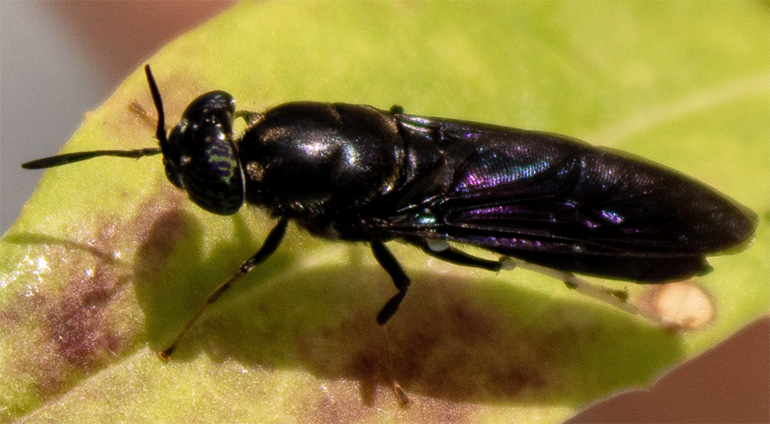
Black soldier flies are a good source of chemicals to make bioplastics.
The researchers will present their results at the fall meeting of the American Chemical Society (ACS). ACS Fall 2023 is a hybrid meeting being held virtually and in-person Aug. 13–17, and features about 12,000 presentations on a wide range of science topics.
“For 20 years, my group has been developing methods to transform natural products — such as glucose obtained from sugar cane or trees — into degradable, digestible polymers that don’t persist in the environment,” said Karen Wooley, PhD, the project’s principal investigator. “But those natural products are harvested from resources that are also used for food, fuel, construction, and transportation.”
So, Wooley began searching for alternative sources that wouldn’t have these competing applications. Her colleague Jeffery Tomberlin, PhD, suggested she could use waste products left over from farming black soldier flies, an expanding industry that he has been helping to develop.
The larvae of these flies contain many proteins and other nutritious compounds, so the immature insects are increasingly being raised for animal feed and to consume wastes. However, the adults have a short life span after their breeding days are over and are then discarded. At Tomberlin’s suggestion, those adult carcasses became the new starting material for Wooley’s team. “We’re taking something that’s quite literally garbage and making something useful out of it,” said Cassidy Tibbetts, a graduate student working on the project in Wooley’s lab at Texas A&M University.
When Tibbetts examined the dead flies, she determined that chitin is a major component. This nontoxic, biodegradable, sugar-based polymer strengthens the shell, or exoskeleton, of insects and crustaceans. Manufacturers already extract chitin from shrimp and crab shells for various applications, and Tibbetts has been applying similar techniques using ethanol rinses, acidic demineralization, basic deproteinization and bleach decolorization to extract and purify it from the insect carcasses. She said her fly-sourced chitin powder is probably purer, since it lacks the yellowish color and clumpy texture of the traditional product. She also notes that obtaining chitin from flies could avoid possible concerns over some seafood allergies. Some other researchers isolate chitin or proteins from fly larvae, but Wooley says her team is the first that she knows of to use chitin from discarded adult flies, which — unlike the larvae — aren’t used for feed.
While Tibbetts continues to refine her extraction techniques, Hongming Guo, another graduate student in Wooley’s lab, has been converting the purified fly chitin into a similar polymer known as chitosan. He does this by stripping off chitin’s acetyl groups. That exposes chemically reactive amino groups that can be functionalized and then crosslinked. These steps transform chitosan into useful bioplastics such as superabsorbent hydrogels, which are 3D polymer networks that absorb water.
Guo has produced a hydrogel that can absorb 47x its weight in water in just one minute. This product could potentially be used in cropland soil to capture floodwater and then slowly release moisture during subsequent droughts, Wooley said. “Here in Texas, we’re constantly either in a flood or drought situation, so I’ve been trying to think of how we can make a superabsorbent hydrogel that could address this.” And because the hydrogel is biodegradable, she said it should gradually release its molecular components as nutrients for crops.
This summer, the team is starting a project to break down chitin into its monomeric glucosamines. These small sugar molecules will then be used to make bioplastics, such as polycarbonates or polyurethanes, which are traditionally made from petrochemicals. Black soldier flies also contain many other useful compounds that the group plans to use as starting materials, including proteins, DNA, fatty acids, lipids, and vitamins.
The products made from these chemical building blocks are intended to degrade or digest when they’re discarded, so they won’t contribute to the current plastic pollution problem. Wooley’s vision for that process would align it with the sustainable, circular economy concept: “Ultimately, we’d like the insects to eat the waste plastic as their food source, and then we would harvest them again and collect their components to make new plastics,” she said. “So the insects would not only be the source, but they would also then consume the discarded plastics.”
The researchers acknowledge support and funding from the Welch Foundation and a private donation.
For health and safety information for ACS Fall 2023, please visit the FAQ webpage.



Tell Us What You Think!