Research & Development World

  • R&D World Home
  • Topics
    • Aerospace
    • Automotive
    • Biotech
    • Careers
    • Chemistry
    • Environment
    • Energy
    • Life Science
    • Material Science
    • R&D Management
    • Physics
  • Technology
    • 3D Printing
    • A.I./Robotics
    • Software
    • Battery Technology
    • Controlled Environments
      • Cleanrooms
      • Graphene
      • Lasers
      • Regulations/Standards
      • Sensors
    • Imaging
    • Nanotechnology
    • Scientific Computing
      • Big Data
      • HPC/Supercomputing
      • Informatics
      • Security
    • Semiconductors
  • R&D Market Pulse
  • R&D 100
    • 2025 R&D 100 Award Winners
    • 2025 Professional Award Winners
    • 2025 Special Recognition Winners
    • R&D 100 Awards Event
    • R&D 100 Submissions
    • Winner Archive
  • Resources
    • Research Reports
    • Digital Issues
    • Educational Assets
    • Subscribe
    • Video
    • Webinars
    • Content submission guidelines for R&D World
  • Global Funding Forecast
  • Top Labs
  • Advertise
  • SUBSCRIBE

Trump administration science cuts disrupt U.S. research landscape

By Heather Hall | March 18, 2025

The Trump administration’s broad cuts to federal science budgets and staff are significantly impacting the U.S. research and development community. From National Institute of Health (NIH) labs to top-tier universities, scientists and engineers are facing stalled projects, hiring freezes, and growing uncertainty as efforts to reduce the federal workforce and suspend research funding take hold.
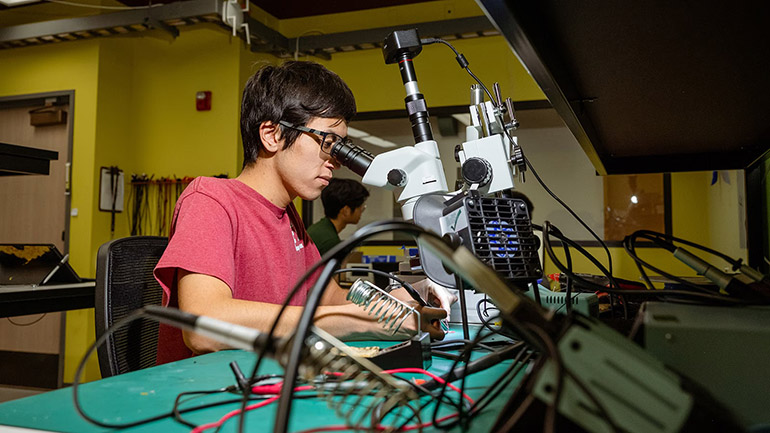
[Image courtesy of CalTech]

Leading institutions are already feeling the strain. According to Bloomberg, Columbia University is contending with a $400 million federal funding gap, Harvard has frozen faculty hiring, and Caltech is delaying postdoctoral appointments. These disruptions are limiting opportunities for early-career researchers and slowing progress on key projects.

Federal data systems are also under threat. Some government research portals — particularly those tied to climate and health — have gone offline, putting grants and long-term data access at risk. Cuts to agencies like the National Weather Service may undermine private-sector innovation in forecasting and modeling. Economist Jeffrey Lazo told Bloomberg that public weather data supports over $85 billion in annual economic activity — a value that may be difficult to sustain without federal infrastructure.

According to Science Magazine, nearly 1,200 probationary employees were initially ordered to be terminated at the NIH. After appeals from Acting NIH Director Matthew Memoli, 250 early-career scientists and staff were reinstated, but further layoffs remain possible.

The research community’s uncertainty is prompting laboratories to cut back or seek alternative funding sources. Postdoctoral positions and tenure-track opportunities are decreasing, and some institutions are postponing or halting research entirely. Legal challenges have been launched against certain administration actions, especially where funding freezes conflict with congressional intent.

With Congress now debating short — and long-term funding measures, the future of federally supported science in the U.S. remains unclear. In the meantime, research leaders are urging teams to prepare for continued disruption.
“This is jeopardizing our Nation’s ability to stay at the forefront of science and engineering by reducing or eliminating a generation of young technical talent,” — Fiona Harrison, chair of Caltech’s Division of Physics, Mathematics, and Astronomy, told Bloomberg.

Related Articles Read More >

House bill puts $48.8 billion toward biomedical research while cutting CDC by $1 billion
White House proposes giving political appointees final say on research grants
Science agencies reportedly restricting international collaboration
Nature opens its anti-publications-bias format to all fields, where up to 60% of hypotheses fail review
rd newsletter
EXPAND YOUR KNOWLEDGE AND STAY CONNECTED
Get the latest info on technologies, trends, and strategies in Research & Development.

R&D World Digital Issues

Fall 2025 issue

Browse the most current issue of R&D World and back issues in an easy to use high quality format. Clip, share and download with the leading R&D magazine today.

R&D 100 Awards
Research & Development World
  • Subscribe to R&D World Magazine
  • Sign up for R&D World’s newsletter
  • Contact Us
  • About Us
  • Drug Discovery & Development
  • Pharmaceutical Processing
  • Global Funding Forecast

Copyright © 2026 WTWH Media LLC. All Rights Reserved. The material on this site may not be reproduced, distributed, transmitted, cached or otherwise used, except with the prior written permission of WTWH Media
Privacy Policy | Advertising | About Us

Search R&D World

  • R&D World Home
  • Topics
    • Aerospace
    • Automotive
    • Biotech
    • Careers
    • Chemistry
    • Environment
    • Energy
    • Life Science
    • Material Science
    • R&D Management
    • Physics
  • Technology
    • 3D Printing
    • A.I./Robotics
    • Software
    • Battery Technology
    • Controlled Environments
      • Cleanrooms
      • Graphene
      • Lasers
      • Regulations/Standards
      • Sensors
    • Imaging
    • Nanotechnology
    • Scientific Computing
      • Big Data
      • HPC/Supercomputing
      • Informatics
      • Security
    • Semiconductors
  • R&D Market Pulse
  • R&D 100
    • 2025 R&D 100 Award Winners
    • 2025 Professional Award Winners
    • 2025 Special Recognition Winners
    • R&D 100 Awards Event
    • R&D 100 Submissions
    • Winner Archive
  • Resources
    • Research Reports
    • Digital Issues
    • Educational Assets
    • Subscribe
    • Video
    • Webinars
    • Content submission guidelines for R&D World
  • Global Funding Forecast
  • Top Labs
  • Advertise
  • SUBSCRIBE