Research & Development World

  • R&D World Home
  • Topics
    • Aerospace
    • Automotive
    • Biotech
    • Careers
    • Chemistry
    • Environment
    • Energy
    • Life Science
    • Material Science
    • R&D Management
    • Physics
  • Technology
    • 3D Printing
    • A.I./Robotics
    • Software
    • Battery Technology
    • Controlled Environments
      • Cleanrooms
      • Graphene
      • Lasers
      • Regulations/Standards
      • Sensors
    • Imaging
    • Nanotechnology
    • Scientific Computing
      • Big Data
      • HPC/Supercomputing
      • Informatics
      • Security
    • Semiconductors
  • R&D Market Pulse
  • R&D 100
    • 2025 R&D 100 Award Winners
    • 2025 Professional Award Winners
    • 2025 Special Recognition Winners
    • R&D 100 Awards Event
    • R&D 100 Submissions
    • Winner Archive
  • Resources
    • Research Reports
    • Digital Issues
    • Educational Assets
    • Subscribe
    • Video
    • Webinars
    • Content submission guidelines for R&D World
  • Global Funding Forecast
  • Top Labs
  • Advertise
  • SUBSCRIBE

Understanding the Strange Behavior of Water

By University of Bristol | March 27, 2018

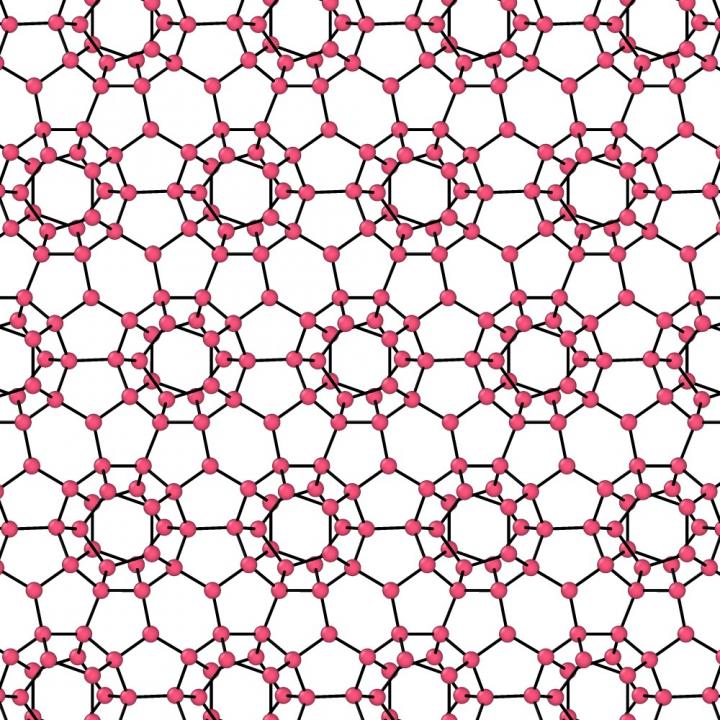
A clathrate ice, with oxygens represented as spheres, and hydrogen-bonds as lines. The work has shown how complex crystalline structures emerge as a result of water’s interactions.

The properties of water have fascinated scientists for centuries, but yet its unique behaviour remains a mystery.

Published this week in the journal Proceedings of the National Academy of Sciences of the United States of America, a collaboration between the Universities of Bristol and Tokyo has attempted a novel route to understand what makes a liquid behave like water.

When compared to an ordinary liquid, water displays a vast array of anomalies. Common examples include the fact that liquid water expands on cooling below 4 C, which is responsible for lakes freezing from the top rather than the bottom.

In addition, the fact that water becomes less viscous when compressed, or its unusually high surface tension, allows insects to walk on water’s surface.

These and many other anomalies are of fundamental importance in countless natural and technological processes, such as the Earth’s climate, and the possibility of life itself. From an anthropic viewpoint, it is like the water molecule was fine-tuned to have such unique properties.

Starting from the observation that the properties of water seem to appear fine-tuned, a collaboration between Dr John Russo from the University of Bristol’s School of Mathematics and Professor Hajime Tanaka from the University of Tokyo, harnessed the power of powerful supercomputers, using computational models to slowly “untune” water’s interactions.

This showed how the anomalous properties of water can be changed and eventually reduced to those of a simple liquid. For example, instead of floating on water, the density of ice can be changed continuously until it sinks, and the same can be done with all water anomalies.

Dr Russo said: “With this procedure, we have found that what makes water behave anomalously is the presence of a particular arrangement of the water’s molecules, such as the tetrahedral arrangement, where a water molecule is hydrogen-bonded to four molecules located on the vertices of a tetrahedron.

“Four of such tetrahedral arrangements can organise themselves in such a way that they share a common water molecule at the centre without overlapping.

“It is the presence of this highly ordered arrangement of water molecules, mixed with other disordered arrangements that gives water its peculiar properties.

“We think this work provides a simple explanation of the anomalies and highlights the exceptional nature of water, which makes it so special compared with any other substance.”

Related Articles Read More >

Medable’s Digital Data Flow Agent focuses on protocol translation as the agentic race accelerates
AI image firm Midjourney spins up health division, unveils ‘Ultrasonic CT’
Q&A: Owkin’s five-year Sanofi deal bets on ‘purpose-built’ AI agents
Genetically modified hookworms could produce and deliver therapeutics within a host
rd newsletter
EXPAND YOUR KNOWLEDGE AND STAY CONNECTED
Get the latest info on technologies, trends, and strategies in Research & Development.

R&D World Digital Issues

Fall 2025 issue

Browse the most current issue of R&D World and back issues in an easy to use high quality format. Clip, share and download with the leading R&D magazine today.

R&D 100 Awards
Research & Development World
  • Subscribe to R&D World Magazine
  • Sign up for R&D World’s newsletter
  • Contact Us
  • About Us
  • Drug Discovery & Development
  • Pharmaceutical Processing
  • Global Funding Forecast

Copyright © 2026 WTWH Media LLC. All Rights Reserved. The material on this site may not be reproduced, distributed, transmitted, cached or otherwise used, except with the prior written permission of WTWH Media
Privacy Policy | Advertising | About Us

Search R&D World

  • R&D World Home
  • Topics
    • Aerospace
    • Automotive
    • Biotech
    • Careers
    • Chemistry
    • Environment
    • Energy
    • Life Science
    • Material Science
    • R&D Management
    • Physics
  • Technology
    • 3D Printing
    • A.I./Robotics
    • Software
    • Battery Technology
    • Controlled Environments
      • Cleanrooms
      • Graphene
      • Lasers
      • Regulations/Standards
      • Sensors
    • Imaging
    • Nanotechnology
    • Scientific Computing
      • Big Data
      • HPC/Supercomputing
      • Informatics
      • Security
    • Semiconductors
  • R&D Market Pulse
  • R&D 100
    • 2025 R&D 100 Award Winners
    • 2025 Professional Award Winners
    • 2025 Special Recognition Winners
    • R&D 100 Awards Event
    • R&D 100 Submissions
    • Winner Archive
  • Resources
    • Research Reports
    • Digital Issues
    • Educational Assets
    • Subscribe
    • Video
    • Webinars
    • Content submission guidelines for R&D World
  • Global Funding Forecast
  • Top Labs
  • Advertise
  • SUBSCRIBE