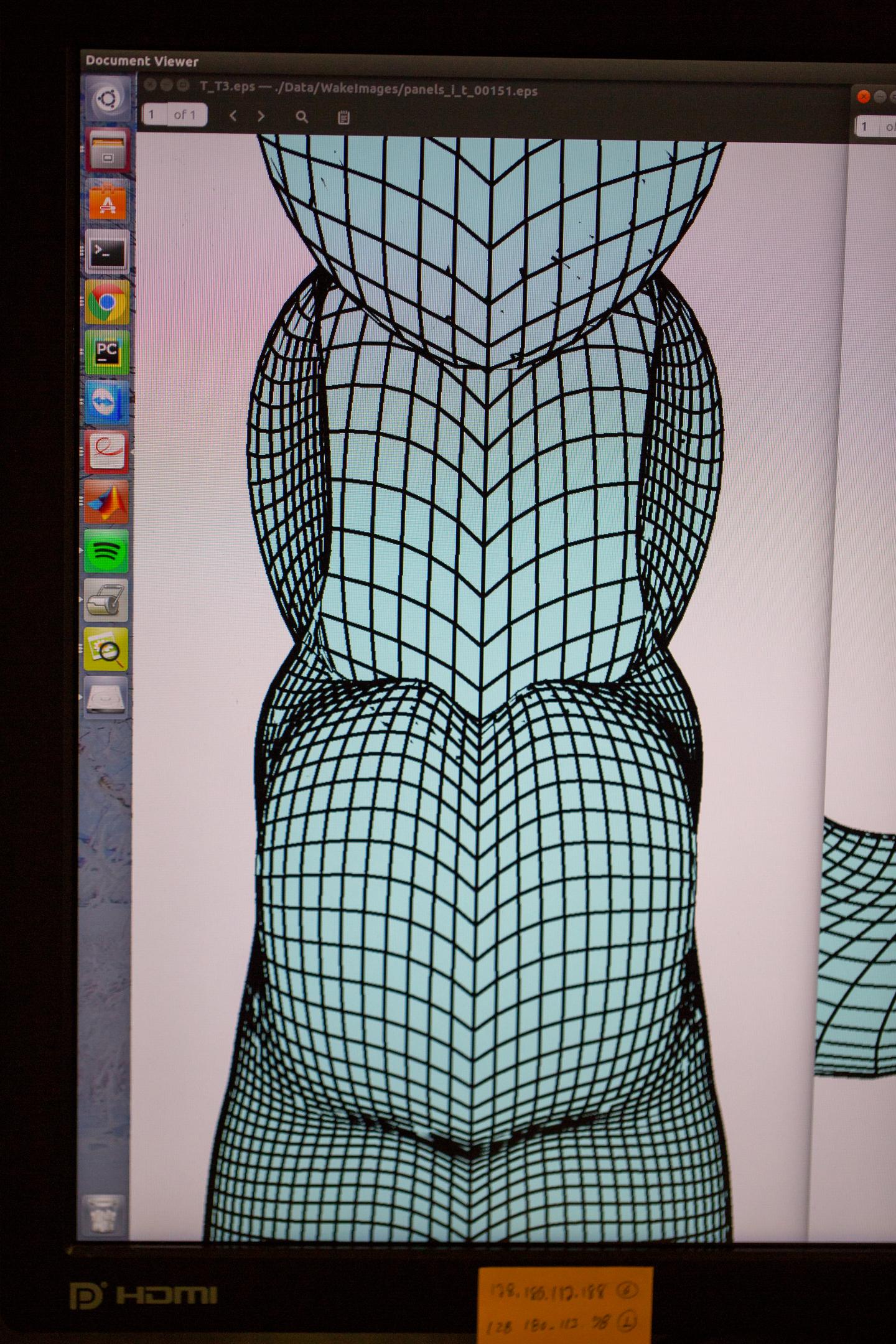
This image shows the wake structure left behind by a swimming dolphin produced using an in-house fast boundary element method numerical framework. It is a top down view of the wake structure. The result was produced by Fatma Ayancik, a PhD graduate student at Lehigh University, and it is part of her results examining the propulsive performance of dolphins and whales. The goal is to discover the science behind producing the next-generation of unmanned underwater systems that are bio-inspired. This work is funded through the Office of Naval Research (ONR) on a Multi-disciplinary University Research Initiative (MURI) program. As such, this is a collaborative project with the University of Virginia, West Chester University, Princeton University and Harvard University. Source: Christa Neu, Lehigh University Communications + Public Affairs
It is easy to speculate why fish might swim in schools — better protection from predators, improved foraging capability, easier fish-to-fish communication. Yet, none of these reveal why fish might move together in a specific pattern.
Research on the energetics of schools of fish offers counter-intuitive data–the group patterns do not necessarily maximize energy use.
Then why do they do it? Assistant professor of mechanical engineering and mechanics, Keith Moored, believes that fluid-mediated forces are at work. In fact, his previous research has pointed to its likelihood.
“The 3-D formation created by a group of fish is akin to atoms being pulled by forces into a lattice structure,” says Moored.
Gaining a comprehensive understanding of these collective interactions could help scientists determine how fragile biological networks are to overfishing, loss of habitat and a changing climate. It could also open the door to the development of schools of bio-inspired technologies.
Currently, unmanned underwater vehicles are used to assist in commercial fishing, for water sample collection, in search and rescue operations and for military purposes.
In the future, says Moored, instead of just one, it is likely that a group of devices will be sent underwater to perform a set of tasks as this collective approach is much more efficient. But there are obstacles.
“The key to making a breakthrough in the design of high-performance collectives of bio-inspired devices is to understand the fundamental fluid mechanics of collective interactions,” says Moored. “But right now we don’t have a thorough understanding of the fluid dynamics between fish in schools.”
Moored has received a National Science Foundation (NSF) Career Award to explore this promising area of inquiry. He will use the funds to gain a better understanding of flow mechanisms that occur among unsteady (due to oscillating fins), three-dimensional interacting bodies in complex arrangements.
Ultimately his work could answer the question: what can scientists borrow from nature to achieve teams of aquatic vehicles as optimized for underwater movement as fish swimming in a school?
Transforming our understanding of schooling
One of Moored’s first objectives is to characterize the forces, energetics and flow physics of collective locomotion for various arrangements typical of animal locomotion.
With extensive experience developing fluid dynamic testing facilities, he will use a low-speed wind tunnel facility and two pitching wings–wing models that can mimic the tail oscillations of a fish. The wings will be arranged in various configurations and subjected to a number of flow conditions.
Moored will characterize the flow fields among interacting pitching wings using a stereoscopic particle image velocimetry system which is designed to obtain instantaneous velocity measurements and related properties in fluids. He will also use a six axis force and torque sensor which can take six simultaneous measurements.
“Essentially, my team and I will attach the sensor to the pitching wing model and it will sense all of the forces acting on the wing, including the thrust and drag,” says Moored.
These quantification studies will constitute the first time such detailed measurements of the forces, energetics and flow fields of three dimensional thrust-producing interacting bodies in such complex arrangements have been assembled.
Unlocking a structural mystery
Using the same experiments, Moored will also examine his hypothesis that the lattice-like arrangements seen in schooling arrangements in nature may be due to fluid-mediated forces.
In previously published work, Moored has shown that a stable equilibrium distance–a state in which a body tends to return to its original position after being disturbed–exists between two interacting pitching wing models in a side-by-side arrangement. He found that equilibrium was stable for air or water flow disturbances in the cross-stream direction.
“If one swimmer moved away from the other a fluid-mediated force would pull them back together and vice versa,” says Moored.
By probing variations of position he will determine whether the location he previously identified or others like it are truly stable equilibria in three-dimensions.
Such a force map could transform scientists’ understanding of schooling behavior–an important step toward a fuller understanding of group behaviors in biology and a major development in underwater vehicle design inspired by nature.