The Human-Occupied Vehicle (HOV) Alvin is returning to the ocean, now with an autonomous underwater vehicle (AUV) that could enable scientists to explore deep-sea trenches.
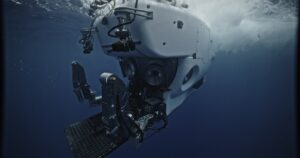
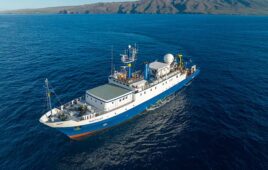
As part of its post-overhaul sea trials, Alvin successfully completed a deep dive to 6,374 meters, reaffirming its ability to safely transport researchers and engineers to Earth’s most extreme environments. (Photo by Luis Lamar, ©Woods Hole Oceanographic Institution)
The Woods Hole Oceanographic Institution (WHOI) announced that the U.S. Navy’s Director of Submarine Programs (DSP) has certified the human-occupied submersible Alvin to return to service after its overhaul and testing program.
Alvin is owned by the Navy and operated by WHOI as part of the NSF-funded National Deep Submergence Facility (NDSF). NSF covered the full cost of the overhaul and funds more than 90% of its annual operations, Brian Midson, the program director for NSF’s Ship and Submersible Support, said in a press release.
The vehicle can dive to 6,500 meters and stay submerged for up to ten hours. In addition, WHOI has tested the vehicle on dives of up to 30 days in a row without requiring scheduled maintenance. Over its lifetime, Alvin has completed more than 5,300 dives, exploring hydrothermal vents, uncovering new forms of life and documenting historical shipwrecks, including the Titanic.
During its overhaul, which is conducted every five years, the vehicle was fully disassembled, inspected, upgraded and reassembled before undergoing a series of dockside and at-sea tests.
Exploring deeper with an autonomous vehicle
Alvin’s first cruise after the overhaul is underway now, Anna Michel, chief scientist for NDSF said in an email to R&D World.
“The cruise that is currently taking place is headed to the Mid-Cayman Rise to study shrimp that inhabit hydrothermal vent sites. One of the sites is at about 5,000 meters deep. Prior to the major upgrade that resulted in Alvin being certified to 6,500 meters in 2022, this site at the Mid-Cayman Rise was not reachable by Alvin,” she said.
With the 2022 upgrade, Alvin can reach over 99% of the ocean floor. However, it still cannot reach deep trenches, Michel said. That’s where Deep Venture, part of the most recent upgrade, comes in.
“We hope that Deep Venture will be able to help science to make discoveries in these deep parts of the ocean,” she added.
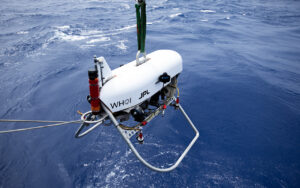
Engineering and ship teams tested a small autonomous underwater vehicle (AUV) known as Deep Venture, designed to complement Alvin operations. (Photo by Daniel Cojanu, ©Woods Hole Oceanographic Institution)
Deep Venture is an autonomous underwater vehicle that allows researchers to collect data about deep sea sites, including high-resolution images, detailed maps and biological and chemical data.
“Going to sea is very expensive and many scientists wait a long time to get out to sea for their research. As a result, it is important that we get as much science completed on a cruise as possible. Using Deep Venture, we can maximize our time out at sea,” Michel said.
Deep Venture can dive at night, she said, which allows scientists and pilots to learn about the site before they dive the next day.
WHOI developed Deep Venture in collaboration with NASA’s Jet Propulsion Laboratory (JPL). The vehicle is engineered to operate down to a depth of 11,000 meters and can execute complex missions without real-time human control.
Deep Venture is equipped with advanced navigation and decision-making systems originally developed for autonomous exploration of remote planets.
NDSF is also currently building a medium-sized remotely operated vehicle (MROV), Michel said. Sea trials are scheduled for later this year, with a science verification cruise scheduled for next year, she said.
“We are looking forward to this new ROV being available for the scientific community,” she added.