In 2025, the National Institutes of Health (NIH) unexpectedly terminated 2,291 active research grants, totaling $2.45 billion. A new study documents how the cancellations varied by gender and career stage, finding that early-career investigators and women were disproportionately affected.
The study found that the cuts were likely most detrimental for early-stage researchers, who have fewer resources and less security. It concluded that graduate students, postdoctoral fellows and assistant professors are among the most vulnerable because they typically focus their energy on a single grant. Similarly, women scholars are heavily concentrated in training and early-career awards, and are unlikely to have multiple grants or hard-money positions.
Academic medical centers accounted for the largest number of terminated grants. The study found that Harvard, the University of California system and the University of Texas system were the most affected, followed by R1 doctoral universities and Association of American Universities (AAU) institutions such as Columbia, Pennsylvania, Michigan and North Carolina.
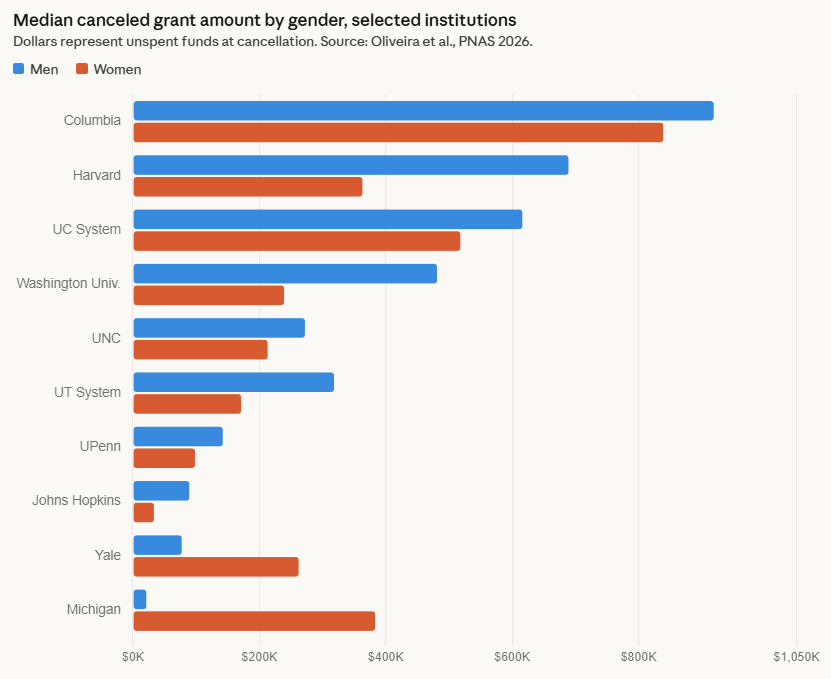
Data from PNAS
The researchers also found that women’s projects were smaller on average, with median awards of $0.94 million compared with $1.4 million for men. Gender differences were more pronounced among early-career investigators. Women also had a larger share of active resources at cancellation, 57.9% versus 48.2% for men, meaning more ongoing research and personnel support were abruptly halted. Among assistant professors, 59.8% of terminated projects were women-led. Women also represented 60.2% of affected doctoral candidates and 48% of postdoctoral fellows.
Institutional patterns reveal gender disparity
Institutional patterns varied by gender, reflecting heterogeneity rather than consistent institutional vulnerability. Overall, women-led projects were smaller in value. Total awarded amounts were $1.12 billion for women versus $2.66 billion for male-led projects among the 10 most affected institutions. Among these institutions, women had canceled funds of approximately $529 million versus $1.49 billion for men. The study concluded that the disparity suggests reduced financial flexibility for female investigators.
At Michigan, 64.3% of terminated grants were women-led, with median canceled awards of $383,000 for women versus $20,000 for men. At Harvard, women represented nearly 40% of affected investigators, with median canceled grants of $362,000 compared with $689,000 for men. At Yale, women accounted for over 42% of cancellations, with median values of $262,000 versus $77,000. At Johns Hopkins, women led half of the canceled projects but lost more than two-thirds of the terminated funding; men lost 24.4% of support compared with 31.6% for women.
Applying the NIH multiplier of $2.56 per $1 invested, the $2.45 billion in canceled awards ($1.70 billion from men and $753 million from women principal investigators) corresponds to approximately $6.29 billion in unrealized economic output. Because women led a larger share of training and early-career grants, the terminations disproportionately disrupted stages of the biomedical pipeline where women are most represented, intensifying risks to research continuity and workforce development. Overall, the 2025 terminations unevenly affected women investigators and key career stages, magnifying long-term consequences for the U.S. biomedical workforce.
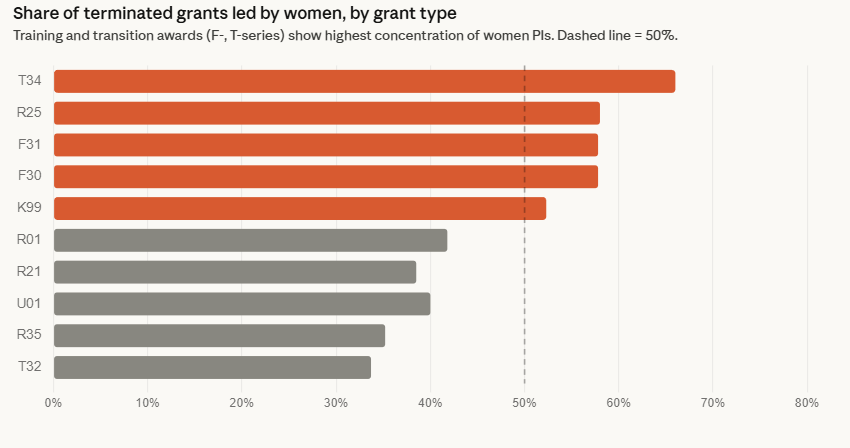
Orange: career stages with majority women. Gray: career stages with minority women. Data from PNAS.
Findings underscore risks to scientific workforce development
Demographic patterns indicate that women and early-career researchers were more likely to hold smaller grants with higher proportions of committed funds at the time support ended. These investigators may have been especially vulnerable to abrupt changes, consistent with prior work showing that women and early-career scientists frequently face structural constraints, hold fewer simultaneous awards and have more limited financial buffers.