Research & Development World

  • R&D World Home
  • Topics
    • Aerospace
    • Automotive
    • Biotech
    • Careers
    • Chemistry
    • Environment
    • Energy
    • Life Science
    • Material Science
    • R&D Management
    • Physics
  • Technology
    • 3D Printing
    • A.I./Robotics
    • Software
    • Battery Technology
    • Controlled Environments
      • Cleanrooms
      • Graphene
      • Lasers
      • Regulations/Standards
      • Sensors
    • Imaging
    • Nanotechnology
    • Scientific Computing
      • Big Data
      • HPC/Supercomputing
      • Informatics
      • Security
    • Semiconductors
  • R&D Market Pulse
  • R&D 100
    • 2026 R&D 100 Award Winners
    • 2026 Professional Award Winners
    • 2026 Special Recognition Winners
    • R&D 100 Awards Event
    • R&D 100 Submissions
    • Winner Archive
  • Resources
    • Research Reports
    • Digital Issues
    • Educational Assets
    • Subscribe
    • Video
    • Webinars
    • PharmSci360
    • Content submission guidelines for R&D World
  • Global Funding Forecast
  • Top Labs
  • Advertise
  • SUBSCRIBE

Crumpling of Hybrid Nanostructures Increases Sensitivity

By R&D Editors | November 5, 2015

Illustration of SERS enhancement from a crumpled graphene-Au nanoparticles hybrid structure. Raman spectrum is enhanced the most when the target molecule is situated at the center of Au nanoparticles in valley of crumpled graphene as depicted in inset. Image: University of IllinoisBy “crumpling” to increase the surface area of graphene-gold nanostructures, researchers from the University of Illinois at Urbana-Champaign have improved the sensitivity of these materials, opening the door to novel opportunities in electronics and optical sensing applications.

“I believe that this work will benefit researchers in the area of surface plasmonics by providing a new strategy/design for enhancing the surface enhanced Raman spectroscopy (SERS) detection limit,” explains SungWoo Nam, an assistant professor of mechanical science and engineering at Illinois. “This mechanical self-assembly strategy will enable a new class of 3D crumpled graphene-gold (Au) nanostructures. The enhanced limit of detection will allow biomedical and environment monitoring of important molecules at high sensitivity by SERS.”

SERS substrates are used to analyze the composition of a mixture at the nanoscale for environmental analysis, pharmaceuticals, material sciences, art and archeological research, forensic science, drug detection, food quality analysis, and single cell detection. Using a combination of gold and silver nanoparticles and Raman-active dyes, SERS substrates also can target specific DNA and RNA sequences.

“This work demonstrates the unique capability of micro-to-nanoscale topographies of the crumpled graphene-Au nanoparticles — higher density, three-dimensional optically active materials — that are further enhanced by the formation of hot spots, bringing the nanoparticles closer,” says Juyoung Leem, a graduate student and first author of the study, “Mechanically Self-Assembled, Three-Dimensional Graphene-Gold Hybrid Nanostructures for Advanced Nanoplasmonic Sensors,” published in Nano Letters. “We achieve a 3D crumpled graphene-Au hybrid structure by the delamination and buckling of graphene on a thermally activated, shrinking polymer substrate. This process enables precise control and optimization of the size and spacing of integrated Au nanoparticles on crumpled graphene for higher SERS enhancement.”

According to Nam, the 3D crumpled graphene-Au nanostructure exhibits at least one order of magnitude higher SERS detection sensitivity than that of conventional, flat graphene-Au nanoparticles. The hybrid structure is further adapted to arbitrary curvilinear structures for advanced, in situ, nonconventional, nanoplasmonic sensing applications.

“One of the key advantages of our platform is its ability to shrink and adapt to complex 3D surfaces, a function that has not been previously demonstrated,” Nam says. An earlier study by Nam’s research group was the first to demonstrate graphene integration onto a variety of different microstructured geometries, including pyramids, pillars, domes, inverted pyramids, and the 3D integration of gold nanoparticle/graphene hybrid structures.

Release Date: November 4, 2015
Source: University of Illinois at Urbana-Champaign 
Related Articles Read More >

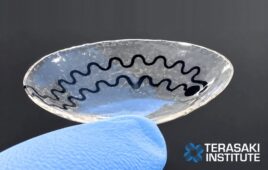
Smart contact lenses move from glucose to stress and mood
Speaker Giving a Talk at Business Meeting. Audience in the conference hall. Business and Entrepreneurship. Panoramic composition suitable for banners.
BioPharma Supply Chain & Logistics Nexus returns to San Diego in November
How Cypris evolved from selling patent reports to agentic R&D intelligence
New video series: Travel for engineers
rd newsletter
EXPAND YOUR KNOWLEDGE AND STAY CONNECTED
Get the latest info on technologies, trends, and strategies in Research & Development.

R&D World Digital Issues

Fall 2025 issue

Browse the most current issue of R&D World and back issues in an easy to use high quality format. Clip, share and download with the leading R&D magazine today.

R&D 100 Awards
Research & Development World
  • Subscribe to R&D World Magazine
  • Sign up for R&D World’s newsletter
  • Contact Us
  • About Us
  • Drug Discovery & Development
  • Pharmaceutical Processing
  • Global Funding Forecast

Copyright © 2026 Arrowfly LLC. All Rights Reserved. The material on this site may not be reproduced, distributed, transmitted, cached or otherwise used, except with the prior written permission of Arrowfly
Privacy Policy | Advertising | About Us

Search R&D World

  • R&D World Home
  • Topics
    • Aerospace
    • Automotive
    • Biotech
    • Careers
    • Chemistry
    • Environment
    • Energy
    • Life Science
    • Material Science
    • R&D Management
    • Physics
  • Technology
    • 3D Printing
    • A.I./Robotics
    • Software
    • Battery Technology
    • Controlled Environments
      • Cleanrooms
      • Graphene
      • Lasers
      • Regulations/Standards
      • Sensors
    • Imaging
    • Nanotechnology
    • Scientific Computing
      • Big Data
      • HPC/Supercomputing
      • Informatics
      • Security
    • Semiconductors
  • R&D Market Pulse
  • R&D 100
    • 2026 R&D 100 Award Winners
    • 2026 Professional Award Winners
    • 2026 Special Recognition Winners
    • R&D 100 Awards Event
    • R&D 100 Submissions
    • Winner Archive
  • Resources
    • Research Reports
    • Digital Issues
    • Educational Assets
    • Subscribe
    • Video
    • Webinars
    • PharmSci360
    • Content submission guidelines for R&D World
  • Global Funding Forecast
  • Top Labs
  • Advertise
  • SUBSCRIBE