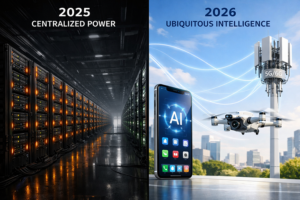
 In 2025, the AI story was about scale: GPUs, massive data centers, record AI capex. In 2026, the story may shift to the connective tissue, networks that make edge-to-cloud systems fast, reliable and secure enough for agentic workflows and real-time decisions.
“As the focus of AI shifts from training to inference, edge computing will be required to address the need for reduced latency and enhanced privacy,” said Dave McCarthy, IDC research vice president for cloud and edge services. McCarthy went on to predict the rise of business models that were “previously not possible with centralized infrastructure” would arise as a result.
If that sounds familiar, it should. Edge computing has been “about to arrive” for years. 5G was supposed to transform everything; mostly it delivered incrementally faster phone connectivity.
And then there’s networking infrastructure stalwarts who saw meteoric growth in the 1990s thanks to the internet. On March 27, 2000, Cisco passed Microsoft to become the most valuable company in the world, with a market cap surpassing $500 billion. It was the essential infrastructure play of the internet era, the NVIDIA of its moment. Then the dot-com bubble burst. The stock fell nearly 90%. It took 25 years to recover: Cisco shares finally topped their 2000 peak just this month.
Today, NVIDIA’s market cap is roughly 14 times Cisco’s. The action moved to cloud, software and now AI. The field has changed almost unthinkably over the past decades. Now Cisco is pitching “AgenticOps” and self-operating networks. Nokia and NVIDIA are announcing billion-dollar partnerships to build “AI-native” wireless. The same companies that have been describing autonomous network visions for years say this time the technology is ready.
So what’s different now?
The short answer: AI workloads exist at scale, and they have latency requirements that physics will not let you solve from a centralized data center. ChatGPT has 800 million weekly users, with hundreds of millions accessing it via mobile. Agentic AI systems, autonomous tools that sense, reason, and act, need response times measured in tens of milliseconds.
The vendor bet: networks that operate themselves
Cisco is leaning into the idea that AI operations will become a first-class mode of running networks, not just a support feature. “In 2026, we will witness a fundamental reimagining of the IT function as organizations enter the era of AgenticOps and intelligent networks,” said Austin Lin, VP of Product Management, Network Platform.
His operational promise is clear: IT teams will “see more, react less,” shifting from reactive troubleshooting to supervising autonomous systems.
In emailed remarks, Lawrence Huang, SVP and GM of Network Platform, puts the business logic in one line: “A competitive advantage now comes from real-time efficiency, integration, and trust, not just raw power.”
Aruna Ravichandran, SVP and CMO for AI, Networking and Collaboration, makes a stronger claim: “By 2026, workplace networking across campus, branch, and Industrial IoT will cross a structural tipping point: the network will stop being an object that IT operates and become a system that operates itself.”
She describes the mechanics as closed-loop automation: “What began as AI-assisted troubleshooting will evolve into AgenticOps, digital workers that autonomously manage the full network lifecycle.” She goes on to describe agents detecting anomalies, correlating root causes, enforcing intent, remediating issues and “continuously optimizing performance in closed-loop fashion.”
In Cisco’s eyes, the network stands to become something closer to research infrastructure: an adaptive system that observes itself, learns from its own telemetry and changes its own behavior.
The Nokia-NVIDIA wager: AI-RAN as the next platform
NVIDIA CEO Jensen Huang argues that AI-RAN will “revolutionize telecommunications, a generational platform shift.” Nokia CEO Justin Hotard frames the same bet as a consumer promise: the partnership, he said, will “accelerate AI-RAN innovation to put an AI data center into everyone’s pocket,” he said in a press release.
The idea is to treat the radio access network as more than a set of deterministic network functions. It becomes an edge platform that can run inference close to users, while also using AI to optimize the network itself. Done well, that could turn mobile networks into the default place to host latency-sensitive workloads: assistants that follow you between locations, AR overlays that need to feel instant, industrial control systems that cannot tolerate round trips to a distant region.
Dell and Ericsson: Edge compute meets network APIs
Across the ecosystem, vendors are converging on a similar thesis. Dell CTO John Roese says, “AI is increasingly living closer to where the data and users are, which is out at the edge, on the device, in the real world.”
Ericsson is leaning on the maturity of 5G and the rise of network APIs as the bridge from connectivity to application platform. “With the maturity of 5G, the emergence of powerful networks APIs, and the rapid evolution of AI, 2026 is shaping up to be a breakthrough year where connectivity becomes a true platform of national and industrial innovation,” the company said in a recent fireside chat.
Governance, power and the slow grind of deployment
Not all think the AI wave has legs. SAS Senior Vice President, Fraud & Security Intelligence Stu Bradley predicts “2026 will mark the start of AI’s market reckoning – when hype collides with governance and only accountable innovation endures. The push for consistent ROI and transparent oversight will shutter vanity projects and reward the disciplined, refocusing investment on the fundamentals: data orchestration, sound modeling and explainable governance. Overhyped technologies will fade, replaced by responsible AI built for measurable impact and with operational rigor.” NYU professor Gary Marcus, a persistent AI skeptic whose 2025 predictions proved largely accurate, offers a blunter assessment: “Despite all the hype, agents didn’t turn out to be reliable,” he wrote this year.
As agentic workflows spread, the failure modes change. The first major incident will sharpen demand for guardrails, audit trails and rollback mechanisms.
But others see 2026 as the year agents finally find their footing. Dell’s Roese predicts that agents will prove most valuable not as autonomous replacements for workers, but as “continuity managers” that keep complex processes on track, with humans and AI coordinating rather than competing. Cisco’s bet on AgenticOps assumes the same: that the real unlock comes when agents handle the routine so humans can supervise the exceptions.
If both camps are right, 2026 may be less about whether agents work and more about where they do. And that question leads back to the network. The infrastructure investments announced this year, NVIDIA’s billion-dollar Nokia partnership, Cisco’s autonomous network push, the industry-wide pivot to edge, are all premised on the idea that intelligence needs to live closer to the action.