Research & Development World

  • R&D World Home
  • Topics
    • Aerospace
    • Automotive
    • Biotech
    • Careers
    • Chemistry
    • Environment
    • Energy
    • Life Science
    • Material Science
    • R&D Management
    • Physics
  • Technology
    • 3D Printing
    • A.I./Robotics
    • Software
    • Battery Technology
    • Controlled Environments
      • Cleanrooms
      • Graphene
      • Lasers
      • Regulations/Standards
      • Sensors
    • Imaging
    • Nanotechnology
    • Scientific Computing
      • Big Data
      • HPC/Supercomputing
      • Informatics
      • Security
    • Semiconductors
  • R&D Market Pulse
  • R&D 100
    • 2025 R&D 100 Award Winners
    • 2025 Professional Award Winners
    • 2025 Special Recognition Winners
    • R&D 100 Awards Event
    • R&D 100 Submissions
    • Winner Archive
  • Resources
    • Research Reports
    • Digital Issues
    • Educational Assets
    • Subscribe
    • Video
    • Webinars
    • Content submission guidelines for R&D World
  • Global Funding Forecast
  • Top Labs
  • Advertise
  • SUBSCRIBE

New Technique Reveals Limb Control in Flies–and Maybe Robots

By Ecole Polytechnique Federale de Lausanne | October 22, 2018

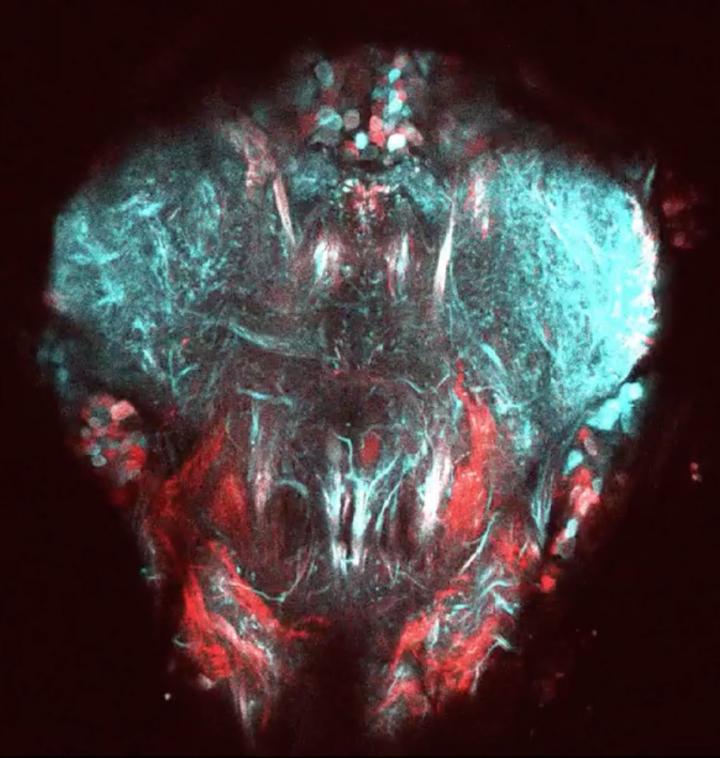
Two-photon image of neural tissue controlling the front legs of the fly. Neurons express fluorescent proteins to visualize neural activity (cyan) and neural anatomy (red). Credit: Pavan Ramdya, EPFL

One of the major goals of biology, medicine, and robotics is to understand how limbs are controlled by circuits of neurons working together. And as if that is not complex enough, a meaningful study of limb activity also has to take place while animals are behaving and moving. The problem is that it is virtually impossible to get a complete view of the activity of motor and premotor circuits that control limbs during behavior, in either vertebrates or invertebrates.

Scientists from the lab of Pavan Ramdya at EPFL’s Brain Mind Institute and Interfaculty Institute of Bioengineering have developed a new method for recording the activity of limb control neural circuits in the popular model organism, the fruit fly Drosophila melanogaster. The method uses an advanced imaging technique called “two-photon microscopy” to observe the firing of fluorescently labeled neurons that become brighter when they are active.

The scientists focused on the fly’s ventral nerve cord, which is a major neural circuit controlling the legs, neck, wings, and two dumbbell-shaped organs that the insect uses to orient itself, called the “halteres”. But most importantly, they were able to image the fly’s ventral nerve cord while the animal was carrying out specific behaviors.

The scientists discovered different patterns of activity across populations of neurons in the cord during movement and behavior. Specifically, the researchers looked at grooming and walking, which allowed them to study neurons involved in the fly’s ability to walk forward, backwards, or to turn while navigating complex environments.

Finally, the team developed a genetic technique that makes it easier to access to the ventral nerve cord. This can help future studies that directly investigate circuits associated with complex limb movements.

“I am very excited about our new recording approach,” says Professor Pavan Ramdya. “Combined with the powerful genetic tools available for studying the fly, I believe we can rapidly make an impact on understanding how we move our limbs and how we might build robots that move around the world just as effectively as animals.”

Related Articles Read More >

Noetik’s TARIO-2: A ‘world model’ that reads a tumor from a single slide
Six months in, Lilly says its supercomputer is starting to change the work with ‘near-infinite’ AI tokens
Boltz built its drug-discovery API ‘for agents as much as for people’
NVIDIA Announces BioNeMo Agent Toolkit with traction from nearly 50 partners, including Lilly, Thermo Fisher and Dassault
rd newsletter
EXPAND YOUR KNOWLEDGE AND STAY CONNECTED
Get the latest info on technologies, trends, and strategies in Research & Development.

R&D World Digital Issues

Fall 2025 issue

Browse the most current issue of R&D World and back issues in an easy to use high quality format. Clip, share and download with the leading R&D magazine today.

R&D 100 Awards
Research & Development World
  • Subscribe to R&D World Magazine
  • Sign up for R&D World’s newsletter
  • Contact Us
  • About Us
  • Drug Discovery & Development
  • Pharmaceutical Processing
  • Global Funding Forecast

Copyright © 2026 WTWH Media LLC. All Rights Reserved. The material on this site may not be reproduced, distributed, transmitted, cached or otherwise used, except with the prior written permission of WTWH Media
Privacy Policy | Advertising | About Us

Search R&D World

  • R&D World Home
  • Topics
    • Aerospace
    • Automotive
    • Biotech
    • Careers
    • Chemistry
    • Environment
    • Energy
    • Life Science
    • Material Science
    • R&D Management
    • Physics
  • Technology
    • 3D Printing
    • A.I./Robotics
    • Software
    • Battery Technology
    • Controlled Environments
      • Cleanrooms
      • Graphene
      • Lasers
      • Regulations/Standards
      • Sensors
    • Imaging
    • Nanotechnology
    • Scientific Computing
      • Big Data
      • HPC/Supercomputing
      • Informatics
      • Security
    • Semiconductors
  • R&D Market Pulse
  • R&D 100
    • 2025 R&D 100 Award Winners
    • 2025 Professional Award Winners
    • 2025 Special Recognition Winners
    • R&D 100 Awards Event
    • R&D 100 Submissions
    • Winner Archive
  • Resources
    • Research Reports
    • Digital Issues
    • Educational Assets
    • Subscribe
    • Video
    • Webinars
    • Content submission guidelines for R&D World
  • Global Funding Forecast
  • Top Labs
  • Advertise
  • SUBSCRIBE