Research & Development World

  • R&D World Home
  • Topics
    • Aerospace
    • Automotive
    • Biotech
    • Careers
    • Chemistry
    • Environment
    • Energy
    • Life Science
    • Material Science
    • R&D Management
    • Physics
  • Technology
    • 3D Printing
    • A.I./Robotics
    • Software
    • Battery Technology
    • Controlled Environments
      • Cleanrooms
      • Graphene
      • Lasers
      • Regulations/Standards
      • Sensors
    • Imaging
    • Nanotechnology
    • Scientific Computing
      • Big Data
      • HPC/Supercomputing
      • Informatics
      • Security
    • Semiconductors
  • R&D Market Pulse
  • R&D 100
    • 2026 R&D 100 Award Winners
    • 2026 Professional Award Winners
    • 2026 Special Recognition Winners
    • R&D 100 Awards Event
    • R&D 100 Submissions
    • Winner Archive
  • Resources
    • Research Reports
    • Digital Issues
    • Educational Assets
    • Subscribe
    • Video
    • Webinars
    • PharmSci360
    • Content submission guidelines for R&D World
  • Global Funding Forecast
  • Top Labs
  • Advertisers
    • Advertise
    • PR Submissions
    • Eblast Submissions
  • SUBSCRIBE

Electrochemical Sensor for Fast Detection of Phenol in Wastewater

By World Scientific | December 11, 2018

In a paper published in NANO, researchers from the Harbin Institute of Technology have discovered a low cost and non-enzymatic phenol sensor that exhibits high sensitivity, good selectivity, reproducibility, and stability which has potential application in phenol detection in discharged wastewater.

Phenol as one of the recalcitrant organic contaminants is universal in wastewater. From the perspective of controlling environmental pollutants it is meaningful and desirable for us to monitor and control phenol pollutant.

Electrochemical sensor for phenol detection as an alternative technique has potential application due to its unique superiority such as portability, low-cost, convenience for handling, real-time monitoring, low maintenance and fast response. The electrode material in electrochemical sensor played a dominant role in enhancing phenol-sensing performance by increasing electron-oxidation current of phenol.

Consequently, it is crucial to screen out appropriate electrode material with high sensitivity, good selectivity, and stability for electrochemical detection of phenol. The transitional metal Ni has wide application in electrocatalyzing organic substances due to excellent catalytic activity and abundant reserves. However, Ni nanoparticle is inclined to aggregation due to its large specific surface energy, leading to decrease in active sites and catalytic activity loss.

Multi-walled carbon nanotube (MWCNT) with unique 1D structure, outstanding electrical and mechanical properties can be used as scaffold to anchor Ni nanoparticle for preventing Ni nanoparticle from aggregation, but also enhancing electron transfer rate, thus improving phenol sensing performance. This Ni/MWCNT-based electrochemical sensor has potential application in phenol detection in discharged wastewater.

The Harbin Institute of Technology team is now exploiting innovative strategies to further improve phenol-sensing performance such as enhancing sensitivity, lowering detection limit, and widening detection range while decreasing cost in the meantime.

Related Articles Read More >

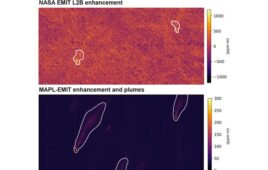
Two methane maps of the same EMIT scene: NASA's standard L2B enhancement, grainy with two small outlined plumes, above MAPL-EMIT output showing elongated plumes against a clean dark background.
Google AI finds more methane plumes in NASA satellite data
A data center campus with exhaust stacks beside a canal
1 in 4 data centers sits in a water-stressed area. Few states track how much water they use
Research vessel Nautilus is mapping the bottom of the Mariana Trench with new multibeam sonar 
Inside the Lab: NETL’s Oil and Gas Center of Excellence focuses on technologies to enhance production   
rd newsletter
EXPAND YOUR KNOWLEDGE AND STAY CONNECTED
Get the latest info on technologies, trends, and strategies in Research & Development.

R&D World Digital Issues

Fall 2026 issue

Browse the most current issue of R&D World and back issues in an easy to use high quality format. Clip, share and download with the leading R&D magazine today.

R&D 100 Awards
Research & Development World
  • Subscribe to R&D World Magazine
  • Sign up for R&D World’s newsletter
  • Contact Us
  • About Us
  • Drug Discovery & Development
  • Pharmaceutical Processing
  • Global Funding Forecast

Copyright © 2026 Arrowfly LLC. All Rights Reserved. The material on this site may not be reproduced, distributed, transmitted, cached or otherwise used, except with the prior written permission of Arrowfly
Privacy Policy | Advertising | About Us

Search R&D World

  • R&D World Home
  • Topics
    • Aerospace
    • Automotive
    • Biotech
    • Careers
    • Chemistry
    • Environment
    • Energy
    • Life Science
    • Material Science
    • R&D Management
    • Physics
  • Technology
    • 3D Printing
    • A.I./Robotics
    • Software
    • Battery Technology
    • Controlled Environments
      • Cleanrooms
      • Graphene
      • Lasers
      • Regulations/Standards
      • Sensors
    • Imaging
    • Nanotechnology
    • Scientific Computing
      • Big Data
      • HPC/Supercomputing
      • Informatics
      • Security
    • Semiconductors
  • R&D Market Pulse
  • R&D 100
    • 2026 R&D 100 Award Winners
    • 2026 Professional Award Winners
    • 2026 Special Recognition Winners
    • R&D 100 Awards Event
    • R&D 100 Submissions
    • Winner Archive
  • Resources
    • Research Reports
    • Digital Issues
    • Educational Assets
    • Subscribe
    • Video
    • Webinars
    • PharmSci360
    • Content submission guidelines for R&D World
  • Global Funding Forecast
  • Top Labs
  • Advertisers
    • Advertise
    • PR Submissions
    • Eblast Submissions
  • SUBSCRIBE