Research & Development World

  • R&D World Home
  • Topics
    • Aerospace
    • Automotive
    • Biotech
    • Careers
    • Chemistry
    • Environment
    • Energy
    • Life Science
    • Material Science
    • R&D Management
    • Physics
  • Technology
    • 3D Printing
    • A.I./Robotics
    • Software
    • Battery Technology
    • Controlled Environments
      • Cleanrooms
      • Graphene
      • Lasers
      • Regulations/Standards
      • Sensors
    • Imaging
    • Nanotechnology
    • Scientific Computing
      • Big Data
      • HPC/Supercomputing
      • Informatics
      • Security
    • Semiconductors
  • R&D Market Pulse
  • R&D 100
    • 2025 R&D 100 Award Winners
    • 2025 Professional Award Winners
    • 2025 Special Recognition Winners
    • R&D 100 Awards Event
    • R&D 100 Submissions
    • Winner Archive
  • Resources
    • Research Reports
    • Digital Issues
    • Educational Assets
    • Subscribe
    • Video
    • Webinars
    • PharmSci360
    • Content submission guidelines for R&D World
  • Global Funding Forecast
  • Top Labs
  • Advertise
  • SUBSCRIBE

Scientists Develop a Tunable Bio-Imaging Device Using Terahertz Plasmonics

By Tokyo Institute of Technology | March 5, 2019

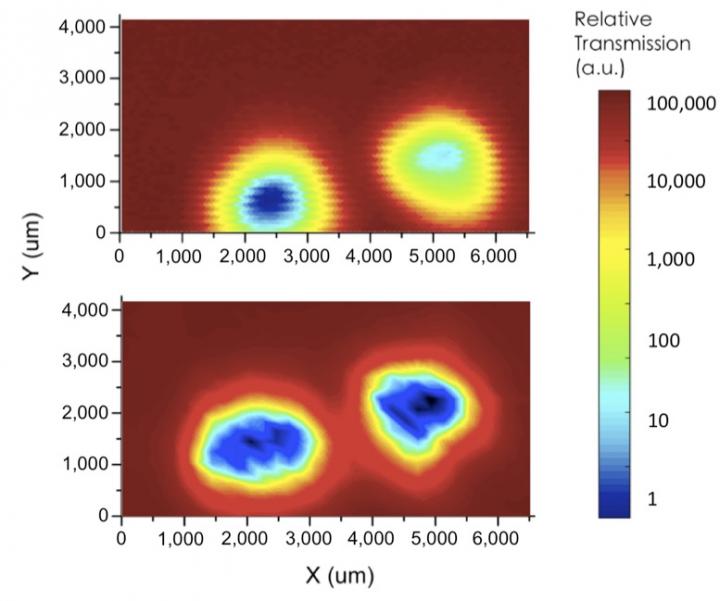
Terahertz mapping of the mouse-tail samples using a conventional setup (upper image) and the SBE (lower image). The hair (yellow and red), skin (light blue), and bone (dark blue) were clearly distinguishable using the SBE. Credit: Scientific Reports

Researchers at Tokyo Institute of Technology (Tokyo Tech) have developed an easy-to-use, tunable biosensor tailored for the terahertz range. Images of mouse organs obtained using their new device verify that the sensor is capable of distinguishing between different tissues. The achievement expands possibilities for terahertz applications in biological analysis and future diagnostics.

Plasmonics are highly sought-after technologies for device applications in security, sensing and medical care. They involve harnessing the excitation of free electrons in metals that are called surface plasmons. One of the most promising applications of plasmonic materials is the development of ultra-sensitive biosensors.

The ability to combine plasmonics with emerging terahertz (THz) technologies for detecting tiny, biological samples has so far proven challenging, mainly because THz light waves have longer wavelengths than visible, infrared and ultraviolet light.

Now, Yukio Kawano and colleagues at Tokyo Tech’s Laboratory for Future Interdisciplinary Research of Science and Technology working in collaboration with researchers at Tokyo Medical and Dental University have found a way to overcome this barrier by designing a frequency-tunable plasmonic-based THz device.

One of the key features of the new device is its spiral bull’s eye (SBE) design (see Figure 1). Due to its smoothly varied grooves, “the groove period continuously changes with the diameter direction, resulting in continuously frequency-tunable characteristics,” Kawano says in their study published in Scientific Reports.

Another advantage of the new design is that it incorporates a so-called Siemens-star aperture, which enables a user-friendly way of selecting the desired frequency by simply changing the rotation of the spiral plasmonic structure.

“The device also increases the electric field intensity at the subwavelength aperture, thus significantly amplifying the transmission,” Kawano says.

In preliminary experiments to assess how well the new device could visualize biological tissues, the researchers obtained THz transmission spectra for various mouse organs, as shown in Figure 2. To probe further, they also conducted THz mapping of mouse tails. By comparing images obtained with and without the SBE design, the study showed that the former led to a markedly improved ability to distinguish between different tissues such as hair, skin and bone (see Figure 3).
Related Articles Read More >

July 2026 issue of Medical Design & Outsourcing: Robotic stroke telesurgery’s time is now
Perseverance uncovers buried evidence of Mars’ ancient water history using ground-penetrating radar
University of Michigan researchers identify higher-order protein rings that regulate programmed cell death
JWST spots a 6-mile moon hiding in Uranus’ rings
rd newsletter
EXPAND YOUR KNOWLEDGE AND STAY CONNECTED
Get the latest info on technologies, trends, and strategies in Research & Development.

R&D World Digital Issues

Fall 2025 issue

Browse the most current issue of R&D World and back issues in an easy to use high quality format. Clip, share and download with the leading R&D magazine today.

R&D 100 Awards
Research & Development World
  • Subscribe to R&D World Magazine
  • Sign up for R&D World’s newsletter
  • Contact Us
  • About Us
  • Drug Discovery & Development
  • Pharmaceutical Processing
  • Global Funding Forecast

Copyright © 2026 Arrowfly LLC. All Rights Reserved. The material on this site may not be reproduced, distributed, transmitted, cached or otherwise used, except with the prior written permission of Arrowfly
Privacy Policy | Advertising | About Us

Search R&D World

  • R&D World Home
  • Topics
    • Aerospace
    • Automotive
    • Biotech
    • Careers
    • Chemistry
    • Environment
    • Energy
    • Life Science
    • Material Science
    • R&D Management
    • Physics
  • Technology
    • 3D Printing
    • A.I./Robotics
    • Software
    • Battery Technology
    • Controlled Environments
      • Cleanrooms
      • Graphene
      • Lasers
      • Regulations/Standards
      • Sensors
    • Imaging
    • Nanotechnology
    • Scientific Computing
      • Big Data
      • HPC/Supercomputing
      • Informatics
      • Security
    • Semiconductors
  • R&D Market Pulse
  • R&D 100
    • 2025 R&D 100 Award Winners
    • 2025 Professional Award Winners
    • 2025 Special Recognition Winners
    • R&D 100 Awards Event
    • R&D 100 Submissions
    • Winner Archive
  • Resources
    • Research Reports
    • Digital Issues
    • Educational Assets
    • Subscribe
    • Video
    • Webinars
    • PharmSci360
    • Content submission guidelines for R&D World
  • Global Funding Forecast
  • Top Labs
  • Advertise
  • SUBSCRIBE