Research & Development World

  • R&D World Home
  • Topics
    • Aerospace
    • Automotive
    • Biotech
    • Careers
    • Chemistry
    • Environment
    • Energy
    • Life Science
    • Material Science
    • R&D Management
    • Physics
  • Technology
    • 3D Printing
    • A.I./Robotics
    • Software
    • Battery Technology
    • Controlled Environments
      • Cleanrooms
      • Graphene
      • Lasers
      • Regulations/Standards
      • Sensors
    • Imaging
    • Nanotechnology
    • Scientific Computing
      • Big Data
      • HPC/Supercomputing
      • Informatics
      • Security
    • Semiconductors
  • R&D Market Pulse
  • R&D 100
    • 2025 R&D 100 Award Winners
    • 2025 Professional Award Winners
    • 2025 Special Recognition Winners
    • R&D 100 Awards Event
    • R&D 100 Submissions
    • Winner Archive
  • Resources
    • Research Reports
    • Digital Issues
    • Educational Assets
    • Subscribe
    • Video
    • Webinars
    • Content submission guidelines for R&D World
  • Global Funding Forecast
  • Top Labs
  • Advertise
  • SUBSCRIBE

Perseverance uncovers buried evidence of Mars’ ancient water history using ground-penetrating radar

By Julia Rock-Torcivia | March 25, 2026

NASA’s Perseverance rover’s ground-penetrating radar detected a magnesium-carbonate formation, evidence of an ancient river delta on Mars. Carbonates record past interactions between water and carbon dioxide in Mars’ atmosphere. The results of the radar observations were published in Science Advances. 
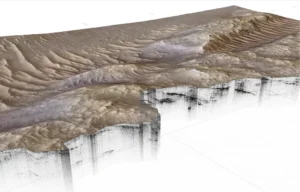
A cross-section into the Margin unit within Jezero crater, more than 35 meters below ground. RIMFAX has revealed an earlier subsurface deltaic environment under the present-day delta, thereby extending the period of potential habitability back further in time. Credit: NASA/JPL/UCLA/UiO/ETH Zurich

Researchers said the rover revealed geological features up to 115 feet (35 meters) underground while traversing 3.8 miles (6.1 km) of terrain inside the Jezero Crater, an area in Mars’ northern hemisphere, believed to have been flooded with water and home to an ancient lake basin. The Margin unit soundings reached depths about 1.75 times deeper than any other geological unit previously explored in the Jezero crater. 

Sediments hint at a habitable ancient environment

Perseverance identified layered sediments and eroded surfaces indicative of a delta environment, a large-scale fan-shaped deposit of sediment formed at the location where a river enters a larger body of water. The carbonate sediments can preserve biosignatures, indicating that the crater hosted a potentially habitable environment. The researchers estimated that the now-buried delta dates to about 3.7 to 4.2 billion years ago. Mars, like Earth, formed about 4.5 billion years ago, meaning the delta existed relatively early in its history. 

The rover’s RIMFAX instrument sends radar pulses downward and records pulses bouncing back off underground features, creating a three-dimensional map of the subsurface. The new findings were based on RIMFAX’s deepest data collected to date, obtained over a span of 250 Martian days from September 2023 to February 2024. 

Inside the RIMFAX instrument

The pulses from the RIMFAX radar travel down through rock and sediment until they hit a boundary between two different materials, at which point some of the energy bounces back up to the instrument. The scientists then measure the depth of the boundary by the time it takes for the pulse to return. 

The pulses bounce back when they hit a change in material density or composition. For example, where loose sediment meets harder rock or where one type of rock layer meets another. The strength of the return signal tells the scientists about how different the two materials are. 

Perseverance takes a reading every 10 centimeters as it drives, stitching together thousands of individual soundings into a continuous cross-sectional image. The carbonate and olivine material in the Margin unit is unusually transparent to radar, meaning the signal loses very little energy passing through it. This allowed the radar to penetrate to 35 meters, roughly 1.75 times deeper than anywhere else in the crater previously explored. 

When the return signals show up as tilted, repeating layers dipping towards the crater basin, this is consistent with how sediment accumulates in a delta. Material is carried by the river and deposited as it enters a larger body of standing water. 

The buried delta predates the fan-shaped Western Delta visible on the surface of the crater today, suggesting that water was present earlier than previously known. 
Related Articles Read More >

The space junk problem threatening future missions
Study reveals fungal strains can survive sterilization procedures and Martian conditions
Researchers use ML to improve the resolution of the Webb telescope
How NASA designed the X-59 to eliminate the sonic boom
rd newsletter
EXPAND YOUR KNOWLEDGE AND STAY CONNECTED
Get the latest info on technologies, trends, and strategies in Research & Development.

R&D World Digital Issues

Fall 2025 issue

Browse the most current issue of R&D World and back issues in an easy to use high quality format. Clip, share and download with the leading R&D magazine today.

R&D 100 Awards
Research & Development World
  • Subscribe to R&D World Magazine
  • Sign up for R&D World’s newsletter
  • Contact Us
  • About Us
  • Drug Discovery & Development
  • Pharmaceutical Processing
  • Global Funding Forecast

Copyright © 2026 WTWH Media LLC. All Rights Reserved. The material on this site may not be reproduced, distributed, transmitted, cached or otherwise used, except with the prior written permission of WTWH Media
Privacy Policy | Advertising | About Us

Search R&D World

  • R&D World Home
  • Topics
    • Aerospace
    • Automotive
    • Biotech
    • Careers
    • Chemistry
    • Environment
    • Energy
    • Life Science
    • Material Science
    • R&D Management
    • Physics
  • Technology
    • 3D Printing
    • A.I./Robotics
    • Software
    • Battery Technology
    • Controlled Environments
      • Cleanrooms
      • Graphene
      • Lasers
      • Regulations/Standards
      • Sensors
    • Imaging
    • Nanotechnology
    • Scientific Computing
      • Big Data
      • HPC/Supercomputing
      • Informatics
      • Security
    • Semiconductors
  • R&D Market Pulse
  • R&D 100
    • 2025 R&D 100 Award Winners
    • 2025 Professional Award Winners
    • 2025 Special Recognition Winners
    • R&D 100 Awards Event
    • R&D 100 Submissions
    • Winner Archive
  • Resources
    • Research Reports
    • Digital Issues
    • Educational Assets
    • Subscribe
    • Video
    • Webinars
    • Content submission guidelines for R&D World
  • Global Funding Forecast
  • Top Labs
  • Advertise
  • SUBSCRIBE