Research & Development World

  • R&D World Home
  • Topics
    • Aerospace
    • Automotive
    • Biotech
    • Careers
    • Chemistry
    • Environment
    • Energy
    • Life Science
    • Material Science
    • R&D Management
    • Physics
  • Technology
    • 3D Printing
    • A.I./Robotics
    • Software
    • Battery Technology
    • Controlled Environments
      • Cleanrooms
      • Graphene
      • Lasers
      • Regulations/Standards
      • Sensors
    • Imaging
    • Nanotechnology
    • Scientific Computing
      • Big Data
      • HPC/Supercomputing
      • Informatics
      • Security
    • Semiconductors
  • R&D Market Pulse
  • R&D 100
    • 2025 R&D 100 Award Winners
    • 2025 Professional Award Winners
    • 2025 Special Recognition Winners
    • R&D 100 Awards Event
    • R&D 100 Submissions
    • Winner Archive
  • Resources
    • Research Reports
    • Digital Issues
    • Educational Assets
    • Subscribe
    • Video
    • Webinars
    • PharmSci360
    • Content submission guidelines for R&D World
  • Global Funding Forecast
  • Top Labs
  • Advertise
  • SUBSCRIBE

Study reveals fungal strains can survive sterilization procedures and Martian conditions

By Julia Rock-Torcivia | May 8, 2026

A paper published in Applied and Environmental Microbiology identified 23 fungal strains isolated from NASA spacecraft assembly cleanrooms capable of surviving ultraviolet radiation exposure. 
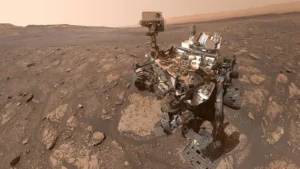
NASA’s Curiosity Mars rover. Credit:
NASA/JPL-Caltech/MSSS

Using experimental simulation facilities, the researchers conducted a comprehensive assessment of microbial survivability and morphology on the most resilient spacecraft-associated microorganisms. 

Simulating Mars and sterilization protocols

The researchers used a Mars Simulation Chamber, a gas-tight chamber replication Martian UV-visible radiation, atmospheric composition (95.8% CO₂, 2.1% Ar, 1.9% N₂ and 0.2% O₂) and pressure (6 mbar) to test the fungal strains. They also exposed the strain to temperatures of 125 and 150 degrees Celsius to test the efficacy of common spacecraft sterilization protocols. 

The scientists also exposed the fungal strains to Californium-252 to provide a chronic low-dose neutron field of 2.16 mGy per day, mimicking the galactic cosmic rays encountered during deep-space travel. During initial screening, 23 fungal strains survived 3,000 Jm-2 of UVC exposure. All 23 UVC-resistant strains belonged to filamentous ascomycete fungi. 

One strain, Aspergillus calidoustus, demonstrated remarkable survival under simulated Martian conditions, withstanding up to 1,440 minutes of Martian solar irradiation, Mars atmospheric pressure and composition and the presence of Martian regolith. Lethality only occurred under combined irradiation and cooling to negative 60 degrees Celsius, the mean Mars surface temperature. A. calidoustus survived long-duration neutron radiation exposure and dry-heat microbial reduction technique.

A. calidoustus exhibited high resilience to neutron radiation, with a 35% reduction in viable conidia after one month of exposure and a 57% reduction in viable conidia after six months of exposure. The strain also survived 120 minutes at 125 degrees Celsius with only a 3-log loss, proving more heat-resistant than the standard bacterial bioindicator, Bacillus pumilus. 

The CO2-rich simulated Martian atmosphere actually appeared to have a cryoprotective effect on A. calidoustus during cooling. However, this was negated by the presence of Martian regolith, likely due to increased thermal conductivity. 

Scanning Electron Microscopy (SEM) revealed deep pitting and scarring on the conidium surface following exposure to the Martian atmosphere and irradiation. 

Missions might have already brought fungi to Mars

This was the first study to perform and end-to-end evaluation of eukaryotic microbial survival across conditions that occur during preparation for, travel to and robotic exploration of Mars. The capacity for fungal conidia to survive multiple space-relevant conditions suggests their potential as forward contaminants, capable of being transported to and persisting on Mars. The results also raise the possibility that previous missions may have already brought microbes from Earth to Mars. 

The research also has potential implications for biocontamination within the food, pharmaceutical and medical sectors. 
Related Articles Read More >

How a plant virus could keep astronauts medicated on a trip to Mars
The science behind the Prada-designed spacesuit for Artemis 
NASA is confident Blue Origin will be ready for Artemis III despite explosion
Blue Origin explosion leaves Artemis experiments in limbo
rd newsletter
EXPAND YOUR KNOWLEDGE AND STAY CONNECTED
Get the latest info on technologies, trends, and strategies in Research & Development.

R&D World Digital Issues

Fall 2025 issue

Browse the most current issue of R&D World and back issues in an easy to use high quality format. Clip, share and download with the leading R&D magazine today.

R&D 100 Awards
Research & Development World
  • Subscribe to R&D World Magazine
  • Sign up for R&D World’s newsletter
  • Contact Us
  • About Us
  • Drug Discovery & Development
  • Pharmaceutical Processing
  • Global Funding Forecast

Copyright © 2026 WTWH Media LLC. All Rights Reserved. The material on this site may not be reproduced, distributed, transmitted, cached or otherwise used, except with the prior written permission of WTWH Media
Privacy Policy | Advertising | About Us

Search R&D World

  • R&D World Home
  • Topics
    • Aerospace
    • Automotive
    • Biotech
    • Careers
    • Chemistry
    • Environment
    • Energy
    • Life Science
    • Material Science
    • R&D Management
    • Physics
  • Technology
    • 3D Printing
    • A.I./Robotics
    • Software
    • Battery Technology
    • Controlled Environments
      • Cleanrooms
      • Graphene
      • Lasers
      • Regulations/Standards
      • Sensors
    • Imaging
    • Nanotechnology
    • Scientific Computing
      • Big Data
      • HPC/Supercomputing
      • Informatics
      • Security
    • Semiconductors
  • R&D Market Pulse
  • R&D 100
    • 2025 R&D 100 Award Winners
    • 2025 Professional Award Winners
    • 2025 Special Recognition Winners
    • R&D 100 Awards Event
    • R&D 100 Submissions
    • Winner Archive
  • Resources
    • Research Reports
    • Digital Issues
    • Educational Assets
    • Subscribe
    • Video
    • Webinars
    • PharmSci360
    • Content submission guidelines for R&D World
  • Global Funding Forecast
  • Top Labs
  • Advertise
  • SUBSCRIBE