NASA today announced the four members of the Artemis III crew and gave updates on the mission, including how a recent explosion during a Blue Origin test is affecting the timeline.
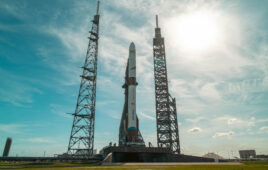
Blue Origin’s New Glenn Rocket. Credit: Blue Origin
The Blue Origin New Glenn rocket exploded during a hotfire test at Cape Canaveral Space Force Station on May 28. The incident destroyed the rocket and damaged the launch infrastructure.
John Couluris, senior vice president of Lunar Permanence at Blue Origin, reported that the company is making “excellent progress” on its investigation and cleanup efforts. It expects to have the vehicle for Artemis III completed and ready for launch in 2027, aligning with the date set when the mission was restructured from a lunar landing to a Low Earth Orbit (LEO) validation flight.
As Blue Origin rebuilds Launch Complex 36A, it is also constructing Launch Complex 36B and maintaining the pace of production for landers and Artemis vehicles, Couluris said.
Couluris also said the company plans to launch the Mark 1 lander later this year in a mission that will demonstrate components of Blue Origin’s Artemis landers, including the BE-7 engines.
Jeremy Parsons, the acting assistant deputy associate administrator of the Moon to Mars Program Office at NASA, stated that NASA “remains confident that New Glenn will be ready for Artemis III”.
The Artemis III mission will begin with the launch of the Blue Origin lander, which can loiter in space for up to 90 days, providing flexibility for the launch of the crew aboard the Orion capsule. Once Orion reaches LEO, it will rendezvous and dock with the Blue Origin spacecraft. The vehicles will remain docked for approximately two days, during which the crew will conduct tests and technology demonstrations.
Orion will then rendezvous and dock with the SpaceX Starship, where it will remain for approximately one day. Then Orion will splash down in the Pacific Ocean, ending the mission.
The interdisciplinary, international crew of Artemis III
The mission commander is a two-time astronaut and former International Space Station (ISS) commander, Randy Bresnik. He is a Marine Corps colonel and a test pilot with over 7,000 flight hours.
The pilot for the mission is ESA astronaut and Italian Air Force colonel Luca Parmitano. He was also the first Italian to command the ISS. He is a two-time flier and has been recognized for his composure during a previous spacewalk where his helmet began to fill with water.
Also on the mission will be two mission specialists: Frank Rubio, a record-setting astronaut, Army Black Hawk Helicopter pilot and family medicine physician and Andre Douglas, a test engineer and Coast Guard Reserve Commander who will be making his first space flight.
NASA also announced that Bob Heintz, an Air Force colonel and test pilot, will serve as the backup crew, able to step into any position if necessary.
Bresnik described the mission as a link between the Artemis II test flight and the planned lunar landing of Artemis IV.
“Spaceflight’s hard, and that’s why the most important Artemis mission will always be the next Artemis mission… incrementally determining the flight envelope, expanding it, proving out capabilities and making the operational procedures that we have more and more precise because every single mission we will do after this will be more challenging and more complex,” he said.