A comprehensive analysis of the expected shelf-lives of the entire 2023 ISS formulary found that 54 of 91 medications have a terrestrial shelf-life of 36 months or less, which could be accelerated by space radiation. As NASA aims for Mars missions, which take about 200 days, resupply becomes unrealistic. Now, researchers at the University of California San Diego think they have found a solution in a plant virus.
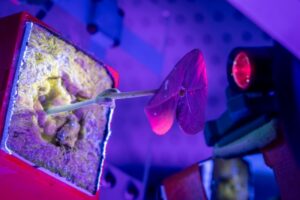
Credit: David Baillot/UC San Diego Jacobs School of Engineering
The scientists developed a method to produce and harvest pharmaceuticals from plants for use by astronauts on long space missions. It could also help bring low-cost pharmaceutical production to resource-limited areas on Earth. The scientists published their findings in npj Science of Plants.
“There are two major problems with pharmaceutical supply in space,” said lead author Patrick Opdensteinen. “One is that resupply is very difficult the further away we get from Earth. For example, when we look at Mars, you would look at about 200 days of interplanetary travel, so that’s not easily done. The second problem is that we can not just stock biopharmaceuticals on a spacecraft, because they degrade faster in the space environment compared to the ground.”
This led the team to search for a way to make therapeutics on a spacecraft as they are needed.
A plant virus as a therapeutic platform
The researchers used cowpea mosaic virus (CPMV), which has demonstrated strong anti-tumor effects in mouse models and clinical studies in canine cancer patients.
“What we proposed in this study is the treatment of cancer, but it can do a lot more,” said Opdensteinen. The researchers could repurpose the plant virus as a vaccine candidate against infectious diseases, he added.
The team chose CPMV as a proof of concept for the platform because it is a lead candidate for cancer treatment, but the platform could evolve well beyond that single use.
“In the future, this could be used to make any biologic drug in space ad hoc using the plant,” said senior author Nicole Steinmetz.
Turning plants into bioreactors
Traditionally, researchers cultivate CPMV in a sterile tank. To eliminate the equipment associated with maintaining sterility, the scientists used vacuum infiltration to deliver genetic instructions telling the plants to express CPMV proteins.
“Everything happens in the plant, so every single plant is like a self-contained and self-sufficient mini bioreactor, and that essentially eliminates a lot of equipment that we would need for maintaining sterility,” said Opdensteinen.
Conventionally, the extraction process destroys the plants. “You essentially just throw the whole plant into a blender, and end up with something that looks like a smoothie, and you can imagine purifying the product from that smoothie is pretty challenging and needs a lot of equipment,” said Opdensteinen.
On a spacecraft, there is no space for such equipment. To solve this problem, the researchers created a new method to extract the CPMV from the plant without destroying it, eliminating the need for the equipment that purifies the plant blend. Instead of blending the entire plant, they first submerged the leaves in a buffer solution and applied vacuum to flood the apoplast, then used centrifugation to draw out the liquid containing CPMV particles.
The method proved effective in mouse models. The scientists also partnered with several veterinary clinics and showed efficacy in treating cancer in canines as well.
“We have seen really great success in the clinic, where pets came in with very late-stage disease where no other therapies have worked. When we gave our plant virus drug candidate to the animals, some were cured of the disease. They’re in complete remission years after treatment,” said Steinmetz.
Testing the limits in simulated space conditions
The environment within a spacecraft provides specific challenges to cultivating plant life. The team simulated zero gravity, space radiation and temperature fluctuations to test how the plants grew.
To recreate the effects of space radiation, the scientists used hydrogen peroxide to cause oxidative stress, which is the main effect of space radiation on plants. They also used a random positioning machine and climate control chambers to simulate zero gravity and temperature fluctuations.
“The interesting part we found is that yields did not break down, even when we stressed the plants. They actually increased a little bit,” said Opdensteinen. “That kind of process resilience is exactly what you want on a spacecraft: a system that keeps working even in an emergency, rather than failing precisely when you need it most.”
The process still has a limited yield compared with traditional methods, resulting in about 10% to 20% of the yield from extracting the whole plant. But the team has eliminated all of the complex equipment that traditional extraction requires and their process leaves the plant intact.
The team had an early-stage meeting with the FDA earlier this year. “That was a very successful meeting,” Steinmetz said. “In the near future, we are expecting to get funding for the translational development to get it towards the clinic.”
“Improving yields is our next major goal. We’re exploring genetic engineering to direct more of our product into plant cell compartments that allow elution without breaking the plant,” said Opdensteinen.
Opdensteinen said the platform could realistically be ready by 2030, which aligns with NASA’s stated goal of establishing a permanent human presence on the moon by approximately 2030.