Axiom Space and Prada unveiled the Liquid Cooling and Ventilation Garment (LCVG), the inner layer of the Axiom Extravehicular Mobility Unit (AxEMU), this week. The garment was designed for NASA’s Artemis IV, which is scheduled to land on the moon in 2028.
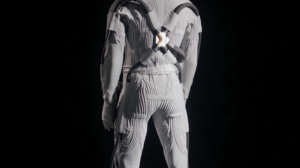
Credit: Axiom Space and Prada
“By bringing together the best in both aerospace engineering as well as luxury craftsmanship and advanced product development, we have developed a garment that neither company could have created independently,” Axiom CEO Jonathan Cirtain said in a press release.
The LCVG functions as an internal “safety suit” worn directly against the astronaut’s body. The primary function of the garment is to maintain a stable internal environment.
Prada and Axium developed the suit using advanced 3D modeling and engineered knitting to ensure consistent cooling and ventilation during spacewalks lasting up to eight hours. Prada used these methods to create a single, continuous, form-fitting garment without bulky seams, allowing for a greater range of motion.
Managing metabolic heat on the Moon
The companies designed the LCVG to manage the metabolic heat astronauts generate during extravehicular activities. A network of tubes will circulate cold water across major muscle groups to absorb body heat and transport it to the suit’s portable life-support system (PLSS), which expels it into space. The garment also features a fully redundant cooling circuit in case the primary loop fails.
Through a separate network of tubes, the suit delivers fresh oxygen to the helmet and routes exhaled CO2 back through the PLSS for filtration before the oxygen is recirculated. The system flushes fresh oxygen across the astronaut’s face, creating a continuous airflow that pushes exhaled carbon dioxide towards the suit’s chemical scrubbers. This prevents CO2 pockets from forming around the mouth and nose.
“Every minute astronauts spend outside their vehicle, the LCVG is working to keep them safe. It manages their thermal environment, supports their breathing and does it all while they’re pushing their bodies to the limit,” Axiom Space Senior Vice President of Spacecraft Development, Russell Ralston, said in a press release.
Custom materials blend for comfort and durability
The outer shell of the suit is a heavy-duty custom-woven blend of Teflon, Nomex and Kevlar. These materials make the suit friction and tear resistant, flame resistant and protective against space debris.
Directly beneath the outer suit is a sequence of highly reflective layers that help deal with the temperature fluctuations. There are multiple ultra-thin layers of Kapton and Mylar, each coated with a microscopic layer of vapor-deposited aluminum to reflect heat. A web-like polyester netting called Dacron prevents the sheets from touching.
Prada combined proprietary synthetic fibers and Spandex to create the LCVG’s seamless, moisture-wicking fabric. Axiom Space used medical-grade polyurethane plastic tubing for the tubing networks.
The suit must withstand the harsh conditions of the lunar South Pole, where temperatures can fluctuate by up to 400 degrees Fahrenheit. The suit’s exterior acts as the primary barrier against the external environment, while the LCVG regulates the temperature within the suit.
Axiom Space and Prada have developed methods to create made-to-measure garments that could potentially move NASA away from discrete sizing to suits tailored for individual astronauts.
Axiom and Prada revealed the suit’s outer layer in 2024 and the full qualification suit will be delivered to NASA by the end of 2026. A prototype will be tested in 2027, possibly on the International Space Station.
Space travel meets luxury fashion
Historically, NASA has designed and owned its own spacesuits. The Extravehicular Mobility Units used on the ISS were designed by the agency, but are based on 40-year-old technology.
For Artemis, NASA pivoted to the xEVAS (Exploration Extravehicular Activity Services) contract, which Axiom Space won with a $228 million task order. Under the contract, Axiom was free to seek out partnerships without government intervention.
Axiom chose Prada for its expertise in in-house engineering and advanced materials, which it used to design the uniforms for the Luna Rossa sailing team. These uniforms use ultra-lightweight carbon fibers, advanced structural composites and aerodynamic, weather-resistant textiles, much of which is also used in designing spacesuits.