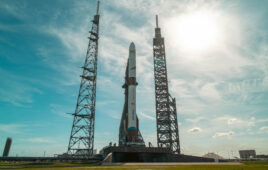
Blue Origin’s uncrewed New Glenn rocket exploded during a hotfire test at Cape Canaveral Space Force Station last week. No casualties were reported, but the incident destroyed the rocket and damaged the launch infrastructure.
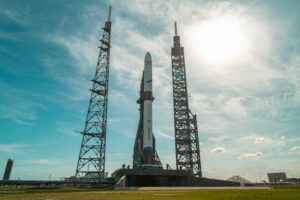
Blue Origin’s New Glenn Rocket. Credit: Blue Origin
The explosion could also threaten the timeline of NASA’s Artemis program, as Blue Origin is one of two primary contractors, alongside SpaceX, for lunar landing services.
At approximately 9 p.m. ET last Thursday, Blue Origin conducted a static hotfire test of the New Glenn rocket at Launch Complex 36. The test was intended to fire the seven BE-4 engines in the booster stage while the vehicle remained secured to the pad.
Seconds after ignition, the vehicle exploded. The blast was felt across Cape Canaveral and Cocoa Beach, and was visible as far north as South Carolina. Blue Origin and local officials confirmed that the launch area had been evacuated before the test and all personnel were accounted for.
“We will work with our partners to support a thorough investigation of this anomaly, assess near-term mission impacts, and get back to launching rockets. We will provide information on any impacts to the Artemis and Moon Base programs as it becomes available,” NASA Administrator Jared Isaacman said in a post on X. NASA intended Artemis III, scheduled for 2027, to test docking procedures of the Orion capsule and landers from SpaceX and Blue Origin.
Unlike competitor SpaceX, Blue Origin currently has no backup facility.
Likely delayed: Moon Base I and the VIPER Rover
The Moon Base I mission, scheduled for launch in fall 2026, had planned to use Blue Origin’s Blue Moon Mark 1 Endurance lander to deliver NASA payloads, including the Stereo Cameras for Lunar Plume-Surface Studies and the Laser Retroreflective Array (LRA). The cameras would capture video and photos of the lunar surface to provide 3D views of how the rocket plume interacted with the lunar surface, while the LRA used reflected laser light from orbiting spacecraft to determine its exact location and distance to Earth.
NASA had also selected Blue Origin to deliver the VIPER Rover to the Moon’s south pole using its Blue Moon MK1 lander. NASA spent $450 million building the rover before the mission was cancelled in July 2024. In September 2025, Blue Origin was selected to revive the mission with a new target of late 2027. The VIPER will search for volatile resources, such as ice, on the lunar surface and collect data to support future exploration. Blue Origin is responsible for the complete landing mission architecture.
Earlier last week, NASA announced that it had awarded Blue Origin $188 million with an option period worth $280.4 million for two task orders to launch two lunar rovers in 2028. The rovers will inform site planning and reduce risks for crewed Artemis missions as they will enable NASA to characterize the terrain, move materials, pre-stage resources and mature systems needed for long-duration lunar exploration.
Timeline uncertainty: Artemis III and IV experiments
As part of the Artemis III LEO demonstration, scheduled for mid-2027, a Blue Moon Mark 2 prototype was scheduled to complete a low Earth orbit demonstration to reduce risk before a crewed Moon landing.
Additionally, three surface science instruments were originally selected for a crewed lunar landing version of Artemis III and are now planned for deployment on Artemis IV. Led by Mehdi Benna from the University of Maryland, Baltimore County, the Lunar Environment Monitoring Station (LEMS) is a compact, autonomous seismometer suite for continuous, long-term monitoring of moonquakes. It will characterize the regional structure of the Moon’s crust and mantle.
The Lunar Effects on Agricultural Flora (LEAF) experiment, also planned to be on board the Artemis IV, will observe plant photosynthesis, growth and systemic stress responses in space radiation and partial gravity. Led by Space Lab Technologies, this experiment could help scientists understand how to grow plants on the moon for human nutrition.
The Lunar Dielectric Analyzer (LDA) was also planned for the Artemis IV mission to measure the regolith’s ability to propagate an electric field, which could be essential in the search for lunar volatiles, including ice. The instrument will gather information about the subsurface structure, monitor dielectric changes caused by the angle of the sun and look for frost formation or ice deposits.
Two more experiments were originally planned for the Artemis IV mission, which plans to use a Blue Moon Mark 2 or Starship vehicle. The South Pole Seismic Station (SPSS) would enable scientists to characterize the lunar interior structure, determine the rate at which the moon is struck by meteorite impacts and monitor the seismic environment in real time. The station was developed by JPL, which received a $25 million award from NASA.
The final experiment planned to be on board the Artemis IV is the DUst and plaSma environmenT survEyoR (DUSTER), which would characterize dust and plasma around the landing site to measure the charge, velocity, size and flux of dust particles from the lunar surface. It will study how the lunar environment responded to human presence and was developed by the University of Colorado Boulder with a $24.8 million grant.
As of publication, NASA has not stated exactly how the explosion will affect the Artemis timeline. As the launch site could take months to repair, the agency may have to depend on SpaceX for its Starship. If SpaceX is also delayed, the missions will likely be pushed back.