Research & Development World

  • R&D World Home
  • Topics
    • Aerospace
    • Automotive
    • Biotech
    • Careers
    • Chemistry
    • Environment
    • Energy
    • Life Science
    • Material Science
    • R&D Management
    • Physics
  • Technology
    • 3D Printing
    • A.I./Robotics
    • Software
    • Battery Technology
    • Controlled Environments
      • Cleanrooms
      • Graphene
      • Lasers
      • Regulations/Standards
      • Sensors
    • Imaging
    • Nanotechnology
    • Scientific Computing
      • Big Data
      • HPC/Supercomputing
      • Informatics
      • Security
    • Semiconductors
  • R&D Market Pulse
  • R&D 100
    • 2025 R&D 100 Award Winners
    • 2025 Professional Award Winners
    • 2025 Special Recognition Winners
    • R&D 100 Awards Event
    • R&D 100 Submissions
    • Winner Archive
  • Resources
    • Research Reports
    • Digital Issues
    • Educational Assets
    • Subscribe
    • Video
    • Webinars
    • PharmSci360
    • Content submission guidelines for R&D World
  • Global Funding Forecast
  • Top Labs
  • Advertise
  • SUBSCRIBE

A Bright ‘Glow Stick’ Marker for Cells

By American Chemical Society | March 8, 2017

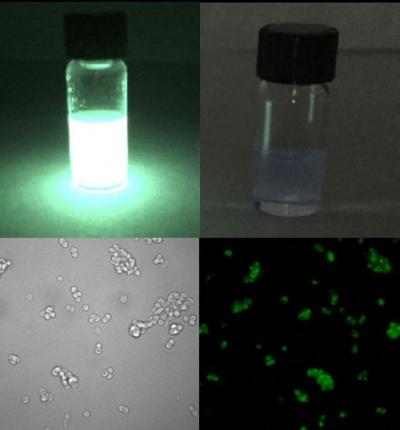
A new chemiluminescent probe (left) is much brighter than luminol (right) currently used in crime scenes; also, this probe can be used directly in cells (below), unlike most chemiluminescent systems today. Source: American Chemical Society

Any child who has played with a glowstick or captured a firefly understands the wonder of chemiluminescence, or chemical light. This process is already used to detect blood at crime scenes and to determine the concentrations of different components of biological samples. This week in ACS Central Science, researchers introduce a new chemiluminescent probe that is better for use in water and up to 3,000 times brighter than previous probes.

Chemiluminescent probes are among the most sensitive diagnostic tools for DNA sequencing, crime scene analysis and immunoassays. Most systems use a cocktail with one emitter molecule that detects the species of interest by giving off weak light, and another two additional ingredients — a fluorophore and a soap-like substance called a surfactant — that amplify the signal to detectable levels. However, energy is lost in the transfer process from one molecule to the other, and surfactants are not biocompatible. Doron Shabat and colleagues proposed that by tweaking the electronic structure of current probes to improve their inherent fluorescence, they could create a new single-component emission system that would work for many applications.

The researchers investigated many variants of the most-common emitter molecule by swapping out elements and testing the resulting changes in emission. Shabat and colleagues found that, in one instance, simply adding two key atoms resulted in a much brighter probe than those currently on the market. In addition, this particular molecule is suitable for direct use in cells. Based on this molecule, the researchers developed sensors to detect several biologically relevant chemicals. They also used the chemiluminescent molecule to measure the activity of several enzymes and to image cells by microscopy — something that had previously required the genetic engineering of the firefly’s enzymatic machinery. They say that scientists will now have in hand a new powerful methodology to prepare highly efficient chemiluminescence sensors for detection and imaging of various cell activities and analytes.

Related Articles Read More >

As AI floods drug discovery with designs, Twist uses DNA chips to tackle the wet-lab bottleneck
Purple Glowing Spiral Fractal Background Image, Illustration - Vortex repeating spiral patterns, Symmetrical repeating geometric patterns. Abstract design, black background
Recursion says its Norstella-backed real-time simulation can expand trial eligibility by up to 40%
NIH employees warn of ‘institutionalized destruction’ one year after Bethesda Declaration
Cradle’s CEO on the AI agent boom and the reality of experimental feedback in life sciences
rd newsletter
EXPAND YOUR KNOWLEDGE AND STAY CONNECTED
Get the latest info on technologies, trends, and strategies in Research & Development.

R&D World Digital Issues

Fall 2025 issue

Browse the most current issue of R&D World and back issues in an easy to use high quality format. Clip, share and download with the leading R&D magazine today.

R&D 100 Awards
Research & Development World
  • Subscribe to R&D World Magazine
  • Sign up for R&D World’s newsletter
  • Contact Us
  • About Us
  • Drug Discovery & Development
  • Pharmaceutical Processing
  • Global Funding Forecast

Copyright © 2026 Arrowfly LLC. All Rights Reserved. The material on this site may not be reproduced, distributed, transmitted, cached or otherwise used, except with the prior written permission of Arrowfly
Privacy Policy | Advertising | About Us

Search R&D World

  • R&D World Home
  • Topics
    • Aerospace
    • Automotive
    • Biotech
    • Careers
    • Chemistry
    • Environment
    • Energy
    • Life Science
    • Material Science
    • R&D Management
    • Physics
  • Technology
    • 3D Printing
    • A.I./Robotics
    • Software
    • Battery Technology
    • Controlled Environments
      • Cleanrooms
      • Graphene
      • Lasers
      • Regulations/Standards
      • Sensors
    • Imaging
    • Nanotechnology
    • Scientific Computing
      • Big Data
      • HPC/Supercomputing
      • Informatics
      • Security
    • Semiconductors
  • R&D Market Pulse
  • R&D 100
    • 2025 R&D 100 Award Winners
    • 2025 Professional Award Winners
    • 2025 Special Recognition Winners
    • R&D 100 Awards Event
    • R&D 100 Submissions
    • Winner Archive
  • Resources
    • Research Reports
    • Digital Issues
    • Educational Assets
    • Subscribe
    • Video
    • Webinars
    • PharmSci360
    • Content submission guidelines for R&D World
  • Global Funding Forecast
  • Top Labs
  • Advertise
  • SUBSCRIBE