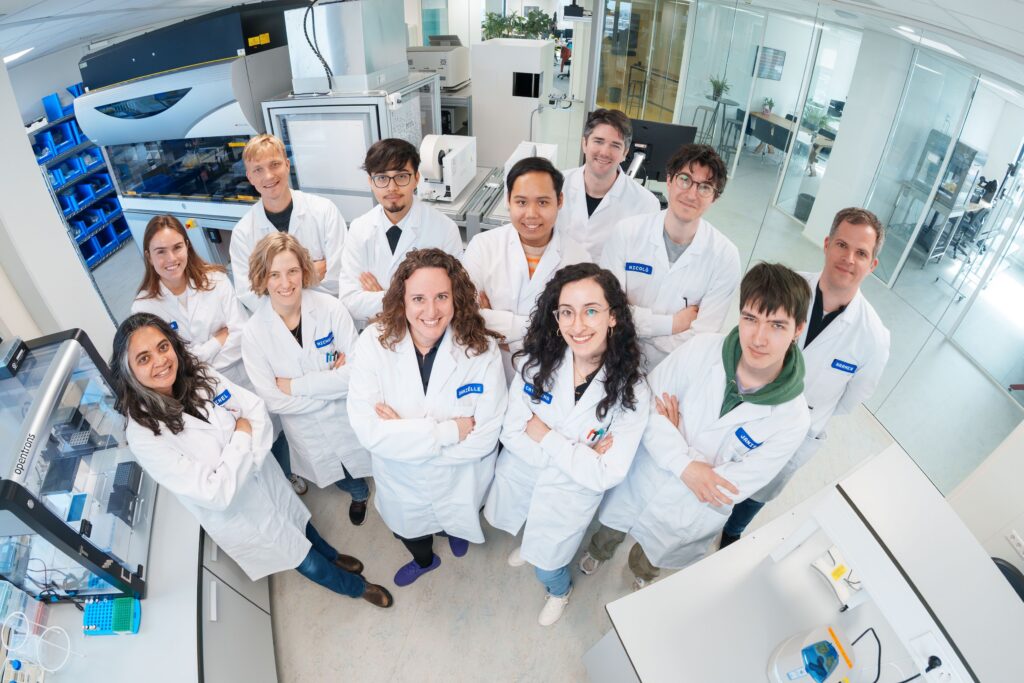
Members of Cradle’s team at the company’s lab in Amsterdam, surrounded by the automated liquid-handling and analytical equipment used to test the company’s AI-designed protein sequences. Image courtesy of Cradle.
Within roughly 18 months, Google DeepMind, Microsoft, Amazon, NVIDIA, OpenAI and Anthropic have all launched or upgraded products aimed at scientific research, many of them built around AI agents that promise to compress the earliest, most expensive stages of discovery.
That push builds on the explosive growth of AI coding tools. Even as many frontier labs and hyperscalers continue to find profitability from AI efforts elusive, coding platforms from Anthropic and OpenAI are seeing rapid adoption and revenue growth. Anthropic reported its company-wide annualized revenue run rate crossed $47 billion in May 2026, up from $14 billion in February, with Claude Code’s run-rate revenue doubling since early 2026 to more than $2.5 billion in May. Meanwhile, OpenAI said Codex surpassed 5 million weekly active users by early June, up more than sixfold since the desktop app launched in February.
The race has also driven consolidation. SpaceXAI, formerly xAI and now the generative AI arm of SpaceX, agreed to acquire Cursor for $60 billion.
Frontier labs are now adapting that coding-agent playbook to life sciences. Wet-lab research, however, operates through a much slower and more expensive feedback loop.
“A lot of people talk about AI-developed drugs and think about it the way they think about AI-developed code,” said Stef van Grieken, CEO and co-founder of Cradle, an AI protein-engineering software company.
Code gives an agent a comparatively tight and legible feedback loop. It can execute a program, run tests, inspect an error and revise its work within minutes. “The code is there and it works or it doesn’t,” van Grieken said. “Getting a drug, or any biomolecule, to market involves a long list of things you have to do to get somewhere.”
The paperwork layer moves first
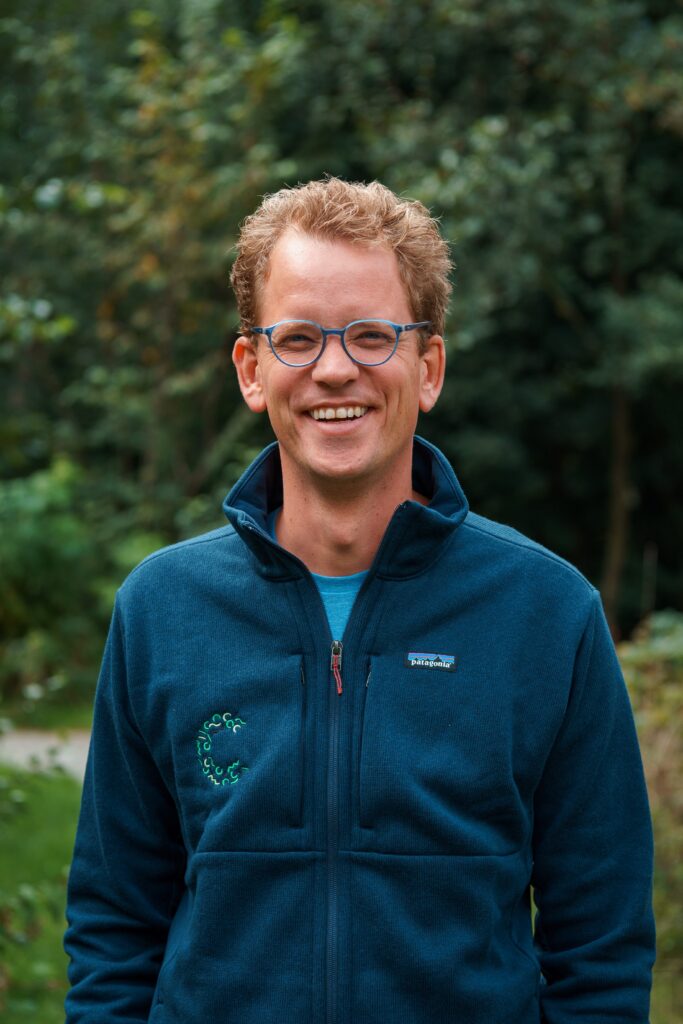
Stef van Grieken
Bringing a drug from discovery to launch remains a decade-plus undertaking, with Deloitte estimating an average cost of $2.67 billion in 2025. So far, the clearest gains have appeared in narrower workflows involving documents, data and operations.
At Novo Nordisk, for instance, clinical study reports that once occupied a team of writers for weeks now draft in minutes. AWS said in 2025 that Novo Nordisk’s work with AWS, MongoDB and Anthropic cut the time required to generate critical documentation by more than 90%.
“When you look at what the frontier labs are doing right now, they’re attending to something they’re very good at: look at lots of documents, literature, and data, and help people build hypotheses around modes of action, look at competitive landscapes, write documents for clinical trials, analyze data in ways that are much easier to do,” van Grieken said. “That’s core, ‘chatbot’ functionality.”
IQVIA, too, has partnered with NVIDIA to develop agentic services to automate tasks, connect market data and accelerate clinical trials and commercialization. Salesforce and Veeva are also pushing agents into the operating layer of biopharma.
A coding harness, pointed at biology
Anthropic and Google DeepMind build their science products on existing foundation models, while OpenAI trained GPT-Rosalind, released in April as a research preview, specifically for biology, drug discovery and translational medicine. Despite those differences, the products share the basic architecture of coding agents such as Claude Code, Codex and Cursor.
A foundation model supplies the reasoning, while a surrounding software harness gives it access to files, databases and external programs, then lets it run those tools and respond to the results. “You can take some of the tooling people have used in bioinformatics and use a harness to run it,” van Grieken said.
Through that harness, an agent could call a biomolecular model such as AlphaFold 3 or ESMFold2 to predict a protein complex, or run a protein-design pipeline such as BoltzProt-1 to generate and rank prospective binders.
The same architecture can orchestrate mechanistic modeling. An agent could run disease models built in MathWorks’ MATLAB-based SimBiology or implemented with ordinary differential equation solvers in Fortran or Python, vary parameters across thousands of runs and surface a smaller set of perturbations for a scientist to examine.
A scientific workbench still needs scientific judgment
Van Grieken described these platforms as scientific copilots that can conduct literature research, search a company’s historical data and coordinate computational tools.
That workbench can connect to databases such as PubMed, Semantic Scholar, arXiv and FDA resources, while running established bioinformatics tools such as bcftools against locally stored whole-genome sequencing files.
Scientists must still verify the citations and determine whether the resulting analysis is scientifically appropriate. “There are many problems in biology where text or images or coding is not going to help you as much,” van Grieken said.
That need for specialized models and experimental judgment grows when the task moves from analyzing existing knowledge to designing new molecules. Van Grieken places molecular engineering in that category, which is the layer Cradle targets. The company’s software models how protein sequences relate to desired properties, then generates and ranks new sequences for lab testing.
Cradle sells software to customers that run the experiments in their own labs and retain the resulting assets. Generate:Biomedicines and Absci combine AI software, wet labs and internal drug pipelines. Generate has pushed an AI-designed anti-TSLP antibody into Phase 3. EvolutionaryScale supplies protein foundation models, while Chai Discovery focuses on de novo antibody design. Boltz and Tamarind Bio provide inference tools for tasks such as structure prediction.
Cradle’s reliance on experimentally measured customer data points to a broader constraint: biology lacks a shared, continuously expanding corpus comparable to GitHub.
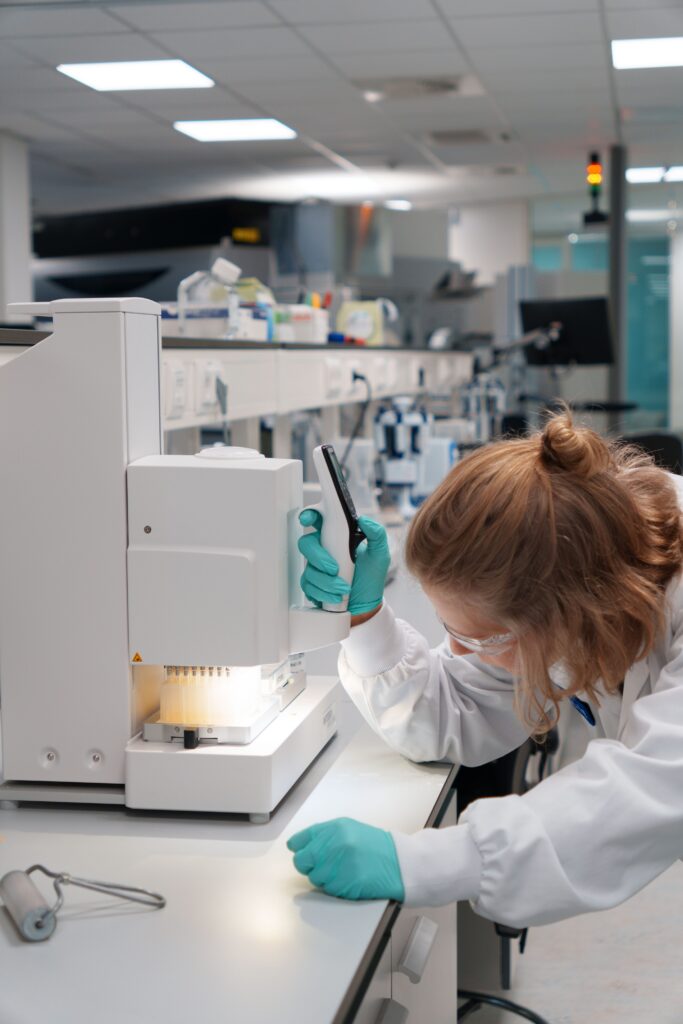
Image courtesy of Cradle
Why there is no GitHub for biology
Apart from the transformer architecture and coding harnesses, one of the core platforms behind the rise of coding agents is GitHub, the Microsoft-owned service where developers commit and update repositories. GitHub functions as a vast, continuously updated record of code and developer activity, giving coding models a corpus to learn from and coding agents a place to write back into. GitHub’s recent decision to use interaction data from many Copilot users for model training shows how coding systems can also capture feedback generated through their own use.
There is no clear GitHub analogue in biology. Consider the scale of proteins alone. The protein database UniProtKB lists sequences in the hundreds of millions, the majority of them computationally annotated and never confirmed by an experiment. Its reviewed subset, Swiss-Prot, held 575,503 entries as of its June 2026 release, and about a fifth of those carry evidence at the protein level. The Protein Data Bank holds roughly 246,000 experimentally determined structures. “Effectively, we have a void when it comes to biology,” van Grieken said.
By contrast, GitHub’s Octoverse report counted more than 180 million developers on the platform as of August 2025, creating upward of 230 new repositories every minute and pushing close to a billion commits over the preceding year.
Coding agents now add to GitHub’s expanding corpus. They also benefit from cheap, machine-verifiable feedback. An agent can write code, run a test suite, inspect the failures and try again, repeating that cycle thousands of times.
Protein engineering runs on a much slower and more expensive feedback loop. Cradle’s process requires scientists to grow cells that express model-designed proteins, purify those proteins and run physical assays to measure properties such as binding, activity, stability and solubility. Each round consumes biological materials, laboratory equipment and time for cells to grow and experiments to run. “When we need to run an experiment, we spend hundreds to tens of thousands of dollars depending on the experiment,” van Grieken said. “Feedback is weeks to months.”
Cradle’s models learn from physically measured experiments, and the sequences its customers need lie outside what that record already contains. Reproducing a protein that evolution has already optimized has little commercial value. The molecules drug developers want are the ones nature had no reason to build. “If we had antibodies that would attack our cancer, that’d be awesome, but we don’t. So we need to make things that are out of domain, but not so far out of domain that they stop working,” van Grieken said.
In software, a faulty output can often be caught by automated tests and corrected with another prompt. In protein engineering, a model may generate a 200-amino-acid candidate sequence, represented as a string of 200 letters. Scientists may learn whether it works only after producing and testing the molecule. “So the stakes of generating 200-character strings that are wrong are very different from ‘oh, silly Claude, you clearly didn’t think about this too long, let me reprompt,'” van Grieken said.