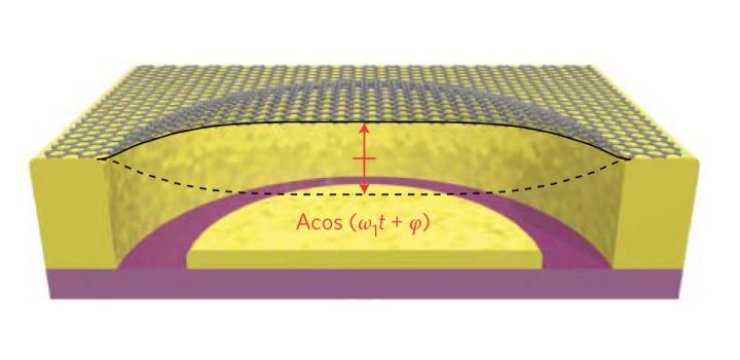
Schematic cross-section of a graphene drum.
Energy dissipation is a key ingredient in understanding many physical phenomena in thermodynamics, photonics, chemical reactions, nuclear fission, photon emissions, or even electronic circuits, among others.
In a vibrating system, the energy dissipation is quantified by the quality factor. If the quality factor of the resonator is high, the mechanical energy will dissipate at a very low rate, and therefore the resonator will be extremely accurate at measuring or sensing objects thus enabling these systems to become very sensitive mass and force sensors, as well as exciting quantum systems. Take, for example, a guitar string and make it vibrate. The vibration created in the string resonates in the body of the guitar. Because the vibrations of the body are strongly coupled to the surrounding air, the energy of the string vibration will dissipate more efficiently into the environment bath, increasing the volume of the sound. The decay is well known to be linear, as it does not depend on the vibrational amplitude.
Now, take the guitar string and shrink it down to nano-meter dimensions to obtain a nano-mechanical resonator. In these nano systems, energy dissipation has been observed to depend on the amplitude of the vibration, described as a non-linear phenomenon, and so far no proposed theory has been proven to correctly describe this dissipation process.
In a recent study, published in Nature Nanotechnology, ICFO researchers Johannes Güttinger, Adrien Noury, Peter Weber, Camille Lagoin, Joel Moser, led by Professor Adrian Bachtold at ICFO, in collaboration with researchers from Chalmers University of Technology and ETH Zurich, have found an explanation of the non-linear dissipation process using a nano-mechanical resonator based on multilayer graphene.
In their work, the team of researchers used a graphene based nano-mechanical resonator, well suited for observing nonlinear effects in energy decay processes, and measured it with a superconducting microwave cavity. Such a system is capable of detecting the mechanical vibrations in a very short period of time as well as being sensitive enough to detect minimum displacements and over a very broad range of vibrational amplitudes.
The team took the system, forced it out-of-equilibrium using a driving force, and subsequently switched the force off to measure the vibrational amplitude as the energy of the system decayed. They carried out over 1000 measurements for every energy decay trace and were able to observe that as the energy of a vibrational mode decays, the rate of decay reaches a point where it changes abruptly to a lower value. The larger energy decay at high amplitude vibrations can be explained by a model where the measured vibration mode “hybridizes” with another mode of the system and they decay in unison. This is equivalent to the coupling of the guitar string to the body although the coupling is nonlinear in the case of the graphene nano resonator. As the vibrational amplitude decreases, the rate suddenly changes and the modes become decoupled, resulting in comparatively low decay rates, thus in very giant quality factors exceeding one million. This abrupt change in the decay has never been predicted or measured until now.
Therefore, the results achieved in this study have shown that nonlinear effects in graphene nano-mechanical resonators reveal a hybridization effect at high energies that, if controlled, could open up new possibilities to manipulate vibrational states, engineer hybrid states with mechanical modes at completely different frequencies, and to study the collective motion of highly tunable systems.
Source: ICFO