Research & Development World

  • R&D World Home
  • Topics
    • Aerospace
    • Automotive
    • Biotech
    • Careers
    • Chemistry
    • Environment
    • Energy
    • Life Science
    • Material Science
    • R&D Management
    • Physics
  • Technology
    • 3D Printing
    • A.I./Robotics
    • Software
    • Battery Technology
    • Controlled Environments
      • Cleanrooms
      • Graphene
      • Lasers
      • Regulations/Standards
      • Sensors
    • Imaging
    • Nanotechnology
    • Scientific Computing
      • Big Data
      • HPC/Supercomputing
      • Informatics
      • Security
    • Semiconductors
  • R&D Market Pulse
  • R&D 100
    • 2026 R&D 100 Award Winners
    • 2026 Professional Award Winners
    • 2026 Special Recognition Winners
    • R&D 100 Awards Event
    • R&D 100 Submissions
    • Winner Archive
  • Resources
    • Research Reports
    • Digital Issues
    • Educational Assets
    • Subscribe
    • Video
    • Webinars
    • PharmSci360
    • Content submission guidelines for R&D World
  • Global Funding Forecast
  • Top Labs
  • Advertise
  • SUBSCRIBE

Smart Tattoo Monitors Health

By Kenny Walter | October 3, 2017

Checking vital health statistics may someday be as simple as shinning a light on a tattoo.

A group of researchers from Harvard Medical School (HMS) and the Massachusetts Institute of Technology (MIT) have developed a smart tattoo ink that changes color to signal changes in various biomarkers, including if an athlete is dehydrated or if a diabetic’s blood sugar rises.

The researchers paired biosensitive inks with traditional tattoo artistry as a way to overcome some of the limitations of biomedical monitoring devices that currently do not seamlessly integrate with the body.

“We were thinking: New technologies, what is the next generation after wearables?” Ali Yetisen, who is a Tosteson postdoctoral fellow at HMS and Massachusetts General Hospital, said in a statement. “And so we came up with the idea that we could incorporate biosensors in the skin.”

The stabilizing ink does not fade or diffuse into surrounding tissue and only changes color according to the chemistry of the body’s interstitial fluid—which can be used as a surrogate for constituents of the blood.

The researchers developed a pair of inks that signify glucose concentration and sodium concentration.

The first ink will change from green to brown as glucose concentration increases, while the second ink grows a more intense green color when viewed under a blue light as sodium concentration rises, an indication of dehydration.

To test the inks, the researchers tattooed segments of pig skin and found the changes in color or intensity in response to different biomarkers.

The next step will be to test the tattoos with other diseases and biomarkers.

The researchers said a long-lasting tattoo could be used to monitor chronic conditions or a temporary design could be used for shorter-duration monitoring.

The ink can also be invisible and only viewable under certain kinds of light that may be available through a smartphone application.     
Related Articles Read More >

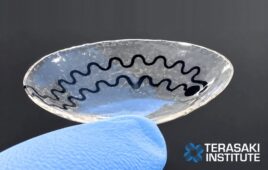
Smart contact lenses move from glucose to stress and mood
Speaker Giving a Talk at Business Meeting. Audience in the conference hall. Business and Entrepreneurship. Panoramic composition suitable for banners.
BioPharma Supply Chain & Logistics Nexus returns to San Diego in November
How Cypris evolved from selling patent reports to agentic R&D intelligence
New video series: Travel for engineers
rd newsletter
EXPAND YOUR KNOWLEDGE AND STAY CONNECTED
Get the latest info on technologies, trends, and strategies in Research & Development.

R&D World Digital Issues

Fall 2026 issue

Browse the most current issue of R&D World and back issues in an easy to use high quality format. Clip, share and download with the leading R&D magazine today.

R&D 100 Awards
Research & Development World
  • Subscribe to R&D World Magazine
  • Sign up for R&D World’s newsletter
  • Contact Us
  • About Us
  • Drug Discovery & Development
  • Pharmaceutical Processing
  • Global Funding Forecast

Copyright © 2026 Arrowfly LLC. All Rights Reserved. The material on this site may not be reproduced, distributed, transmitted, cached or otherwise used, except with the prior written permission of Arrowfly
Privacy Policy | Advertising | About Us

Search R&D World

  • R&D World Home
  • Topics
    • Aerospace
    • Automotive
    • Biotech
    • Careers
    • Chemistry
    • Environment
    • Energy
    • Life Science
    • Material Science
    • R&D Management
    • Physics
  • Technology
    • 3D Printing
    • A.I./Robotics
    • Software
    • Battery Technology
    • Controlled Environments
      • Cleanrooms
      • Graphene
      • Lasers
      • Regulations/Standards
      • Sensors
    • Imaging
    • Nanotechnology
    • Scientific Computing
      • Big Data
      • HPC/Supercomputing
      • Informatics
      • Security
    • Semiconductors
  • R&D Market Pulse
  • R&D 100
    • 2026 R&D 100 Award Winners
    • 2026 Professional Award Winners
    • 2026 Special Recognition Winners
    • R&D 100 Awards Event
    • R&D 100 Submissions
    • Winner Archive
  • Resources
    • Research Reports
    • Digital Issues
    • Educational Assets
    • Subscribe
    • Video
    • Webinars
    • PharmSci360
    • Content submission guidelines for R&D World
  • Global Funding Forecast
  • Top Labs
  • Advertise
  • SUBSCRIBE