Research & Development World

  • R&D World Home
  • Topics
    • Aerospace
    • Automotive
    • Biotech
    • Careers
    • Chemistry
    • Environment
    • Energy
    • Life Science
    • Material Science
    • R&D Management
    • Physics
  • Technology
    • 3D Printing
    • A.I./Robotics
    • Software
    • Battery Technology
    • Controlled Environments
      • Cleanrooms
      • Graphene
      • Lasers
      • Regulations/Standards
      • Sensors
    • Imaging
    • Nanotechnology
    • Scientific Computing
      • Big Data
      • HPC/Supercomputing
      • Informatics
      • Security
    • Semiconductors
  • R&D Market Pulse
  • R&D 100
    • 2026 R&D 100 Award Winners
    • 2026 Professional Award Winners
    • 2026 Special Recognition Winners
    • R&D 100 Awards Event
    • R&D 100 Submissions
    • Winner Archive
  • Resources
    • Research Reports
    • Digital Issues
    • Educational Assets
    • Subscribe
    • Video
    • Webinars
    • PharmSci360
    • Content submission guidelines for R&D World
  • Global Funding Forecast
  • Top Labs
  • Advertise
  • SUBSCRIBE

Shimadzu’s new mass spectrometer series provides eco-friendly elemental analysis

By Heather Hall | January 23, 2024

Shimadzu Scientific Instruments introduces the ICPMS-2040/2050 series of inductively coupled plasma mass spectrometers that feature a proprietary advanced mini-torch system, a redesigned collision/reaction cell, and a high-performance quadrupole mass filter with enhanced resolution. The ICPMS-2040/2050 series is ideal for analyzing the concentration of inorganic elements in solution samples in environmental, pharmaceutical, clinical, food, chemical, and material Industries.

The optimized torch design of the ICPMS-2040/2050 series improves sample ionization efficiency by keeping argon gas consumption low and decreasing the sample flow rate into the plasma. The innovative mini-torch system consumes 11 liters per minute of argon, two-thirds the amount used by typical plasma torches, enabling continuous operation using a 7-cubic-meter gas cylinder for up to 10 hours. These systems have a high-frequency power supply featuring high-speed matching functionality, using low-cost, low-purity (99.95%) argon gas to generate a robust plasma.

The ICPMS-2040/2050 series enables high-sensitivity analysis of target elements. In collision mode, introducing inert helium gas into the cell generates a kinetic energy difference between target and polyatomic ions. This difference is used for polyatomic interference removal in many applications. In reaction mode, when a specific gas is introduced into the cell, a gas with ions reaction occurs to reduce interferences.

These instruments feature a patent-pending high-performance quadrupole mass filter with enhanced resolution that improves signal stability when analyzing samples for long periods by applying a pulse voltage between the analysis of each mass. This maintains a constant charge level at the electrode surface to mitigate ion charge effects on the mass filter.

With the ICPMS-2040/2050 series, operators can analyze masses at 0.5 amu intervals using the high-resolution mode, enabling half-mass correction for doubly charged interferences common in rare earth elements (REEs). In addition, the inter-element correction (IEC) function can correct for interferences that cannot be eliminated by the collision/reaction cell.

The patent-pending redesigned gas controller reduces gas introduction and purge times, allowing analytical conditions to be changed rapidly. While measuring multiple samples, users can start the rinsing sequence early by sending the autosampler probe to rinse while collecting data using the sample already in the probe line to complete the analysis, thus reducing analysis time and conserving the sample without any additional accessory or cost. The ICPMS-2040/2050 series also reduces operator supervision time because the extended rinsing function allows the ICPMS to run autonomously after plasma ignition.

The LabSolutions ICPMS software’s maintenance window indicates the operation times of components and automatically alerts users when it is time to maintain or replace parts. Preset analytical methods come configured with optimized settings, such as plasma conditions, target elements, mass information, and an internal standard, for ICPMS applications such as EPA 200.8, USP 232/233/2232, ICH Q3D, and more.

For more details, visit the ICPMS-2040/2050 series information page.
 

Related Articles Read More >

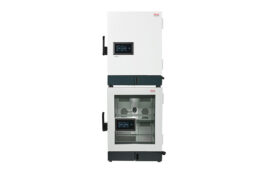
Thermo Fisher launches 250-liter, stackable environmental chambers
Glass vial, pipette and woman scientist in laboratory for medical study, research or experiment. Test tube, dropper and professional female person with chemical liquid for pharmaceutical innovation
Upcoming Solstice webinar to examine hidden sources of lab variability
The Practical Blueprint for Delivering Flexible, Competitive Labs 
Norstella launches Atlas, a biopharma agentic platform that can ‘train you’
rd newsletter
EXPAND YOUR KNOWLEDGE AND STAY CONNECTED
Get the latest info on technologies, trends, and strategies in Research & Development.

R&D World Digital Issues

Fall 2025 issue

Browse the most current issue of R&D World and back issues in an easy to use high quality format. Clip, share and download with the leading R&D magazine today.

R&D 100 Awards
Research & Development World
  • Subscribe to R&D World Magazine
  • Sign up for R&D World’s newsletter
  • Contact Us
  • About Us
  • Drug Discovery & Development
  • Pharmaceutical Processing
  • Global Funding Forecast

Copyright © 2026 Arrowfly LLC. All Rights Reserved. The material on this site may not be reproduced, distributed, transmitted, cached or otherwise used, except with the prior written permission of Arrowfly
Privacy Policy | Advertising | About Us

Search R&D World

  • R&D World Home
  • Topics
    • Aerospace
    • Automotive
    • Biotech
    • Careers
    • Chemistry
    • Environment
    • Energy
    • Life Science
    • Material Science
    • R&D Management
    • Physics
  • Technology
    • 3D Printing
    • A.I./Robotics
    • Software
    • Battery Technology
    • Controlled Environments
      • Cleanrooms
      • Graphene
      • Lasers
      • Regulations/Standards
      • Sensors
    • Imaging
    • Nanotechnology
    • Scientific Computing
      • Big Data
      • HPC/Supercomputing
      • Informatics
      • Security
    • Semiconductors
  • R&D Market Pulse
  • R&D 100
    • 2026 R&D 100 Award Winners
    • 2026 Professional Award Winners
    • 2026 Special Recognition Winners
    • R&D 100 Awards Event
    • R&D 100 Submissions
    • Winner Archive
  • Resources
    • Research Reports
    • Digital Issues
    • Educational Assets
    • Subscribe
    • Video
    • Webinars
    • PharmSci360
    • Content submission guidelines for R&D World
  • Global Funding Forecast
  • Top Labs
  • Advertise
  • SUBSCRIBE