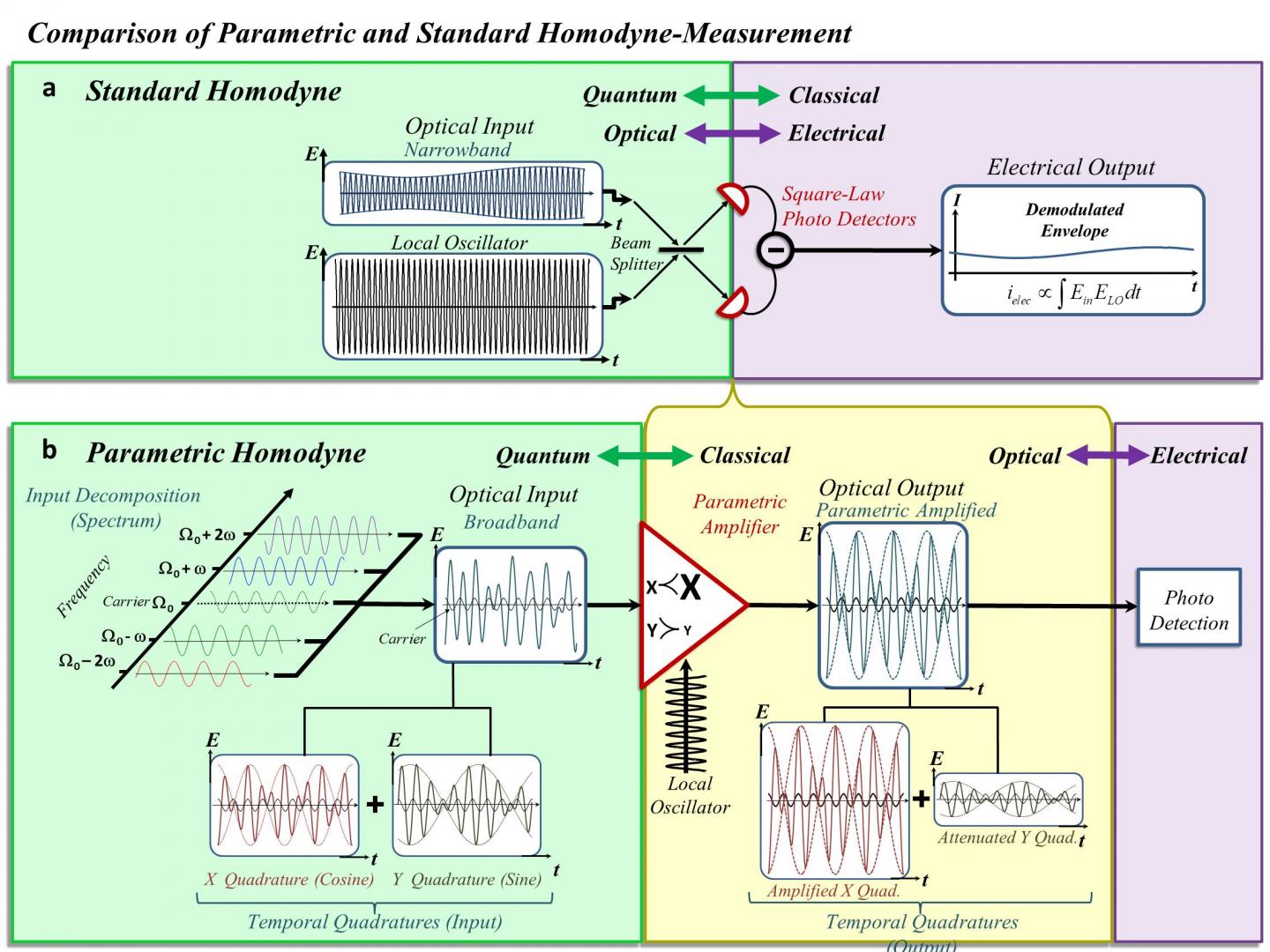
In quantum communication, the participating parties can detect eavesdropping by resorting to the fundamental principle of quantum mechanics — a measurement affects the measured quantity. Thus, an eavesdropper can be detected by identifying traces his measurements of the communication channel leave behind. The major drawback of quantum communication is the slow speed of data transfer, limited by the speed at which the parties can perform quantum measurements. Researchers at Bar-Ilan University have devised a method that overcomes this, and enables an increase in the rate of data transfer by more than 5 orders of magnitude! This image illustrates their technique, in which they replaced electrical nonlinearity with a direct optical nonlinearity, transforming the quantum information into a classical optical signal.
Quantum communication, which ensures absolute data security, is one of the most advanced branches of the “second quantum revolution”. In quantum communication, the participating parties can detect any attempt at eavesdropping by resorting to the fundamental principle of quantum mechanics – a measurement affects the measured quantity. Thus, the mere existence of an eavesdropper can be detected by identifying the traces that his measurements of the communication channel leave behind.
The major drawback of quantum communication today is the slow speed of data transfer, which is limited by the speed at which the parties can perform quantum measurements.
Researchers at Bar-Ilan University have devised a method that overcomes this “speed limit”, and enables an increase in the rate of data transfer by more than 5 orders of magnitude! Their findings were published today in the journal Nature Communications.
Homodyne detection is a cornerstone of quantum optics, acting as a fundamental tool for processing quantum information. However, the standard homodyne method suffers from a strong bandwidth limitation. While quantum optical phenomena, exploited for quantum communication, can easily span a bandwidth of many THz, the standard processing methods of this information are inherently limited to the electronically accessible MHz-to-GHz range, leaving a dramatic gap between the relevant optical phenomena that is used for carrying the quantum information, and the capability to measure it. Thus, the rate at which quantum information can be processed is strongly limited.
In their work, the researchers replace the electrical nonlinearity that serves as the heart of homodyne detection, which transforms the optical quantum information into a classical electrical signal, with a direct optical nonlinearity, transforming the quantum information into a classical optical signal. Thus, the output signal of the measurement remains in the optical regime, and preserves the enormous bandwidth optical phenomena offers.
“We offer a direct optical measurement that conserves the information bandwidth, instead of an electrical measurement that compromises the bandwidth of the quantum optical information,” says Dr. Yaakov Shaked, who conducted the research during his Ph.D. studies in the lab of Prof. Avi Pe’er. To demonstrate this idea, the researchers perform a simultaneous measurement of an ultra-broadband quantum optical state, spanning 55THz, presenting non-classical behavior across the entire spectrum. Such a measurement, using standard method, would be practically impossible.
The research was accomplished through a collaboration between the Quantum Optics Labs of Prof. Avi Pe’er and Prof. Michael Rosenbluh, together with Yoad Michael, Dr. Rafi Z. Vered and Leon Bello at the Department of Physics and Institute for Nanotechnology and Advanced Materials at Bar-Ilan University.
This new form of quantum measurement is relevant also to other branches of the “second quantum revolution”, such as quantum computing with super powers, quantum sensing with super sensitivity, and quantum imaging with super resolution.