 There is a strange recursion happening across the technology landscape right now. Engineers are doing research and development on AI agents whose ultimate job is to do research and development. At Cisco, networking specialists are building autonomous systems that can monitor, troubleshoot and eventually manage the same infrastructure those specialists maintain today. The work is R&D in the truest sense: experimental, iterative and uncertain, aimed at producing tools that will reshape the work itself.
Nick Edwards, a vice president of product management who oversees the company’s enterprise campus switching portfolio, described a field at an inflection point. “You have this existing way of running networks and an existing way of trying to achieve business outcomes, and that’s evolved, you know, over the course of the last couple decades,” he said. New workplace patterns, the acceleration of AI, and a growing security burden are converging at the same time, he argued, creating an opening for Cisco to rethink how networks are operated.

Nick Edwards
The urgency is partly technological and partly demographic. Networks are getting more complicated, while the bench of people who know how to operate them is thinning. “The people who helped pioneer this industry, CCIE and all these types who do these certifications, those are increasingly few and far between as that generation retires,” Edwards said. Early-career talent is often pulled toward other specialties, budgets are tight and the “keep it running” layer is rarely where organizations choose to add headcount. In a world where networks underpin everything from routine collaboration to real-time systems, the shortfall becomes an operational risk.
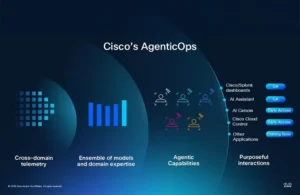
Cisco’s bet is “agentic operations,” or agentic ops, which Edwards framed as different from the typical enterprise AI experience. The distinction matters because much of today’s enterprise AI still works like a search box: a user asks a question, gets an answer and decides what to do next. Agentic ops flips that model. Instead of waiting for a prompt, an agent runs in the background, monitors conditions and surfaces issues proactively with recommended steps. Edwards described it as an “agent-first” operating model, built for autonomous action with oversight, rather than a chatbot-style interface where the user must initiate every interaction. For now, that oversight is literal. “You’ll frequently hear this term human in the loop,” Edwards said. “That means that if the agent is going to proactively say something, ‘hey, there’s something wrong.” I want to make sure I’m the one who has the finger on the button to take action.”
A digital ‘buddy’
In practice, the broader agentic model is meant to change how problems get discovered and handled. Instead of an engineer reacting to a ticket after a failure, an agent watches telemetry and patterns, flags anomalies and proposes a remediation path that a human can approve. Edwards emphasized that the goal is not to replace engineers but to augment them: “It’s really about giving them this 24/7 digital buddy, so to speak, who can handle a lot of these things that would typically kind of require that level of expertise, as well as being able to handle this repetition, you know, with no fatigue, no notion of stopping.” Over time, vendors want those agents to take more actions on their own, at least for well-understood issues, turning operations from reactive firefighting into something closer to preventative maintenance.
One reason Cisco believes it can move quickly is institutional memory, not the human kind but the data kind. Cisco has decades of configuration history, trouble tickets and operational telemetry across an installed base that spans industries. Edwards argued that this depth of domain-specific data helps tune models for networking tasks, where generic AI can struggle without context. The pitch is straightforward: general-purpose models trained broadly can get you partway there, but domain-tuned models, grounded in real operational history, can produce better outcomes.
There is also an interoperability piece that matters as agents spread across domains and vendors. Edwards pointed to MCP, describing it as a way to plug AI tools into different technology stacks, closer to an API layer than a single vendor feature. In practice, that is the connective tissue for a future where network agents, security agents and application agents need to share context across tools without forcing organizations to standardize on one vendor for everything.
The case for why non-networking audiences should care is simplest in environments where time-sensitive insight depends on reliable transport. Edwards pointed to healthcare, where AI systems can flag issues in real-time imaging. “When an AI model spots something in a cardiac anomaly in real time, imaging with some kind of digital pathology, the network cannot be the bottleneck between getting this insight and getting it to the people they need,” he said. “So it’s no longer just an IT issue. It really is kind of a patient outcome issue when it comes to healthcare.” For research institutions, manufacturing floors and distributed campus environments, the same logic applies. In R&D, downtime is more than an IT problem. It can impact science problem, a throughput problem and sometimes a safety problem.
Watching the watcher
Part of what makes agents attractive for network operations is the same thing that makes them useful in coding or log analysis: they can do tedious, repetitive work without flagging. Reviewing security alerts, scanning for misconfigurations, monitoring connection quality across a distributed campus: this is work that demands attention but rarely rewards it, and it is exactly the kind of task that burns out understaffed teams. Agents can run that watch continuously.
But an agent with permissions to reconfigure switches is, from a security standpoint, functionally similar to a privileged user: except it can act faster and at scale. Edwards said Cisco’s approach draws on controls the company has shipped for years. “If this agent appears to be operating in a way that is not aligned with corporate policy, we can give it a tag that would give it access to less sensitive content inside the network. Or maybe you could quarantine it entirely,” he said. The company also offers a product called AI Defense for monitoring agent behavior, but Edwards framed the core logic in simpler terms: customers are starting to “bring on these agents” and asking “how can I give them security posture and profile that is similar to how we treat another human.” Treat the agent like an employee. Scope its permissions. Revoke access if it misbehaves.
Edwards expects 2026 to be the year agentic ops moves from pilots to production. “I think last year it was kind of like, ‘okay, this is a new-ish thing that people are starting to get their head around,'” he said. “I think this is the year that it starts to really get adopted at scale and in mass, because everything is happening so fundamentally quickly.” He cited an engineer on his team who found that model performance had improved roughly fourfold over a year “and I had to do nothing to take advantage of that.”
These last two years, it feels like there’s been more change in two years than there were in the past 20, basically since the smartphone. —Edwards
Whether that velocity produces trust or simply more pressure to adopt before organizations are ready is still an open question. For research institutions, hospitals, and manufacturing operations, environments where the cost of failure is measured in lost data, delayed results or compromised patient care, the answer will depend less on what vendors promise and more on what these agents actually do when nobody is watching.