In most batteries, the electrolyte is a flammable liquid. So-called solid-state batteries use a solid substance as an electrolyte instead. This not only makes them safer, but the solid electrolyte also allows the use of alternative materials for the electrodes, such as pure lithium metal for the anode. As a result, solid-state batteries can potentially achieve much higher energy densities, an advantage for a wide range of applications, from electric cars to portable electronics.

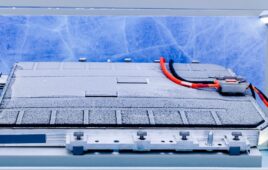
The solid silicone-based electrolyte is elastic, thereby compensating for the voids that form in solid-state batteries during charging and discharging. Credit: Empa
Empa researchers from the Laboratory for Functional Polymers are working on a novel electrolyte that could remedy several issues at once. Unlike most electrolytes for solid-state batteries, which are made of rigid materials, their solid electrolyte is soft and stretchable.
Silicone-based ion conductor
The starting polymer for the electrolyte is a polysiloxane, better known as silicone. This elastic compound has one major disadvantage for battery research: it is nonpolar and thus unable to dissolve the charged particles, the ions. The researchers have succeeded in adding nitrile groups to the backbone of the polymer, making it a good ion conductor while retaining its advantageous elastic properties. The researchers found that a 60% nitrile-functionalization provided the best balance of conductivity and mechanical properties.
The polysiloxane-based polymers exhibit ionic conductivity up to 0.375 mS/cm at 60 °C and a lithium ion transfer number of 0.73, one of the highest reported for polymer Li-ion conducting electrolytes, according to the research paper. Standard polymer electrolytes typically have Li+ transfer numbers of 0.2 to 0.5.
Today’s lithium-ion batteries use an anode based on lithium salts. Using pure lithium metal as the anode material instead could potentially achieve higher energy densities. When the battery is discharged, lithium ions migrate away from the metallic anode; when it is charged, they return. However, they do not deposit themselves in an even layer on the surface of the anode, but form dendrites: tree-like lithium structures that can stretch to the cathode within a few charging cycles and cause a short circuit. In symmetric cells, the electrolyte remained stable for over 400 hours at 0.2 mA/cm2 without short-circuiting.
The use of a solid electrolyte hinders dendrite growth. However, when ions move away from the anode, they leave behind empty spaces, which can cause the anode to lose contact with the electrolyte and reduce the battery’s capacity. This is where the elastic electrolyte developed by Empa researchers kills two birds with one stone: it is solid enough to prevent dendrites, but elastic enough to fill the voids and compensate for the volume changes in the anode during charging and discharging.
Towards flexible batteries
The electrolyte could also be used to manufacture flexible batteries. “Today’s batteries for medical implants, such as pacemakers, are usually hard and uncomfortable for patients,” explains Dorina Opris, who led the research. “Our polymer can serve not only as an electrolyte, but also as a binder material for the cathode.”
Flexibility and safety are not the only advantages of the innovative electrolyte. “The material can be processed into thin films of a few micrometers in thickness, and it is scalable”, says Opris. “If produced on an industrial scale, it is also cheaper than conventional solid polymer electrolytes.”
The researchers are now working on further improving the ionic conductivity of the silicone electrolyte and looking for a suitable industrial partner to begin commercializing the technology.