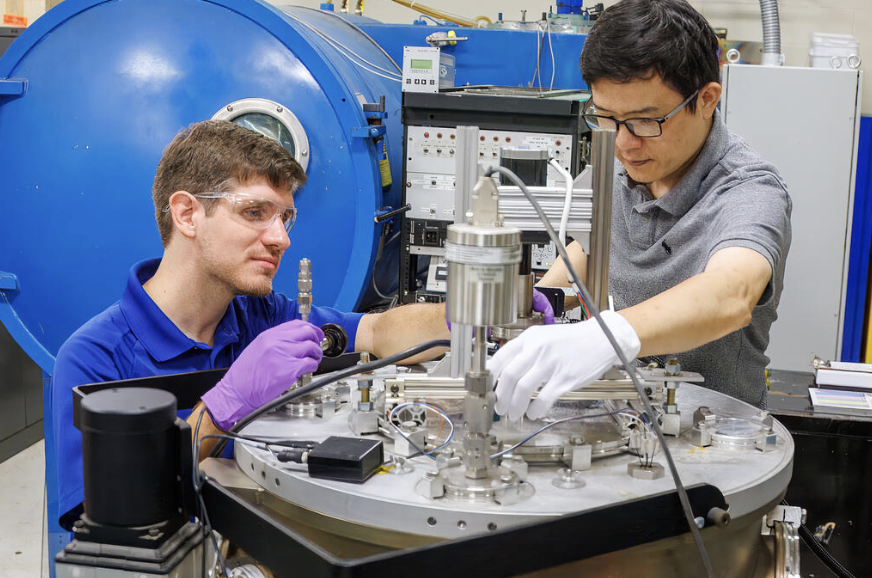
SwRI researchers John Hemmerling, left, and Jianliang Lin work with a deposition chamber used to develop ultra-thin films for solid-state battery interfaces. Credit: Southwest Research Institute
Solid-state batteries have clear advantages, replacing the flammable liquid electrolytes in traditional lithium-ion cells. Manufacturing them remains difficult, given the challenges inherent in solid-to-solid contact during continuous charge and discharge cycles. A central challenge in a solid-state battery is dealing with the boundary between a lithium-metal anode and solid electrolyte.
That region will be the focus of a $128,896 seed project at Southwest Research Institute and Southern Methodist University will test whether ultra-thin metal, metal-oxide and alloy films can stabilize that boundary. The researchers plan to deposit films tens to hundreds of nanometers thick and measure how their chemistry affects lithium nucleation and long-term electrochemical performance.
“One of the biggest technical hurdles is the unstable interface between the lithium metal anode and the solid electrolyte,” said John Hemmerling, a senior research engineer in SwRI’s Materials Engineering Department, in a statement. “The lithium can also deposit in uneven growths, known as dendrites, that damage the contact area and hinder the transfer of ions,” Hemmerling continued. “This accelerates battery degradation, making the battery less efficient over time.”
In the seed project, Hemmerling will work with SwRI staff scientist Jianliang Lin, Ph.D., and SMU mechanical engineering professor Rong Kou, Ph.D. SwRI will contribute its thin-film deposition expertise, while SMU will support battery development and electrochemical testing.