Engineers at the University of California San Diego have developed a new method to upcycle cathodes from used lithium iron phosphate (LFP) batteries into lithium manganese iron phosphate (LMFP), a material that stores more energy and could offer a more valuable second life for batteries used in electric vehicles and grid storage. The findings were published in Joule.
Traditionally, when LFP is recycled, it is decomposed and oxidized into a mixture of lithium salt and iron salt. Then phosphate and manganese are added to create a homogeneous molecular precursor, which is sintered.
“That process tends to be more tedious, because forming the original LFP already took a lot of energy and process control, and then, to make the reaction more homogeneous, they break it all the way down into atomic-level precursors again,” Zheng Chen, professor in the Aiiso Yufeng Li Family Department of Chemical and Nano Engineering at the UC San Diego Jacobs School of Engineering and senior author of the study, said in an interview.
To turn LFP into LMFP, the process needs to introduce manganese, phosphate and more lithium, which are chemically unstable. Mixing these unstable salts with the stable LFP causes uneven distribution of the new material into the LFP lattice, leaving pockets of phosphate and lithium phases.
His team’s new method uses an LMP intermediate to solve this problem. The new method heats the manganese and phosphate at 450°C, causing them to decompose and form LMP, which has a crystal structure and thermodynamic stability similar to LFP. Then the LMP intermediate can mix uniformly with the LFP.
Credit: David Baillot/UC San Diego Jacobs School of Engineering
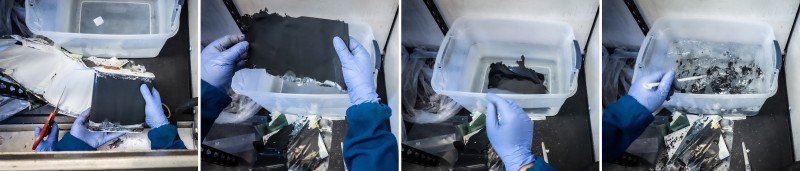
How spent cathode material is recovered from an end-of-life LFP battery. Left to right: the battery pack’s contents are unrolled, cut into smaller sheets, soaked in water, and stirred.
A crowded industry
Five years ago, Chen’s lab published a paper about recycling used LFP battery material back into usable LFP.
“[That paper] actually helped start a fast-growing industry, especially in China,” Chen said.
China dominates the EV battery recycling industry by scale, with CATL’s recycling arm, Brunp, expanding toward processing more than 1 million tons per year by 2030. Botree Recycling Technologies, which partners with clients handling approximately half of China’s power batteries domestically, is building an LFP recycling plant in Spain that is set to open in 2027. China also accounts for roughly 80% of new LMFP-specific IP entrants since 2023, according to a report by KnowMade.
Beijing tightened EV battery rules in April 2026, requiring each power battery in a new EV to have a digital identity, enabling a national power battery traceability information platform. The regulation aims to control the volume of retired batteries.
In the U.S., an IRA loophole has led to a wave of American recycling investment. Materials recycled domestically qualify as “domestically sourced” for EV tax credits, even if the original material was mined and processed in China. However, two of the three largest domestic recyclers have now collapsed within about a year of each other.
Li-Cycle filed for bankruptcy in 2025 after years of cost overruns at its Rochester Hub. Ascend Elements filed Chapter 11 in April 2026 after the DOE canceled two grants. Redwood Materials, which walked away from a $2 billion conditional DOE loan in 2024 in favor of private funding, remains the sector’s most stable major player.
The EV battery recycling market grew from roughly $1.0 billion in 2025 to $1.4 billion in 2026 and is forecast to reach $19 billion by 2033, according to Grand View Research. This is driven by the rise in global EV sales, from 3.2 million units in 2020 to a forecasted 22 to 23 million in 2026.

Credit: David Baillot/UC San Diego Jacobs School of Engineering
The spent LFP cathode undergoes upcycling. Left to right: a jar of zirconia balls is being prepared, to which a powder mixture (consisting of spent LFP and salts) will be added; the mixture is placed in a ball miller, where the zirconia balls bump against the powder to ground and mix it into finer particles; the processed powder is isolated; and finally, the LFP and salt powder mixture is placed in a furnace.
Getting to market
Chen and the team are now looking into commercializing the technology.
“There’s a local startup that came out of the University of California San Diego and works on direct recycling of batteries, so there are some conversations happening there,” Chen said.
ExPost Technology grew out of research in Chen’s Sustainable Materials and Energy Laboratory at UC San Diego in 2022. Its core technology is PRIME, purification-regeneration integrated materials engineering, which directly recovers and restores degraded battery components to near-original capacity and cycle performance. Chen serves as executive advisor and cofounder.
The next step will be to make sure the process can scale.
“We’re able to produce kilogram-scale quantities, which is a lot for university lab research, so we’ve de-risked the scalability challenge to some degree and that looks very promising,” Chen said.
Solving the charge speed problem
Although LMFP can hold more energy than LFP, it also charges and discharges slower.
“That’s an interesting problem we hope to improve using what we’ve learned from the synthesis work,” Chen said.
Where LFP’s energy is derived from the iron redox couple, LMFP is additionally powered by manganese’s redox couple. Iron oxidizes at 3.4 volts, whereas manganese oxidizes at 4.0 volts. Using manganese in addition to iron raises the average voltage at which the battery operates without significantly changing how much lithium the material can hold, allowing LMFP to hold 10% to 20% more energy than LFP.
However, LMFP charges and discharges slower due to Jahn-Teller distortion, which causes a distortion of MnO6 octahedra in the lattice. The lithium ions can only travel along narrow, one-dimensional channels through the crystal, so distortions can partially block a channel with no alternative route. Manganese also conducts electrons and lithium ions more slowly than iron.
A paper published in February complicates this, however, finding that the distortion actually improved lithium transport by enabling a smoother, single-phase reaction pathway instead of the usual two-phase transition.
“We want to leverage our experience and knowledge in synthesis and processing from the recycling work to further engineer the structure, the manganese distribution and the carbon coating uniformity, to increase the charge and discharge rates,” Chen said. “We can’t make progress in academia alone. We need industry and government effort together to actually move things forward.”