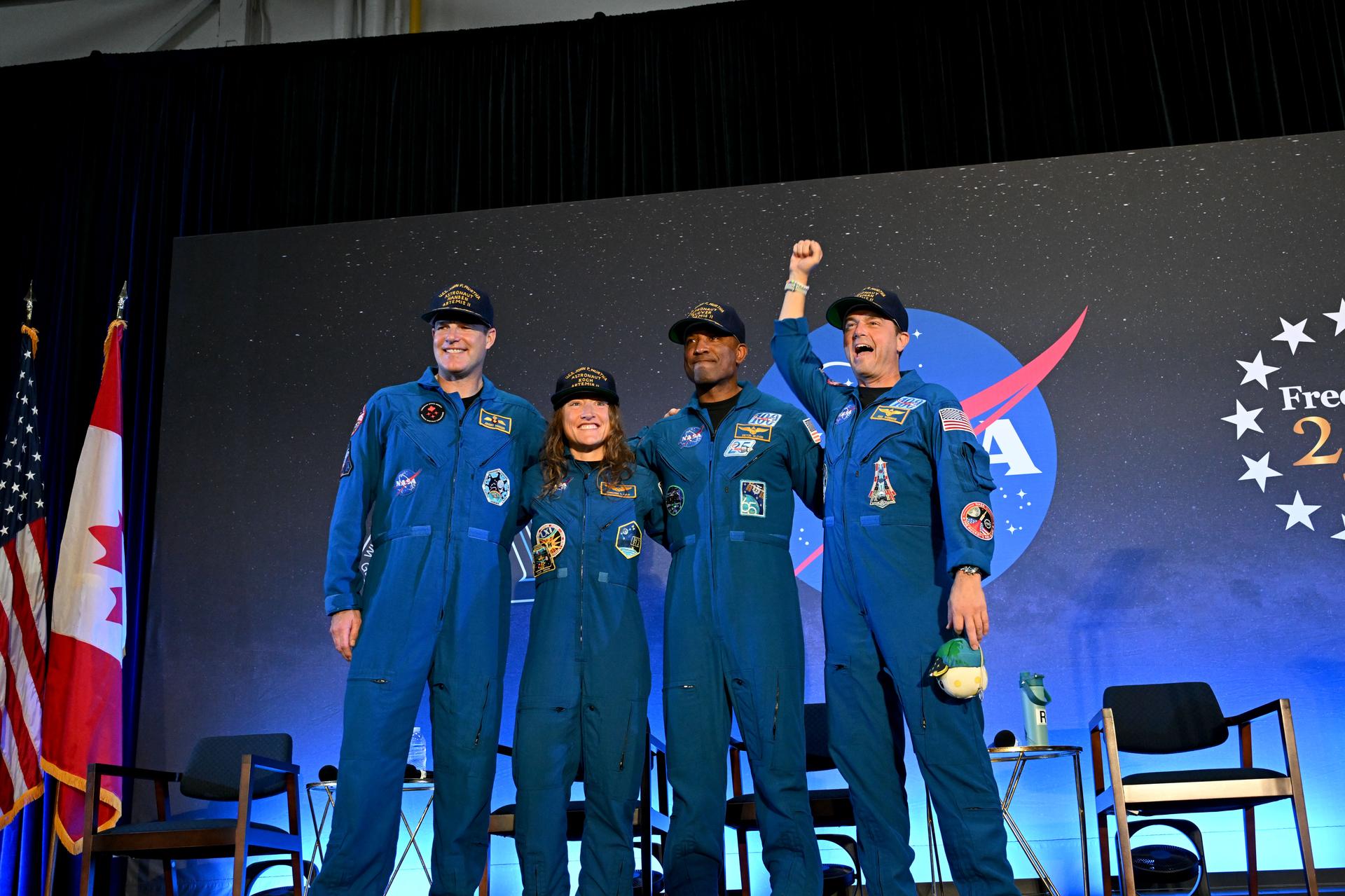
The Artemis II crew: NASA astronauts Reid Wiseman (commander), Christina Koch (mission specialist) and Victor Glover (pilot), along with CSA (Canadian Space Agency) astronaut Jeremy Hansen upon their arrival at Ellington Airport in Houston. The crew returned to NASA’s Johnson Space Center on Saturday, April 11, 2026, following a nearly 10-day journey around the Moon and back to Earth. Credit: NASA/Helen Arase Vargas
The proposed budget still describes the goal of achieving ‘U.S. dominance on the Moon’
The proposed cuts are uneven. Human exploration would come through largely protected. Science, station operations, STEM outreach and parts of Earth observation do not. Artemis would get a roughly 10% raise to $8.5 billion, a $731 million bump aimed at landing astronauts on the Moon “by the end of 2028.” A new $175 million line funds robotic precursor missions to seed a permanent outpost near the lunar south pole, which OMB pitches as both a way to “establish U.S. dominance on the Moon” and “a proving ground” for an eventual Mars mission.
In the red is, broadly speaking, science. The Science Mission Directorate would fall from $7.3 billion to $3.9 billion, a 47% cut. OMB frames the terminated work as “wasteful” spending on “low-priority missions” and singles out the SERVIR Earth-observation partnership with USAID as an example of “climate extremism imposed on developing countries.”
Similarly, Space Operations would drop from $4.2 billion to $3 billion, with a $1.1 billion cut to ISS operations ahead of the station’s 2030 retirement. Safety, Security, and Mission Services would dip from $3 billion to $2 billion. STEM Engagement is zeroed out, eliminating the $143 million the office received in 2026, with OMB arguing NASA “will inspire the next generation of explorers through exciting, ambitious space missions, not through subsidizing woke STEM programming.” Earth Systems Explorers funds only one of its two selected missions, STRIVE or EDGE, through the five-year window. Meanwhile, Landsat gets $109 million structured as a phased handoff to commercial providers.
Proposed budget frames SLS as ‘grossly expensive’
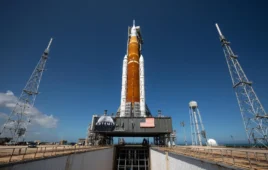
The budget describes the Space Launch System (SLS) as “grossly expensive and delayed” and calls for replacing both SLS and Orion with something “more cost-effective” after current Artemis commitments. An earlier White House version went further, proposing to retire SLS, Orion and ground systems after Artemis III and end Gateway outright. Under the current plan, the $2.6 billion previously allocated to Gateway in last year’s reconciliation package would instead be redirected toward the lunar base.
NASA Administrator Jared Isaacman, confirmed in December after a yearlong process, is backing the request. His argument is that the agency can absorb these cuts because Congress already routed roughly $10 billion to NASA last year through the One Big Beautiful Bill Act for human spaceflight and Mars exploration. In that view, NASA can still launch the Nancy Grace Roman Space Telescope at the end of 2026, fly a nuclear-powered octocopter to Titan in 2028 and keep moving toward a lunar settlement while living within the new budget envelope.