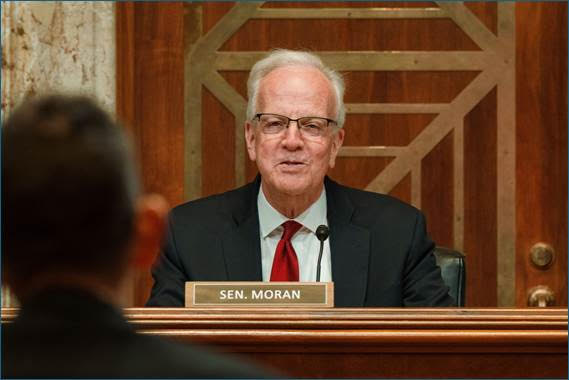
U.S. Senator Jerry Moran (R-Kan.), chairman of the Senate Appropriations Subcommittee on Commerce, Justice, and Science, led a subcommittee hearing to review the President’s FY2027 budget request for NASA
President Trump’s FY2027 budget request would cut NASA by $5.6 billion, with the deepest reductions falling on science and STEM education while leaving Artemis and a planned lunar base camp funded through prior appropriations. The request would cut the Science Mission Directorate by roughly 50%, terminate 27 operating missions, cancel 26 missions in development and zero out the Office of STEM Engagement, pushing science funding more than $1 billion below 2007 levels.
That proposal came before senators today as U.S. Sen. Jerry Moran, R-Kan., chairman of the Senate Appropriations Subcommittee on Commerce, Justice and Science, convened a hearing on NASA’s FY2027 budget. Moran opened by congratulating NASA Administrator Jared Isaacman on the successful Artemis II mission and pressing him on whether the U.S. could beat China back to the Moon. His questioning did not address the proposed cuts, and his office’s post-hearing press release made no mention of the $5.6 billion reduction.
Moran has, however, publicly rejected the cuts outside the hearing room, saying he would favor maintaining agency at levels similar to FY2026. At a Space Symposium event in Colorado Springs on April 12, he said it would be “a mistake to put money only in the missions related to exploration and not into science and the others.” He said his goal was to fund NASA at roughly the FY26 enacted level of $24.4 billion, “reversing the cuts in science and other areas.”
The on-the-record criticism at the hearing came from the subcommittee’s three Democrats. Ranking member U.S. Sen. Chris Van Hollen, D-Md., called the request “a staggering retreat of US leadership and ambition in space” and noted it largely repeats an FY2026 proposal “Congress roundly rejected on a bipartisan basis just months ago.” U.S. Sen. Chris Coons, D-Del., and U.S. Sen. Jeanne Shaheen, D-N.H., also pressed the cuts. Shaheen called the science request “abysmal” and committed to “working in a bipartisan way to put back some of the money.”
One Republican raised a specific science cut. U.S. Sen. Lisa Murkowski, R-Alaska, questioned a roughly 60% reduction to NASA’s sounding rocket program, which supports Poker Flat Research Range in her state.
Isaacman defended the request by pointing to money Congress already provided for Artemis, NASA’s multibillion-dollar program to return astronauts to the Moon and use lunar operations as a bridge to Mars. He argued the prior funding lets NASA standardize the Space Launch System rocket, add a 2027 Artemis mission to reduce risk before a crewed lunar landing and keep selected flagship science missions. Asked whether the U.S. could still beat China to the Moon under the reduced budget, Isaacman said that before NASA reworked Artemis, it was “near unachievable” that American astronauts would arrive first. “We have changed that,” he said.
The flagship-science claim sits in tension with the broader cut. Isaacman told the panel the budget still supports “flagship missions like the Nancy Grace Roman space telescope,” Dragonfly and NEO Surveyor. Van Hollen named the same Roman telescope and Dragonfly as missions threatened by the SMD reduction, calling Roman “ahead of schedule and under budget” and noting the Trump administration proposed terminating it in an earlier budget cycle. Whether all three survive intact will depend on which line items emerge from appropriations markup. An American Astronomical Society analysis of the request found that the FY27 budget reduces Habitable Worlds Observatory technology maturation funding to $5 million, down from $150 million appropriated in FY26.
Van Hollen also pressed Isaacman on the gap between the FY27 request and the “ignition” plan Isaacman has been promoting publicly, which includes the SR-1 Freedom nuclear-powered spacecraft and the Skyfall Mars payload. Neither is funded in the FY27 request. Isaacman said NASA would execute both by repurposing existing hardware rather than asking for new appropriations, describing SR-1 Freedom as a “70% solution” assembled from components that have “sat in the lab” from prior investments.
Moran signaled the committee would not start from the President’s request. “I would guess that our work will begin with the FY 26 as a starting point, a baseline,” he told Isaacman, asking what the agency would want changed from the current year’s appropriation. Congress passed the FY26 bill on a bipartisan basis after rejecting a similar Trump request the previous spring.