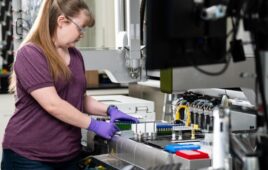
Researchers from North Carolina State University have developed a compact, automated robotic platform for foundational photochemical assays. They call the system Roblonski, after A. Jablonski, who created the Jablonski diagram. They published their findings in ACS Central Science.
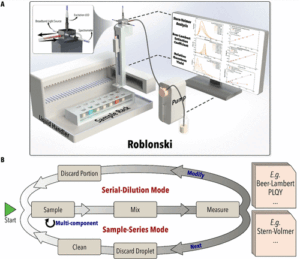
(A) Schematic illustration of the developed robo-fluidic platform (Roblonski) and (B) the general workflows implemented in this work. Credit: ACS Central Science
Reliable photochemical and photophysical characterization is essential for understanding and optimizing photocatalytic processes. However, traditional spectroscopic methods are time-, cost-, material- and labor-intensive.
Automating three foundational photochemical assays
Roblonski automated three foundational photochemical assays with high precision, reproducibility and accuracy, the researchers report. The researchers used Ru(bpy)3(PF6)2 as a model photosensitizer and photocatalyst to test the system. The machine-generated results matched manual experimental measurements and literature benchmarks.
Roblonski reduced sample consumption 20-fold by solution volume and 1,000-fold by reagent moles. It also accelerated data collection fourfold compared to traditional, manual approaches.
“By integrating these photochemically relevant assays into a single, compact automated platform, Roblonski has the potential to lower experimental barriers, enable data-rich evaluation of photocatalysts and substrates and augment autonomous photochemical discovery and characterization,” the researchers claim in their paper.
Roblonski automated Stern-Volmer (SV) analysis, Beer-Lambert (BL) studies and Photoluminescence Quantum Yield (PLQY).
A hybrid robo-fluidic architecture
The system is built around a Gilson GX-241 robotic liquid handler and an Ocean Optics QE-Pro photodiode array spectrometer. A custom flow cell is integrated directly into the liquid handler’s tubing, minimizing wasted sample and speeding up transport. Roblonski is controlled through Python to automatically perform liquid transfers, mixing, spectroscopic measurements and cleaning. The system is just 0.27 cubic meters, small enough to fit inside a standard laboratory glovebox.
The team used Roblonski to perform SV analyses with 11 different quenchers, completing in 25 hours what would take two weeks to complete manually.
The system uses both a broadband UV-vis deuterium-halogen source, for absorption and BL studies, and a narrow-band UV LED, for excitation in photoluminescence and SV analysis.
Roblonski operates on two main modes: serial dilution and sample series. In the serial dilution mode, used for BL and PLQY studies, the robot starts with a stock solution and performs automated dilutions to generate a multi-point calibration curve. In the sample series mode, for SV analysis, the robot prepares a series of vials with a constant catalyst concentration but varying amounts of quencher molecule to observe how the light emission is suppressed.
Roblonski features closed-loop decision-making. If the initial measurement shows that the sample is too concentrated, the system automatically calculates the necessary dilution factor and restarts the assay without human intervention. For SV studies, the system performs a real-time linear regression and automatically prepares and measures additional replicates if the R2 falls below a user-defined threshold.
“Looking forward, Roblonski’s solvent compatibility and adaptability position it for quantitative studies in photochemical kinetics, photochromism, photochemical upconversion and dynamic photoluminescence measurements,” the paper notes. “Similarly, Roblonski’s flexibility makes it amenable for the spectroscopic evaluation of both soft and hard, organic and inorganic materials, semiconductor nanocrystals, metal–organic frameworks and other valuable photonic materials platforms.”