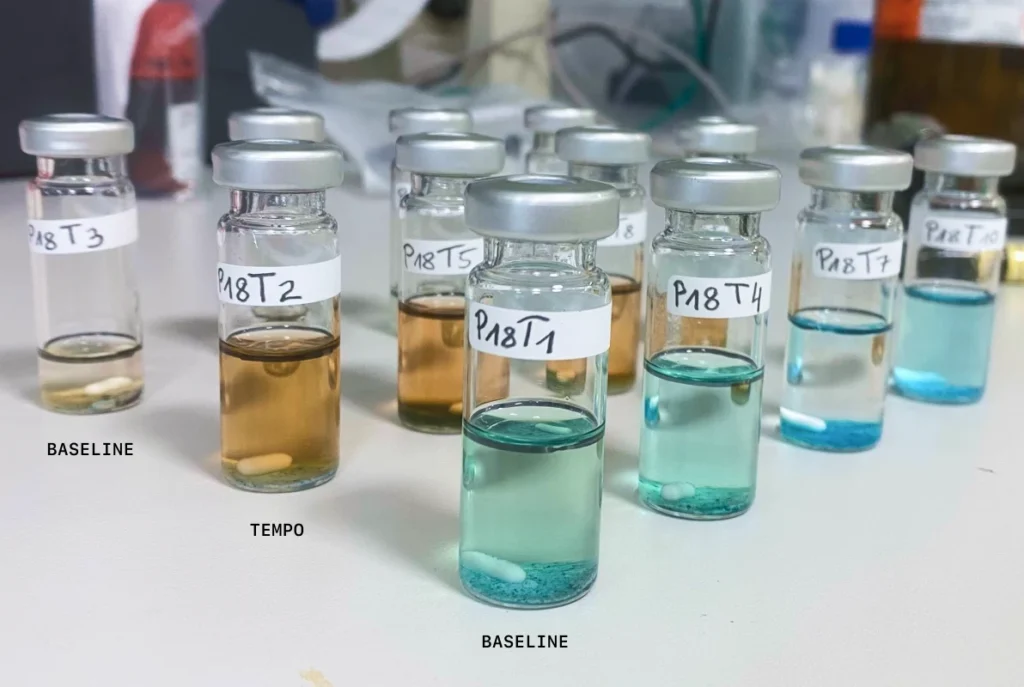
Reaction vials from the manual bench-scale validation, where human chemists repeated representative reactions by hand to confirm the microliter-scale screening results. The vials are labeled by condition, including TEMPO and baseline, no-oxidant runs. Credit: OpenAI/Molecule.one
OpenAI and Molecule.one have announced a system that improved a reaction medicinal chemists rely on but have long struggled to run reliably. OpenAI billed the news as a “near-autonomous AI chemist.”
The setup paired one of OpenAI’s frontier models, GPT-5.4, with Maria, Molecule.one’s agentic chemistry AI, and an automated high-throughput lab. The chemistry target was primary sulfonamide Chan-Lam coupling, a copper-mediated reaction used to attach aryl groups to sulfonamide motifs common in drug-like molecules. TEMPO-like mild oxidants are stable radical additives that can help manage the reaction’s redox chemistry.

Piotr Byrski
Across two rounds, yields improved for 88% of the boronic acids and 83% of the sulfonamides tested. Mean yield rose from 16.6% to 25.2%, and the share of reactions clearing 30% climbed from 15.6% to 37.5%. Maria ran 10,080 reactions in total. Human chemists then repeated representative reactions by hand at bench scale and saw higher yields for 11 of 14 substrate pairs, more than doubling for eight of them.
The preprint frames the chemistry result as a broad high-throughput study in which stoichiometric TEMPO improved C–N bond formation while suppressing oxidative deboronation, a side reaction that destroys the boronic-acid partner before it can form the desired bond. It also reports that 4-hydroxy-TEMPO, or TEMPOL, maintained comparable performance as a lower-cost analog that is easier to remove during workup.
While automated in many respects, humans were still in the loop. “Scientists using Maria wrote the prompts,” said Piotr Byrski, co-founder and CEO of Molecule.one. “GPT-5.4 proposed the research topic: primary sulfonamide Chan-Lam coupling, and hypothesis: TEMPO-like mild oxidants will help with yield and side products. Humans gave the final go-ahead on experiments, making minor corrections to experimental procedures. Maria turned selected ideas into HTE workflows and ran/analyzed them, GPT then reanalyzed the data and proposed a 2nd cycle using the above workflow. At the end, humans ran manual validation and wrote up the manuscript with results.”
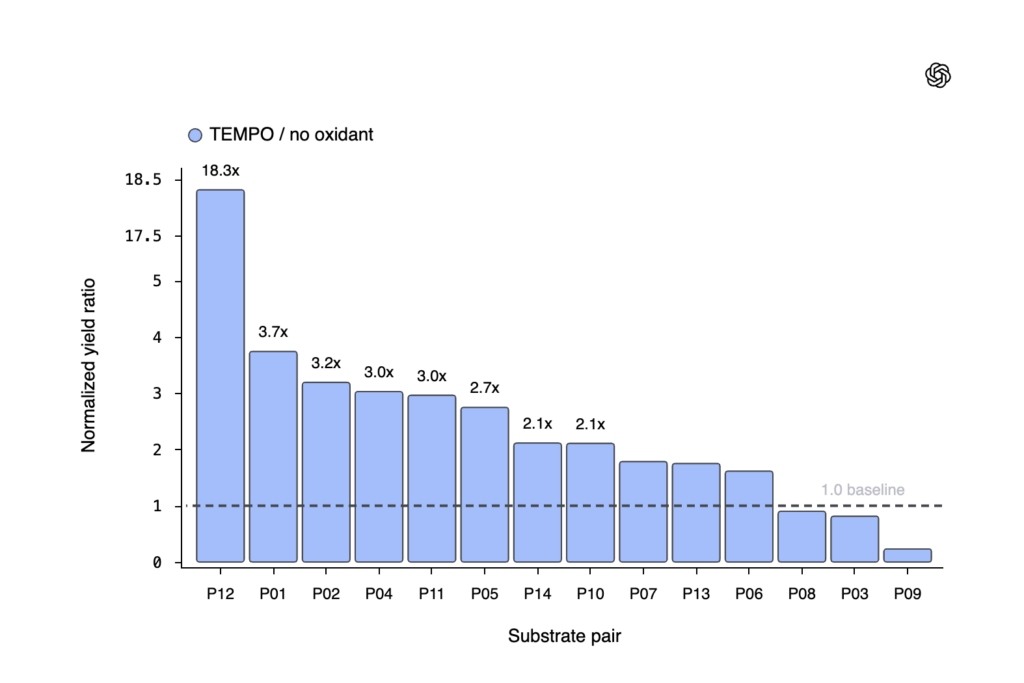
At bench scale, adding TEMPO raised the yield ratio above the no-oxidant baseline (the dashed line) for 11 of 14 substrate pairs, and more than doubled it for eight. The three pairs below the line, P08, P03 and P09, are where TEMPO did not help. Credit: OpenAI
OpenAI researcher Ahmed El-Kishky noted that the research partnership showed “what becomes possible when frontier intelligence is paired with purpose-built scientific agents, automated laboratory infrastructure, and expert chemists.” He added that a model can “contribute across the research loop and help produce an experimentally testable result.”
El-Kishky situated the work next to OpenAI’s other science bets, GPT‑Rosalind, which he said it complements. R&D World has tracked that effort since OpenAI launched GPT-Rosalind, its gated life-sciences model, in April, with Codex as the agentic environment that runs the company’s scientific-tool plugins. “GPT‑Rosalind is our most capable model designed for life sciences research, bringing deeper domain reasoning to areas such as biology and drug discovery, while Codex gives scientists a powerful environment for complex, tool-heavy workflows. The Molecule.one work adds a proof point at the experimental edge, showing how models can connect scientific reasoning to physical validation through partner infrastructure and human judgment.”
On novelty, Byrski pointed to the preprint and outside review. “The sources support the novelty claim well,” he said. He noted that Molecule.one did a “thorough search using industry-standard tools like CAS SciFinder.” “Use of TEMPO in Chan–Lam coupling is underexplored and for the first time broadly tested here,” Byrski added. “Four external chemists reviewed it and confirmed this meets the novelty criteria for publication.”
Byrski said the finding is already practical. “The very broad substrate scope makes it immediately usable in discovery,” he said over email. He added that the gains in yield and side-product profile make it a strong starting point for process development, especially with TEMPOL. He cautioned that microliter-scale yields tend to read lower than larger-scale runs because of scale-specific effects.
“All protocols, condition tables, and bench-scale experiments are publicly shared in the preprint and supporting information,” Byrski said. “There is no plan currently to release raw HTE reaction data.”
Byrski said he and OpenAI Chief Scientist Jakub Pachocki knew each other before the project, having studied together and met through mutual friends from the competitive math and programming world. “We found that both teams are closely aligned on the vision for the impact AI can have on science, and the impact this will have on many industries and society overall. The partnership became natural,” Byrski said.