![Lilly employees inspect infrastructure for LillyPod, the company’s NVIDIA-powered AI supercomputer. [Image: Eli Lilly and Company]](https://www.rdworldonline.com/wp-content/uploads/2026/06/superpod.png)
Lilly employees inspect infrastructure for LillyPod, the company’s NVIDIA-powered AI supercomputer. [Image: Eli Lilly and Company]
In a LinkedIn post this week, Lilly Chief AI Officer Thomas Fuchs said the system, now branded LillyPod, is running large open-weight language models on-prem and making them available across the company with no token or budget limits. He said Lilly is the first in its industry to deploy NVIDIA’s newly released Nemotron 3 Ultra, a roughly 550-billion-parameter open-weight model, on-premises, tuned for its B300 GPUs at FP4 precision. “Optimized for our B300 GPUs at FP4, this model is blazingly fast,” Fuchs wrote. An eight-GPU DGX B300 is rated at 144 petaFLOPS of FP4 (4-bit floating point) inference, versus 72 petaFLOPS of FP8 training. On a like-for-like FP8 basis, that is about 2.25 times the 32 petaFLOPS of the prior Hopper-class DGX H100.
The company is also training its own foundation models spanning chemistry, biology, clinical and manufacturing data. Fuchs cast the move as a matter of “controlling our own destiny,” arguing that no private company should set the limits on what AI research drugmakers can pursue for patients waiting on better medicines.
Lilly is not alone in building this kind of infrastructure. In March, Roche said at the time an expanded NVIDIA partnership gave it the industry’s largest announced GPU footprint, more than 3,500 chips. Roche’s setup differs from Lilly’s in that it is a hybrid-cloud “AI factory” spread across U.S. and European sites.
Lilly’s compute buildout represents something of a sea change for the company. When Fuchs joined Lilly in 2024, the company’s research computing was, by his own account, “very, very modest.” As he put it: “I think eight GPUs for research, then 100, and now with the supercomputer.”
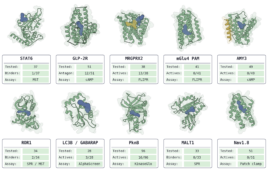
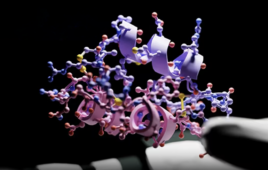
Lilly has begun pointing to concrete research it says the machine enables. Fuchs has described a foundation model the company built that helped co-design a promising small-molecule candidate, with the AI proposing a new chemical fragment that improved its properties. Lilly chemists are now reusing the motif on other targets. Where a productive wet-lab team might test on the order of 2,000 molecular ideas per target in a year, Lilly says LillyPod lets scientists evaluate billions of hypotheses in parallel in a “dry lab” before committing to bench experiments, with early workloads spanning genomics, peptide and molecule design, single-cell biology and imaging.
“Compute is a means to an end,” he said in a January interview. “We want to do better science. We want to come up with better medicines.”

Tell Us What You Think!
You must be logged in to post a comment.