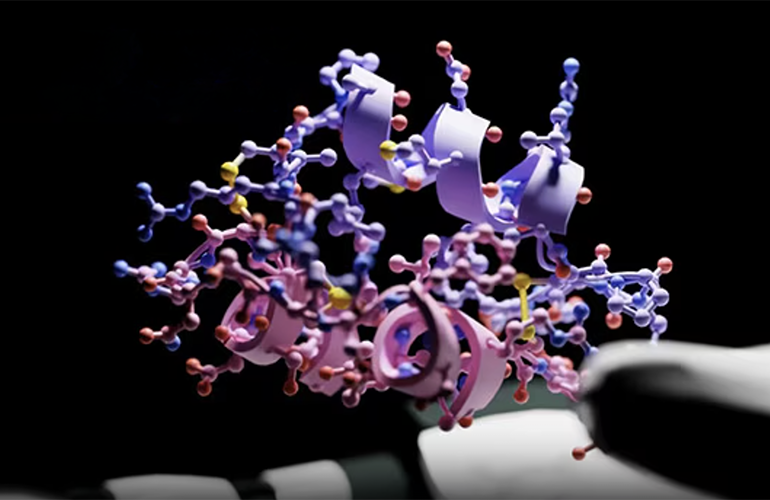
AIDDISON is MilliporeSigma’s AI-powered drug discovery software.
Over the past decade and a half, the Darmstadt-based Merck KGaA has assembled a supplier that touches nearly every bench in the lab. It bought Millipore in 2010, with the membrane filters and Milli-Q water systems that had been lab staples since the 1950s, and added Sigma-Aldrich and its ubiquitous reagents catalog in 2015 for about $17 billion. Now it is wiring that portfolio into an automated lab stack. In 2025 it shipped the Opentrons-powered AAW Automated Assay Workstation, a benchtop robot that runs routine assays with less manual handling. This year, the same logic reached the solvent shelf, with bio-based replacements for workhorse HPLC chemicals.
“A lot of the key products we provide to customers today are foundational,” says Karen Madden, CTO of MilliporeSigma. She points to filters that “were used to produce the very first biological molecules back in the 1980s” and to a catalog that has figured in Nobel-recognized research. She frames the green solvents, introduced in April, as the same habit applied to old chemistry. “Acetonitrile is a great example,” she said, calling the workhorse solvent decades old and not especially sustainable given it is traditionally fossil fuel derived. The company built a drop-in greener replacement. “So there you go: more innovation around something very old.”
A broad portfolio becomes a way to connect the AI lab

Karen Madden, Ph.D.
Merck KGaA differs from many rivals in terms of the number of sectors it serves and its product volume, though the company has sharpened its focus over the years. It sold Consumer Health to P&G in 2018 for approximately €3.4 billion and closed the divestment of Surface Solutions in 2025 for €665 million. The moves leave Healthcare, Life Science and Electronics. Inside Life Science, MilliporeSigma reaches across research chemicals, reagents, filtration, water systems, software, automation, bioprocessing and biomonitoring.
“One of our challenges is that the portfolio is so broad. When I came in as CTO, the real task was figuring out where to put our investments and how to innovate. Over the past few years we’ve put a pretty rigorous portfolio management process in place that lets us steer investments, based largely on how we view the markets, the opportunities, and the innovation potential in each area.” The breadth also has advantages. The current divisions happen to be the pieces autonomous-lab systems can connect across digital design, wet-lab execution, data capture and manufacturing scale-up.
Madden notes that MilliporeSigma has a framework around the key areas it believes will be important for its future. “These sit at the intersection of, first, our customers and what they need today and, more importantly, what they’ll need in the future; second, where technology is going,” Madden said. She pointed to the capability of some technologies to serve as “unlocking events” that open up the capacity to make practical things that were previously not. “AI and generative AI is a good example of that; CRISPR gene editing is another. And third, whether it’s an attractive market: Can we make a difference? Is it growing quickly? Do we have the capabilities and the “right to play”?”
Such criteria help define where MilliporeSigma focuses future innovation beyond its core. Focus areas include life science innovation staples automation and the lab and factories of the future; AI and digital and sustainability as well as integrated novel modalities. The latter extends “beyond antibody therapies into bispecifics, ADCs, mRNA therapies, cell and gene therapies, PROTAC therapies, and GLP-1s, which are all the rage now,” Madden said.
SYNTHIA and the route from molecule to bench
MilliporeSigma’s nearest-term AI runs in two linked products that hand off to each other. AIDDISON, the drug discovery platform the company launched in December 2023, works the design end: it pairs generative AI with machine learning and computer-aided drug design, draws on more than two decades of pharmaceutical R&D data, and screens upward of 60 billion compounds for drug-like properties such as solubility and stability. SYNTHIA, which grew out of the academic Chematica program first published in 2012, works the synthesis end, mapping retrosynthetic routes with expert-coded reaction rules against a catalog of roughly 12 million commercially available building blocks tied to the Sigma-Aldrich web shop and ranking them by cost, step count or how green they are. An API connects the two, so a molecule designed in AIDDISON arrives in SYNTHIA for a manufacturability check and a shopping list.
“We offer that linked back to our physical portfolio of chemistry and building blocks, so you can use AI-assisted design of the molecule, use SYNTHIA to figure out how to synthesize it according to whatever criteria you want, and then order the building blocks to do the physical synthesis and testing,” Madden said.
The lab in a loop, and the automation that feeds it
In its fullest form, an autonomous lab designs, runs and interprets its own experiments with little human input. Getting there is incremental: MilliporeSigma automates and connects its workflows one step at a time.
“That can be simpler automation, like automating a step out,” Madden said, pointing to the company’s partnership with Opentrons to automate some of its workflows and reagents. The payoff she emphasizes is data quality. “Automation isn’t just nice because your hand doesn’t get sore from pipetting,” she said. “It creates more reproducible, higher-quality data. And to use AI, you really need that data.”
The pull runs the other way, too. “So there’s a pull on the other end, AI asking for better data to feed it so it gets smarter and helps you design better experiments,” Madden said. “It goes together: automation for convenience, but also automation as a ‘data factory’ that feeds innovation.”
Put the two together and you get what Madden calls a lab in a loop: AI and in silico modeling design the experiment, the physical lab generates positive and negative data, and the next experiment gets better informed. MilliporeSigma has built it around small molecule discovery, with possible extensions from drug discovery to new materials for the electronics business.
That same loop is also the logic behind MilliporeSigma’s tie-up with Siemens. In April 2025 Siemens agreed to buy Dotmatics, a Boston-based life-science R&D software maker, for $5.1 billion, closing the deal that July. In September, MilliporeSigma’s parent, Merck KGaA, signed a memorandum of understanding with Siemens to connect digital experiment design to physical lab work across discovery, development and manufacturing, the first collaboration to draw on the newly acquired Dotmatics technology. The early pilots center on Dotmatics’ Luma platform, putting MilliporeSigma’s AI tools and reagent ordering in the same environment researchers use to plan and document experiments, then returning the resulting data to inform the next run.
A data-quality focus is pushing the company deeper into biology. Its €104 million ($120 million) purchase of HUB Organoids last year, paired with an October assay partnership with Promega, aims at human-derived organoid models that read out more predictively than 2D cell culture, the kind of data the loop runs on.
Toward the lights-out lab and programmable biology
Each loop is a small, bounded gain. Run enough of them and you arrive at the larger vision the industry keeps invoking. “People have a big vision around this ‘lights-out’ lab of the future, you set it up, walk away, and come back in a week and everything’s done,” Madden said. “The question is how you get there.”
Some of what MilliporeSigma wants from AI is still being built. Bioreactors are the case Madden points to, where the tools to model a run well do not yet exist. “Ideally you’d create a digital twin of some of these processes, including bioreactors, so you can model more accurately what will happen with a particular cell line, particular feeds, a given incubation time,” Madden said, so a run can be optimized before it ever reaches the bench.
Past the automation and the partnerships sits a more fundamental goal, one Madden states with its limit attached. “I really think the holy grail is to understand biology at a digital level so that one day we can actually start to program it the way you would a computer,” she said. “I think we thought that might be possible after the sequencing of the human genome, but it turned out to be a lot more complicated.”