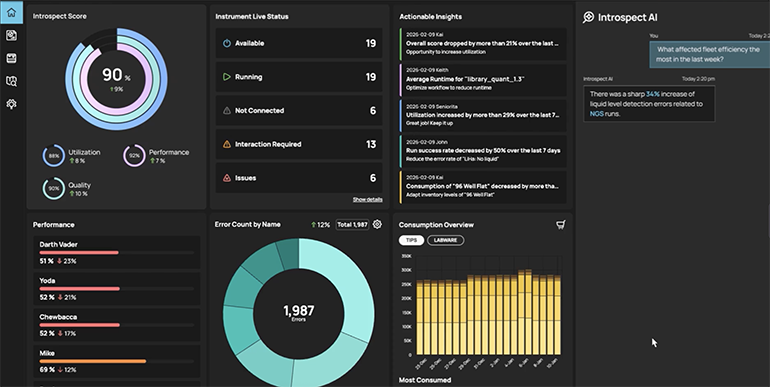
Tecan’s latest bet is on agents. The Swiss lab automation company has built agentic AI into Introspect, its cloud analytics platform, using NVIDIA’s BioNeMo Agent Toolkit, in an announcement on June 24 that opened early access to pharmaceutical, biotech and clinical labs. The agents watch instrument telemetry and environmental data, hunt for the patterns that quietly throttle throughput, and flag them before a run fails. “You can think of it as the fitness tracker of the lab,” Marco Ravot-Licheri, head of digital for Tecan’s Life Sciences business, said in an interview.
The agentic focus follows a roughly four decade focus on automation. Tecan was among the early commercial pioneers of automated liquid handling, and says its 1985 Sampler 500 series was the first process-controlled, fully automated pipetting workstation, which took the pipette out of the scientist’s hand. The Genesis, Freedom EVO and Fluent platforms that followed from 1995 to 2015 took the workflow, leaving the scientist to write, validate and troubleshoot the method. The cloud-based laboratory analytics platform Introspect arrived by the late 2010s. Introspect took the operational memory, pulling instrument uptime, consumables usage and error handling into a cloud dashboard, and a Next-Gen version followed in 2024.
Laying the foundation for agents

Marco Ravot-Licheri
The goal of making Introspect agent native required more work. Tecan rebuilt Introspect’s backend last year, Ravot-Licheri said. “We realized that if we really want to stay relevant in the age of AI, we had to make it an AI-native platform.” That rebuild is why the company could move fast when it met NVIDIA at SLAS, the lab automation and screening conference, in Boston in February.
In March, Tecan announced a new initiative to enable data-driven labs with NVIDIA. The centerpiece of the collaboration involved plugging NVIDIA’s AI tools into Tecan’s existing analytics platform and instruments so labs can get more useful insights and automation out of the data they already generate.
After meeting at SLAS, the Tecan and NVIDIA teams quickly got to work. “We had a follow-on meeting the next week, where they were like, we’ve already picked up some of your tools and are integrating them,” said Stacie Calad-Thomson, global business development lead for pharma labs and manufacturing at NVIDIA. “So from initial trial to announced partnership was very rapid.”
What Tecan uses from BioNeMo
In late June, NVIDIA released the BioNeMo Agent Toolkit, which packages the company’s life-science models and libraries as tools an AI agent can call. NVIDIA has promoted it largely for scientific work such as protein structure prediction, molecular docking, generative chemistry and genomic analysis. Tecan integrated the toolkit into Introspect the following day.

Stacie Calad-Thomson, PhD
“We’ve evolved BioNeMo, and now come out with BioNeMo Agent Toolkit, by packaging up some of our tools and capabilities. That’s what enabled Tecan to get started so quickly, building on our stack,” Calad-Thomson said.
When asked how Introspect calls the BioNeMo Agent Toolkit, Ravot-Licheri said that Tecan uses the agentic framework “all the way from the definition of the guardrails.” That includes the setup of agents and then the use of the Nemotron large language model.
Ravot-Licheri singled out the guardrails. “Working in the lab space, the topic also of AI hallucinations becomes very important,” he said.
NVIDIA offers NeMo Guardrails, an open-source Python library that sits between application code and the model. Users define rails in YAML and Colang, a Python-like DSL, and they run at five stages of an agent’s loop, spanning input, retrieval, dialog, execution and output.
Ravot-Licheri said he is a proponent of a human-centric, AI-empowered lab. “If you think about the lab, it’s a place where highly skilled people do a lot of repetitive and tedious tasks, and that’s what we are focusing on at the moment, and that’s what Introspect addresses,” he said.
In practice, Introspect still functions as a one-way pipe. “We’re not yet controlling the instrument, so there’s a unidirectional flow of data from the instrument to the cloud,” Ravot-Licheri said. Telemetry such as move counters and error counts travels up, along with environmental readings: temperature, humidity, pressure, time of day.
Closing the loop with physical AI
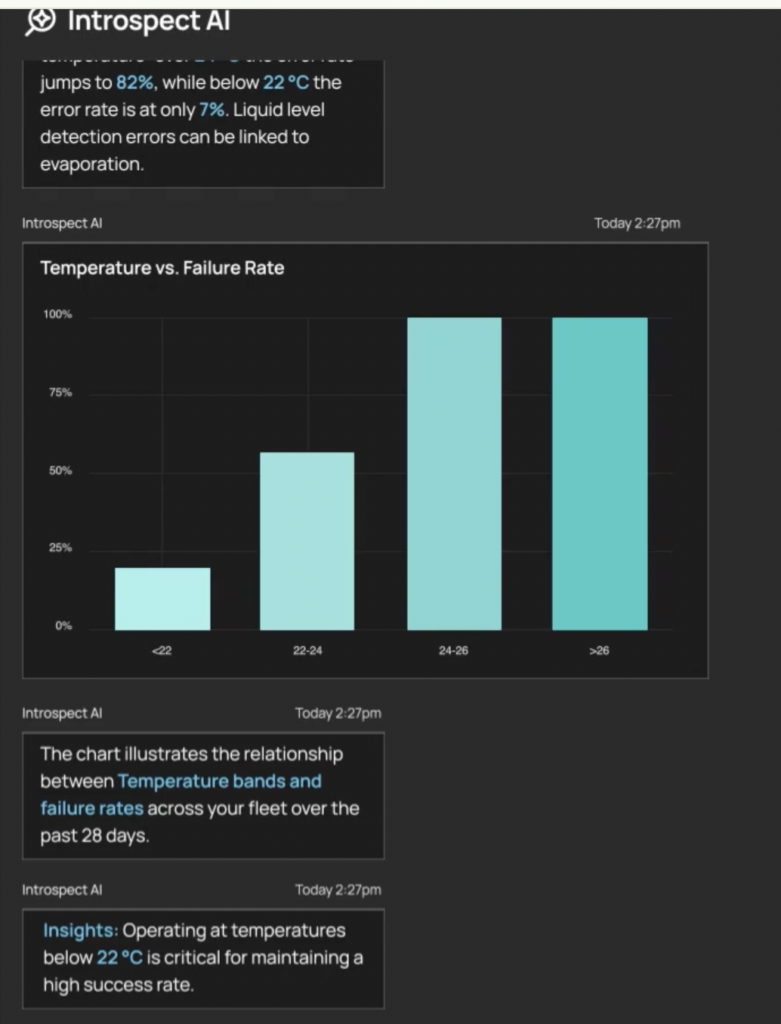
In a Tecan demonstration, Introspect AI analyzes 28 days of fleet data and links higher operating temperatures with rising liquid-level detection failure rates. Image courtesy of Tecan.
The agentic layer is what lets a scientist interrogate that history. Before starting a run, a user can put a question to Introspect in plain language. “I’m about to start an NGS run on this specific instrument. Was there anything that consistently caused errors in the past?” Ravot-Licheri offered as an example. The system then scans correlations across the stored parameters. In one case it flagged humidity spikes that had previously driven exponential error increases, something Ravot-Licheri recalled from his own lab experience in London. Once a pattern is identified, the same agent can be set to watch the variable and alert when conditions enter a danger zone, before the error occurs rather than after.
Calad-Thomson pointed to a Tecan demonstration showing Introspect investigate a 34% increase in liquid-level detection errors associated with NGS runs. The system filters the affected instruments and identifies a correlation with temperature, reporting an 82% error rate above 24 °C compared with 7% below 22 °C. She described the scenario as a scientist stepping away for coffee and receiving an alert before the run failed.
The next iteration would keep him at his coffee. Cameras already sit on Tecan instrument decks, and an agent that can read them gains a second sense to reason with. “The agent could have told him, ‘Yes, there’s a temperature change. I’ve also detected a lighting change. I suspect that, given the time of day, the afternoon sunlight is coming in,'” Calad-Thomson said. The agent is still only reading. It has gone from one sensor stream to three, and the scientist still decides what to do about it.
The version where the agent acts is further out, and Calad-Thomson framed it that way. “Maybe if you’ve got blinds in your lab that are Bluetooth connected, there’s not a reason why the agent wouldn’t be able to then one day talk to that and put down the blinds,” she said.