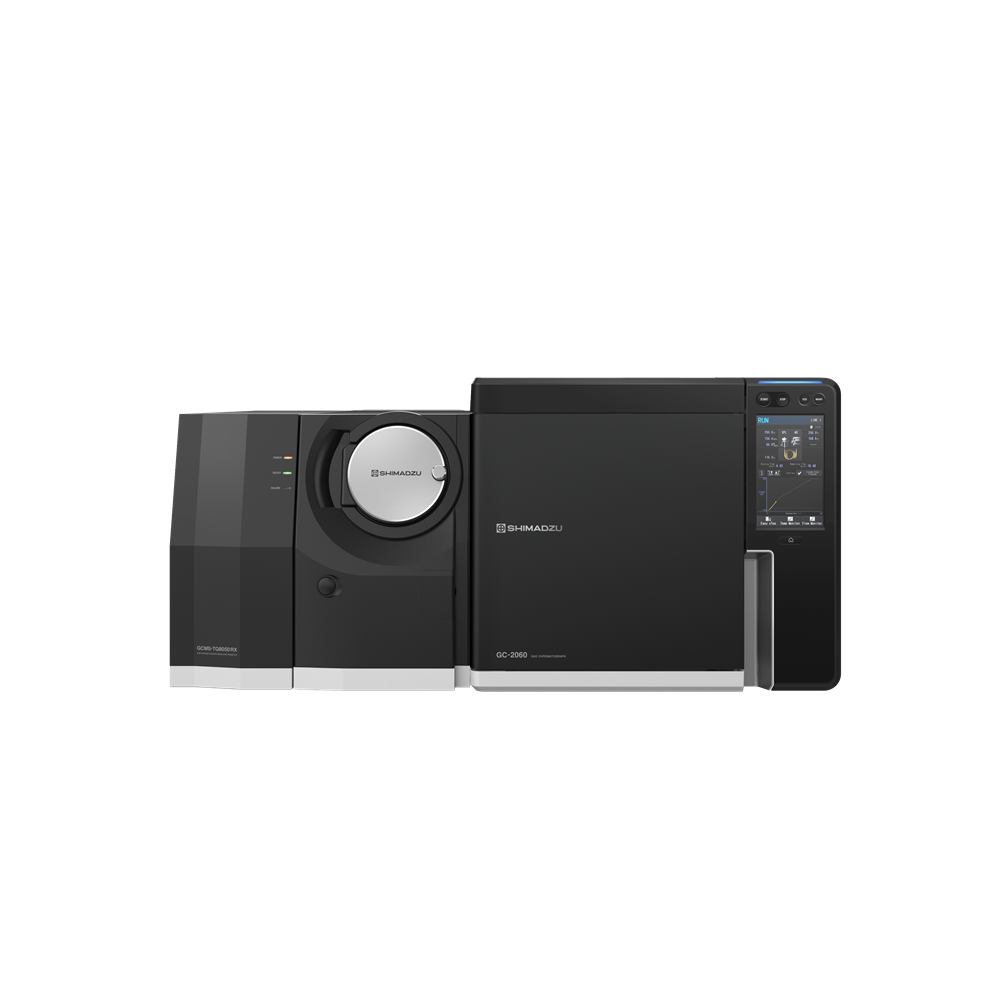
Shimadzu Scientific Instruments’ GCMS-TQ8050 RX triple quadrupole GC-MS/MS system is designed for analysis workflows across food safety, environmental, pharmaceutical and forensic applications.
Shimadzu has introduced the new triple-quadrupole GC-MS platform offers an optional multimode inlet and, on the higher-end GCMS-TQ8050 RX, a newly developed detector designed to reduce noise in trace analysis. Shimadzu says the new series delivers up to 25% higher sensitivity than previous models, while faster inlet cooling cuts maintenance waiting time from 40 minutes to five.
The systems succeed the GCMS-TQ8050 NX, part of the NX series Shimadzu launched in 2018, as the firm notes in an announcement. The RX generation pairs the redesigned detector with Shimadzu’s newer Nexis GC-2060 gas chromatograph and an optional Multi-Mode Injection Unit.
New features include the patented low-noise detector on the 8050 RX, which the company pairs with its existing Off-Axis ion optics in what it calls a dual off-axis configuration. Also new are a Smart MRM+ increment and the multimode injection unit, which arrives by way of the Nexis GC-2060 gas chromatograph Shimadzu introduced earlier this year.
Some of the features in the GC-MS platform and GCMS-TQ8050 RX were also present in older units. The earlier 8050 NX already supported femtogram-level detection using Off-Axis ion optics and noise-reduction technologies, and Shimadzu demonstrated a 0.14 fg instrument detection limit with its optional Boosted Efficiency Ion Source, against a published specification of 0.3 fg or better.
Much of the rest of the RX feature list was already available during the NX generation. Smart MRM method creation, the Peakintelligence machine-learning peak-processing algorithm, the Easy sTop function for servicing the injection port without breaking vacuum, ClickTek connections and the carrier-gas saver all predate this launch. A long-life filament does as well: Shimadzu documented one in use with BEIS on the 8050 NX in 2025.
Shimadzu’s announcement describes the series as delivering industry-leading detection performance. In terms of the competitive landscape, Agilent’s 7010D brochure claims attogram-level sensitivity and also “industry-leading limits of detection.” Thermo Fisher Scientific markets the TSQ 9610 as attogram-level on the same terms. Agilent’s 7010B data sheet specifies a 0.5 fg octafluoronaphthalene IDL at 99% confidence, demonstrated at installation. Shimadzu’s own TQ8050 NX brochure goes as far as “sub-femtogram.”