![Twist's silicon-based DNA synthesis feeds three product lines, spanning NGS tools for reading, synthetic biology for writing and biologics for antibody discovery. [Image courtesy Twist Bioscience]](https://www.rdworldonline.com/wp-content/uploads/2026/07/twist-slide.png)
Twist’s silicon-based DNA synthesis feeds three product lines, spanning NGS tools for reading, synthetic biology for writing and biologics for antibody discovery. [Image courtesy Twist Bioscience]
Frontier AI labs are now pushing for the same transformation in other knowledge work. Pharma is a notable example. At least four drug companies now have supercomputers (Lilly, Roche, BMS, Recursion), and AI has become a near-universal priority at Big Pharma firms in the West as well as in Asia. “In general, AI has been amazing for us,” said Emily Leproust, CEO of Twist Bioscience, during a recent tour of the company’s South San Francisco headquarters. “In the past, scientists would ask, ‘Can you make this cool drug?’ And in general, they would try 100 antibodies.”
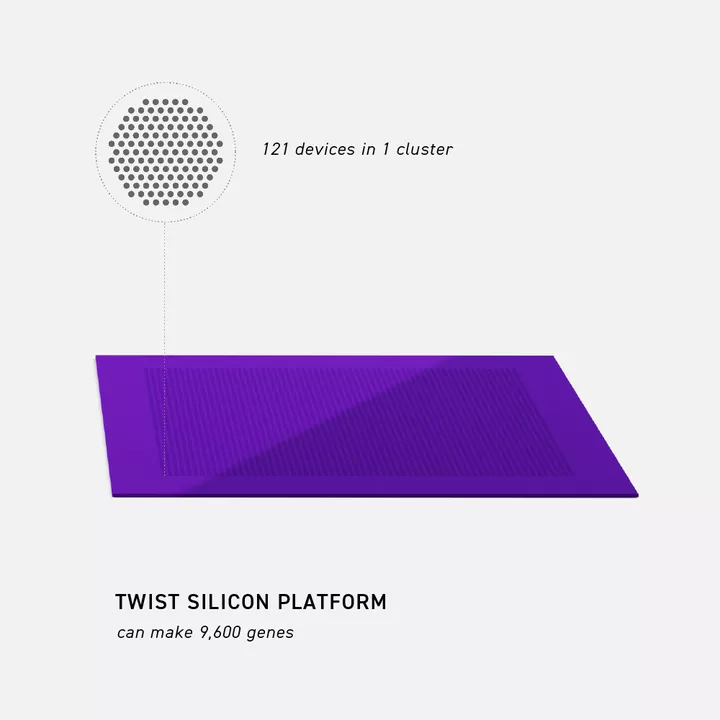
Overview of Twist Bioscience’s semiconductor-based silicon platform for high-throughput synthetic DNA manufacturing. [Image courtesy Twist Bioscience]
Leproust sees such scale as a differentiator. For an order of roughly 100 antibodies, customers can choose among several gene-to-antibody service providers. At 1,000 or 10,000 candidates, she argues that Twist’s integrated workflow, spanning silicon-based DNA synthesis, antibody expression, purification and characterization, narrows the field of providers capable of operating at that scale. Therapeutics revenue rose 49% year over year in the quarter ended June 30, from $27.0 million to $40.4 million, growth Leproust attributed in large part to AI. Therapeutics revenue was $40.8 million in the March quarter, leaving the segment roughly flat sequentially. Twist does not break out AI-enabled discovery revenue on its own, but on the August 3 earnings call, asked by Guggenheim analyst Subhalaxmi Nambi whether roughly $25 million of AI-related orders in fiscal 2025 implied about $50 million in fiscal 2026 and about $100 million in fiscal 2027, chief financial officer Adam Laponis said: “Yes, you got that right.”
Whatever the scale of AI’s disruption in biotech, the pace of change, in many ways, is even more rapid in software development. Anthropic says Claude writes more than 80% of the code merged into its own codebase, and that a typical engineer merges eight times as many lines of code per day as in 2024. Other tech firms have made directionally similar claims.
Conversely, drug development is a more conservative, complex and heavily regulated sector. Bringing a drug from discovery to approval can take a decade or more, while drug development costs routinely surpass $2 billion.
One side effect of the sustained interest in artificial intelligence is the insistence that science can, in some sense, be partly automated in a manner similar to how facets of coding have been. In May, Google DeepMind published Co-Scientist in Nature, a Gemini-based multi-agent system that it claims can accelerate scientific discovery. Co-Scientist generates, ranks and refines scientific hypotheses. Six weeks later, Anthropic launched Claude Science at an event in San Francisco. A range of other companies, including OpenAI and AWS, have similar messaging.
Despite the considerable influence of AI in biotech, to state the obvious, biology is not software development.
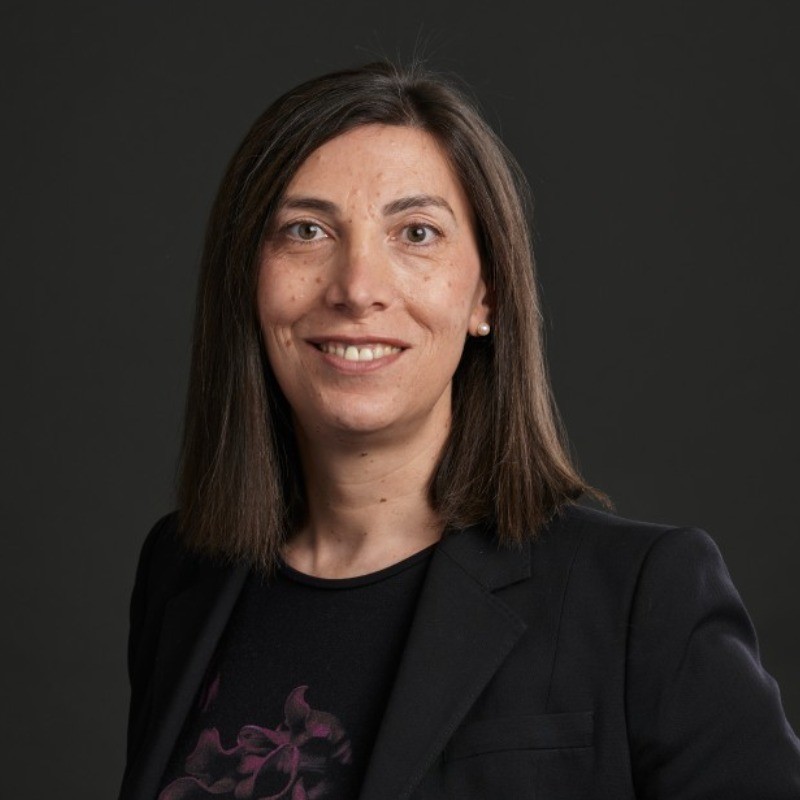
Emily Leproust, Ph.D.
“For coding, it’s simply a dry lab, right?” Leproust said. “Does it compile, yes or no?” she asked. “In biology, you can imagine that the hard part now is not the dry-lab part, designing sequences. Now the hard part is the compilation,” she said. “It’s the wet lab.”
As an example of how the firm says it is making the hard part easier, Leproust pointed to the company’s work with AWS, which launched Amazon Bio Discovery in April. Amazon Bio Discovery combines biological foundation models, an AI agent and integrated lab partners to design antibody candidates, send the most promising molecules for synthesis and testing, and feed the results into the next design cycle. “You go on AWS, you send your target, you pay some tokens, and the AI is going to give you a list of sequences that could be your drug.”
That list of sequences still has to become physical material. “You need a wet lab to build it and test it,” Leproust said. Amazon Bio Discovery connects the computational work on AWS with laboratory partners that can synthesize and test the candidates. Twist Bioscience, Ginkgo Bioworks and A-Alpha Bio currently provide those services. “You can do design and learn on AWS, and you can do the building and testing with Twist,” she said.
Twist says profitable growth is nearing
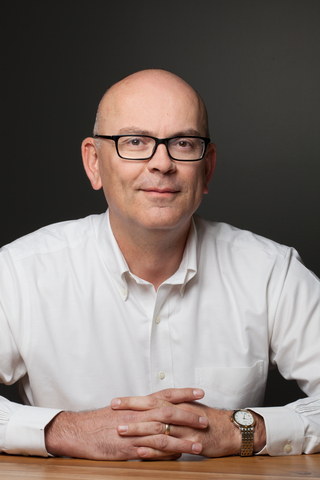
Patrick Finn, Ph.D.
The same platform that converts AI designs into physical molecules also carries Twist’s financial wager. As customers place larger orders, the company expects higher chip use and greater operating leverage from a manufacturing base whose core costs are already in place.
Leproust now says that Twist is within striking distance of turning a profit. “Two years ago, we told people that we’ll be profitable in September 2026, and so here we are,” she said. “As a team, when we say we’re gonna do something, there is some violence in execution and discipline.” She continued: “You tell people that’s your deadline, the minds align, and it happens.”
Patrick Finn, Twist’s president and chief operating officer, connected the profitability target to the company’s growing role in the drug-discovery and diagnostics supply chain. “We are a team that is not in the business of missing numbers,” he said. “On the profitability comment, we have become an integral part of the supply chain,” Finn said.
Speaking of both discovery and diagnostics, Finn noted, “the technology is working beautifully.” The path toward profitability is “a responsibility beyond just a P&L,” Finn added. “If you have a cancer diagnostic that’s going to impact patients’ lives, the most important thing we can do as a supply chain partner is, one, be really good at making a very, very good molecule, and secondly, be here.” He described profitability as “the start line,” giving Twist the capacity to reinvest in additional opportunities.
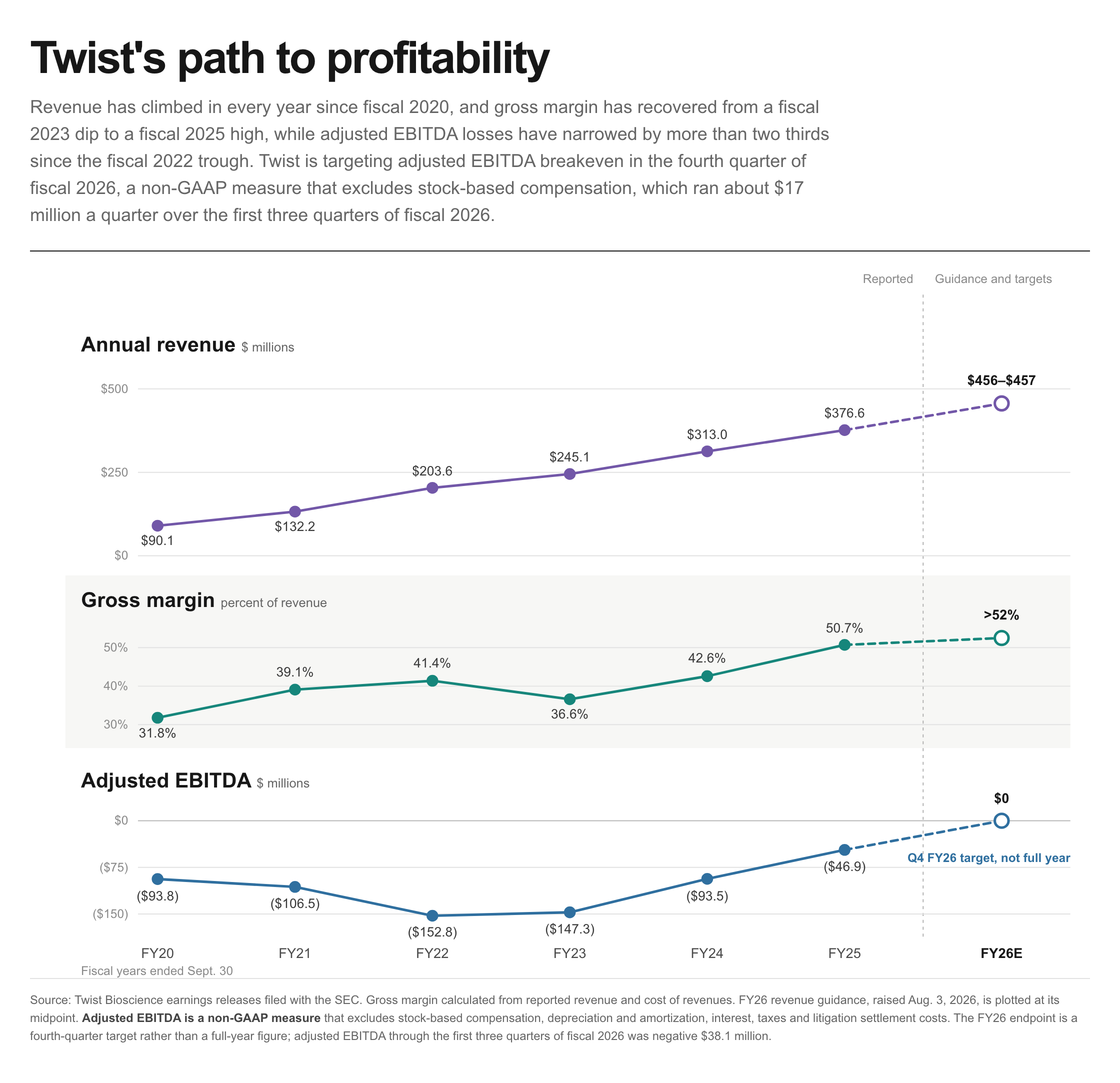
Twist’s third-quarter results, reported August 3, show what has to happen in a single quarter to get there. Adjusted EBITDA was a loss of $11.3 million, wider than the $8.0 million loss a year earlier despite $22 million more revenue. Operating expenses excluding cost of revenues were $98.7 million against $81.4 million a year earlier, a figure that included roughly $2 million in employee transition costs and other one-time items that Laponis said would produce “more than $5 million reduction in OpEx in the fourth quarter.” Against fourth-quarter revenue guidance of $123 million to $124 million, that closes most of the $11.3 million gap and leaves the rest to further cost discipline or to the top of the revenue range.
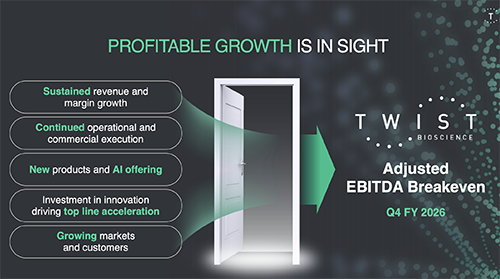
A slide from the June William Blair 46th Annual Growth Stock Conference investor presentation lays out management’s case for reaching breakeven by late fiscal 2026. [Image courtesy Twist Bioscience]
Twist was founded in 2013 and has been public since October 2018. Its annual report in 2023 noted that the company had received an aggregate of $1,333.7 million, including VC and public funding, while the quarterly earnings document for the quarter ended March 31, 2026 noted a $1.3941 billion accumulated deficit.
The machine and the seats
AI designs become physical material inside a set of custom DNA writers, including four at Twist’s South San Francisco headquarters. Gesturing toward one of them, Leproust gave her answer to what separates Twist from the many companies that can synthesize DNA, including numerous DNA synthesis providers across Asia. The underlying chemistry is essentially the same, she acknowledged, and has been known since the 1990s. Twist’s claim to differentiation rests on shrinking that chemistry onto silicon and building the machinery and production processes around it.
“It’s this machine. This is the moat. It’s entirely different … because we miniaturize the chemistry,” she said. “We raised a billion dollars to do it. So we have the patents, we have the capital moat.” Recreating it today would require financing that she doubts the current market would provide.
She brought up the standard 96-well plate to make the point. Roughly the size of an index card, the plate measures about five inches by three and a half and contains 96 wells arranged in a grid. “And what we have is a silicon chip, which is the same size,” Leproust said. Within roughly the same footprint, Twist’s chip provides about 1 million separate sites for synthesizing DNA.
Twist’s Wilsonville, Oregon, facility uses essentially the same automated writer technology. The difference lies in the production line built around it. South San Francisco combines the writers with chip fabrication, platform development and much of the company’s next-generation sequencing manufacturing. Wilsonville automates more of the downstream synthetic-biology workflow used to produce genes and other materials for therapeutics and drug discovery at scale.
“We have two main business lines,” Leproust said. “One is NGS, our diagnostic line. That’s mostly what’s happening here, cancer diagnosis, and then in Oregon is more the therapeutics drug-discovery line. And so for that, we are automating the manufacturing.”
The writer room in South San Francisco sits behind the windows of a Class 10,000 clean room. “This is to protect the DNA,” Leproust said. The features patterned onto the silicon are about 50 microns across, approximately the width of a human hair.
Twist has iterated over time. “Now it’s seven hours to print 100 layers, and just three years ago, it was 24,” Leproust said. “Same machine, but we were able to extract more out of it.”
Where is everybody?
The machines can run for long stretches of time without human intervention. “One of the themes that you should get in the visit is, where is everybody?” Leproust said. The silicon operation runs in batches, and during an active run the room may require only a couple of people.
Miniaturization gives each writer significant capacity. Twist’s economics depend on how much of that capacity it can sell. A chip passes through the same sequence of chemical cycles whether customer orders occupy all of its synthesis sites or only a fraction of them.
Leproust compared the writer to air travel. “The way to think about this: this is the plane, and each of those are seats,” she said. “If we can sell those seats, the cost is the same. We’re already spending money on the plane. It could be 100% marginal profit. And so it’s all about utilization.”
Twist is working both sides of that equation. “We want all the seats used,” Leproust said, “and then we want to fly more planes more often.” The company plans to add two writers in South San Francisco and two in Wilsonville, taking the total from eight to 12.
The latest financials show Twist gaining scale and improving its production economics. Gene shipments rose 56% year over year to approximately 369,000 in the quarter ended June 30, from about 237,000, while gross margin reached 52.8%. Twist shipped to approximately 2,650 customers in the quarter, against about 2,480 a year earlier. Revenue did not keep pace with volume. DSPS revenue grew 39% while gene shipments grew 56%, so revenue across the segment per gene shipped fell about 11%, a rough ratio given that DSPS also covers oligo pools, proteins and antibody services. Leproust told analysts the growth is coming primarily from antibody-type sequences, which are shorter than the genes ordered for many other applications.
Asked on the August 3 call why revenue lagged volume, Leproust said the trade suits Twist. “AI is doing exactly what we thought it would do,” she said. “It just creates more sequences.” Volume is the variable the seat math runs on.
Dealing with increasing complexity
For years, Twist’s NGS business, particularly its exposure to liquid biopsy and other cancer diagnostics, carried much of the investor story. In fiscal 2025, NGS brought in $208.1 million, representing 55% of Twist’s revenue, and grew 23%. The synthetic biology and biopharma businesses that Twist now reports as DNA Synthesis and Protein Solutions generated a combined $168.5 million and grew 17%.
The growth rates have inverted. In the quarter ended June 30, DNA Synthesis and Protein Solutions (DSPS) revenue rose 39%, to $56.6 million. NGS grew 12%, to $61.8 million. Laponis told analysts he expects NGS to return to growth above 20% year over year in the fourth quarter.
In May, the company launched Complex Genes in early access, expanding its clonal-gene offering to sequences up to 7,000 base pairs and designs complicated by repeats, extreme GC content and other structural features. Twist opened the offering to the broader market in late July. During the early-access period, which ran from April 15 to July 21, customers ordered more than 1,800 complex genes across more than 100 orders, and Finn said the company completed the overwhelming majority within a 12-day window.
Three years ago, Twist accepted about 96% of clonal genes, leaving roughly 4% outside its manufacturing range. Complex Genes changes the dynamic. Leproust walked through what a customer did with a rejection historically: drop the gene and lose the experiment, or spend a day or more on codon optimization and resubmit, sometimes repeatedly. Twist says the expanded offering could raise acceptance to approximately 99.5% of clonal-gene orders and 99.9% across all DNA products. On the May earnings call, Finn gave recent rates: Twist accepts about 97% of clonal-gene orders and manufactures about 98.5% of the orders it accepts, while acceptance across the full DNA portfolio stands at roughly 99%.
“If a customer can design it, we are increasingly able to make it,” Finn said on the Q2 earnings call.
The challenge of unlocking synthetic biology’s potential
The idea that biology could become an engineering problem has history as well. The French scientist Stéphane Leduc in 1912 used the term la biologie synthétique. The Polish scientist Wacław Szybalski used “synthetic biology” in the 1970s to describe the potential of making DNA in a lab and “building new genomes.” By the early 2000s, an ecosystem of organizations cropped up focusing on building biological parts like machines.
The tools emerged in fits and spurts. In 1973, Stanford geneticist Stanley Cohen and University of California, San Francisco biochemist Herbert Boyer developed a method for splicing DNA from different organisms. In 1976, Boyer and venture capitalist Robert Swanson launched Genentech to commercialize recombinant DNA technology in South San Francisco.
The overarching quest to industrialize biology has already transformed the pharma industry. Genentech was instrumental in turning recombinant DNA technology into actual medicines in the 1980s. That early work helped establish biologics as a core commercial category. As of 2025, biologics accounted for just under half of the sales of the world’s top 50 drugs (roughly $173 billion of the $355 billion total).
Batman and Robin
When asked what differentiates Twist, Leproust said, “Our strategy is also to meet customers where they are.” She continued: “We’re not trying to tell people, ‘Oh, you should do this or that.’ We have it all in discovery.” The company doesn’t have its own pipeline of drugs, for instance. It supplies the DNA, proteins and discovery tools while leaving target selection and drug strategy to its customers.
“We don’t take biology risk,” Leproust said. “We don’t advise on the target. We don’t advise customers on what to do and which protein, which DNA, which RNA, and we make it for them.”
In other words, the company sells tools for whichever discovery approach a customer has already committed to, and Leproust framed that as a positioning choice. “You, the customer, you’re Batman. You’re the hero. We’re only Robin. We’re your sidekick to make it happen.”
Finn picked up the analogy: “I think the [approach is to] sort of stay in your lane.”
That approach has given Twist a more durable investment story than many companies that tried to build their own drug pipelines or remake biology from end to end. Still, Twist has encountered significant headwinds tied to the technology and manufacturing platform at the center of its pitch.
Agilent Technologies, Leproust’s former employer, sued Twist in 2016, alleging that she had taken technology and trade secrets with her when she founded the company. Twist paid $22.5 million and obtained a license under a 2020 settlement that included no admission of wrongdoing.
In December 2022, investors sued the company, Leproust and then-chief financial officer James Thorburn in the Northern District of California, after the short seller Scorpion Capital published a report alleging that Twist’s platform was less automated than the company represented and that its margins were overstated. Twist called the report “highly misleading, with many distortions and inaccuracies.” The stock fell about 20% the day it appeared, from $38 to $30.43. On the earnings call shortly after, the company told analysts the auditors had proposed no material adjustments; the annual report Twist filed later that month affirmed GAAP conformity notwithstanding a material weakness in IT general controls. Twist’s stock was trading around $96 in the mid-afternoon of August 3, the day the company reported third-quarter results, against a previous close of $91.55. Shares opened at $81.60 and traded as high as $101.91, within a 52-week range of $23.30 to $105.47.
In September 2025, a federal judge dismissed the fraud claim while allowing claims involving automation and product quality to proceed. The parties reached a settlement in principle of approximately $17.1 million in March 2026, and the court granted preliminary approval in July. The settlement includes no admission of liability. Twist recorded $7.2 million in litigation settlement costs, net of recoveries, in its results for the nine months ended June 30.
The broader synthetic bio scoreboard
Leproust’s Batman and Robin framing puts Twist in the sidekick seat, supplying equipment while the customer takes the risk on which molecule matters. Skeptics have looked at the broader synthetic biology market and seen Gotham.
In terms of the broader sector, some of that skepticism earned its keep. Several heavily financed companies struggled to turn ambitious biological platforms into repeatable revenue. Amyris, which engineered yeast to produce squalane and other ingredients for cosmetics and specialty markets, filed for Chapter 11 in August 2023. Zymergen, which combined machine learning, lab automation and engineered microbes to develop advanced materials, raised roughly $530 million at a valuation above $3 billion in its 2021 IPO and about $1.5 billion from investors in total. Ginkgo acquired the company in an all-stock deal valued near $300 million announced in July 2022. Zymergen filed for Chapter 11 in October 2023 as a Ginkgo unit, liquidating its remaining assets in February 2024.
“There has been a reckoning,” Jay Keasling, a synthetic biologist at Lawrence Berkeley National Laboratory and a co-founder of Amyris, told Science in August 2024. Keasling blamed mountains of investor cash that produced an overabundance of ideas and a lack of focus. Amyris alone had built a pipeline of nearly a dozen products, none of which generated enough revenue to carry its personnel and its sprawling fermentation infrastructure. “Early on it is good for companies to be starved of money,” he said. “It forces you to choose what not to do.”
For some players, the reckoning continues. Ginkgo, which appears alongside Twist on Amazon’s partner list, reported first-quarter 2026 revenue of $19 million, down 49% from a year earlier, or 37% excluding a one-time non-cash item in the prior period. Its market capitalization is about $510 million, against the $15 billion pre-money valuation it carried when it went public through a SPAC in 2021.
Several companies that took the biology risk have also run into problems. Exscientia, which had promised AI-designed drug candidates, was absorbed into Recursion in an all-stock deal valued at $688 million. BenevolentAI’s lead compound cleared its Phase 2a safety endpoint but failed on efficacy in atopic dermatitis in April 2023. The company cut about 180 jobs and dropped the program weeks later, refocused on its platform and cut staff again in December 2024, and delisted from Euronext Amsterdam in March 2025 to become private.
The pandemic fueled a biotech funding boom in 2020 and 2021, when cheap capital and surging investor interest allowed companies across the sector to hire rapidly, pursue broad pipelines and reach the public markets early. Then it reversed. The XBI biotech index fell 63.5% from its February 2021 high to its October 2023 trough. U.S. biopharma IPOs went from 103 in 2021 to 15 in 2025. EY counted 977 publicly traded U.S. and EU biotechs in 2021 and 758 in 2025, with 39% of the survivors entering 2025 holding less than a year of cash. By April 2025, about a quarter of biotech stocks traded below the cash on their balance sheets.
Given the cyclical nature of the biotech industry, there is a need to become self-sufficient. “At some point, you have to stop being investor-supported, and you have to become customer-supported,” Leproust said.
Leproust frames Twist’s long path toward profitability as a deliberate investment in scale. She cited a 2017 Harvard Business Review article, which recommends that companies with increasing returns should defer profit-harvesting while there is still customer stickiness to build. The article points to AWS, Facebook and Google as core examples of firms that successfully followed this strategy.
The pattern has a track record in consumer tech. Amazon went public in 1997 and did not post a full year of net income until 2003. Uber, founded in 2009, ran more than $30 billion in cumulative losses before reporting its first full year of operating profit in 2023. In both cases, investors accepted years of losses on the premise that spending ahead of demand would secure a stronger market position.
As mentioned earlier, Twist was founded in 2013 and expects adjusted EBITDA breakeven in fiscal Q4 2026, 13 years in. “Capital is speed, right? Capital is fuel,” she said. “We could have been profitable five years ago, but we would have been a fraction of the size of the business because we would have been capital-limited.”
Twist raised that capital while keeping its product portfolio relatively focused. In May 2025, it spun out its DNA data storage division as Atlas Data Storage, retaining 24% equity, which removed roughly $5 million a quarter in operating costs. It has also recently grown faster than a sluggish life-science tools market. Revenue rose 23% year over year in the quarter ended June 30, while 10x Genomics is guiding to 0% to 4% growth for 2026, PacBio’s first-quarter revenue was flat and Illumina grew 4.8%.
Of synthetic biology, chess and more shots on goal
![[Image courtesy of Adobe Stock]](https://www.rdworldonline.com/wp-content/uploads/2026/07/AdobeStock_322782977-1024x540.jpeg)
[Image courtesy of Adobe Stock]
The medicinal chemist Derek Lowe balked at that assessment in a November 2007 post titled “Andy Grove: Rich, Famous, Smart and Wrong.” “Medical research is different than semiconductor research. It’s harder,” Lowe wrote. He allowed that a blown-up diagram of a chip’s architecture is awe-inspiring, then set it against a cell: “it’s nothing, it’s the instructions on the back of a shampoo bottle compared to the complexity of a living system.” Chips are legible because engineers built them, he argued, while living systems were “glued together by relentless random tinkering.” His summary: “Mr. Grove, you can print out the technical specs for your chips. We don’t have them for cells.” What the industry suffered from was not a shortage of deadlines but “working on some of the hardest scientific problems in the history of the species.”
Lowe has not moved much on the hard part. Speaking in April 2025, he described himself as “a short-term pessimist and a long-term optimist” on AI in drug discovery, and said the problems the industry most wants solved “are almost inversely proportional to the ability of AI to solve them.” The difficult work, he said, is “picking targets and anticipating human tox.” AI has produced real results in protein structure prediction and antibody design, he argued, because those fields sit on well-structured data.
Presented with an analogy, in which drug companies are playing an immensely complicated game of chess and Twist sees itself supplying the board while customers choose the moves, Leproust accepted it and extended it. “We’re giving them more pieces,” she said. In practical terms, Twist’s synthesis and testing platform lets researchers screen large pools of AI-designed antibodies against the biological systems that ultimately determine whether they work. That enables “more shots on goal,” Leproust said.
Beyond the Memorial Sloan Kettering example, in which nearly 300,000 candidates were designed and the top 100,000 sent to Twist for synthesis and testing, Nobel laureate David Baker’s team provides another example. The team used Twist-synthesized DNA to test roughly 36,000 RFdiffusion-designed VHHs across four targets, including 9,000 against the SARS-CoV-2 receptor-binding domain.
Twist has outperformed many other synthetic biology companies while following a semiconductor playbook in biotech. Think photolithography behind yellow-filtered windows, chemical vapor deposition, metrology stations that photograph and QC each chip before use, per-layer imaging that flags bad droplets in red during a run and capacity utilization as the number that decides whether the quarter works.
“Three years ago, some investors were skeptical of whether we could grow as a company because what we said is, we are a fab,” Leproust said. “Now we can grow our revenue without adding people.”